Compostable Kitchen Sponges: Materials, Care and Disposal
Compare cellulose sponges and sponge cloths, understand composting claims, and choose a kitchen cleaning tool you can care for properly.
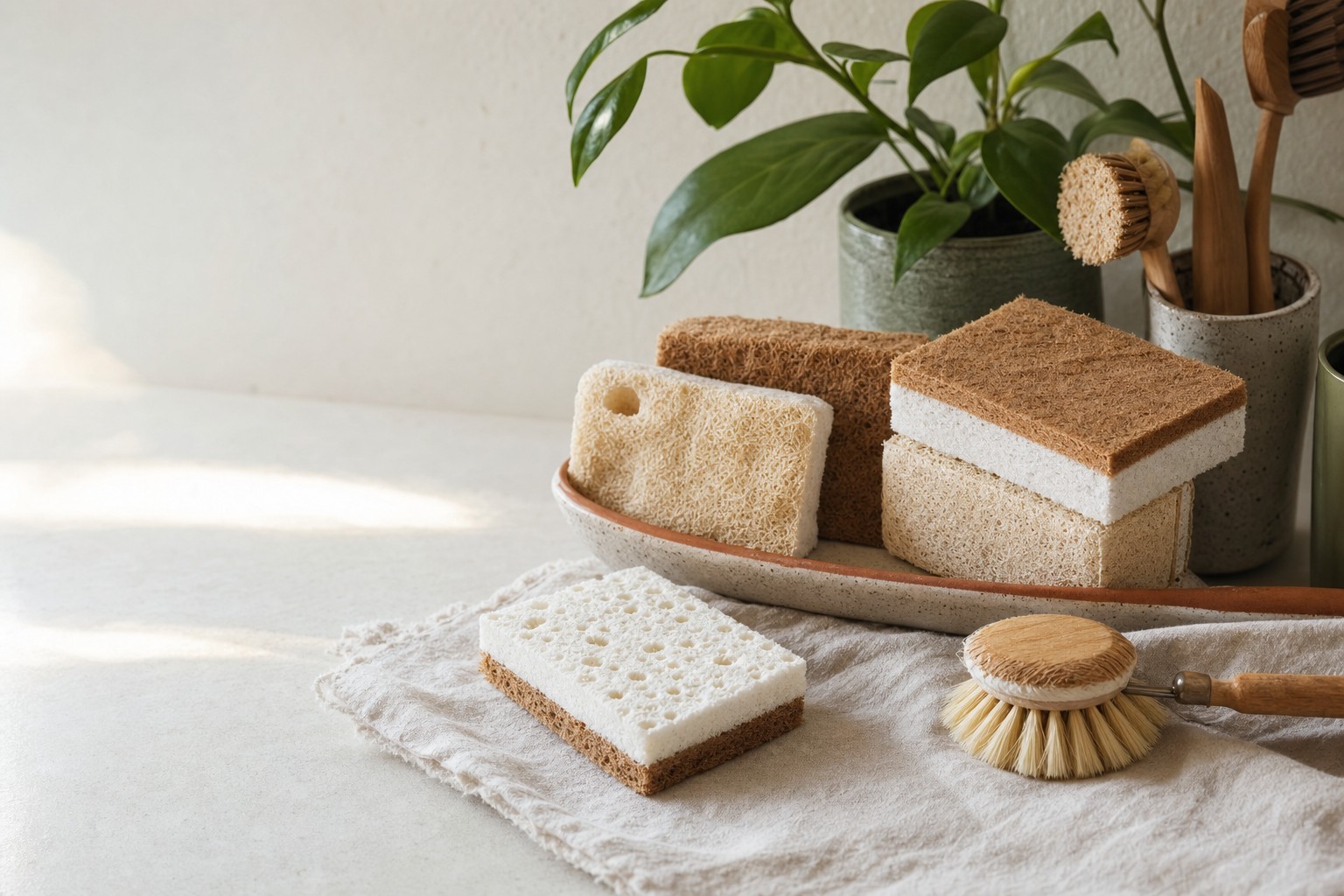
Featured Options Compared in This Guide
Full specs & notes ↓This post contains affiliate links. If you purchase through them, we may earn a commission at no extra cost to you.
A compostable kitchen sponge makes sense when it suits your cleaning tasks, supports a workable sanitation routine, and has somewhere appropriate to go after use. Plant fibers alone do not settle those questions, and compostability does not establish cleaning performance or hygiene.
For counter wiping and spills, cellulose-and-cotton sponge cloths are worth considering. For washing dishes, sanitation compatibility matters as much as the material. For stuck-on food, do not assume a sponge cloth replaces an abrasive scrubber—or that a plant-fiber scrubber cannot scratch cookware.
Choose the format around the job
| Your main task | What to prioritize | Practical tradeoff |
|---|---|---|
| Wiping counters and collecting spills | A washable sponge cloth with clear drying instructions | Swedish-style dishcloths dry faster than traditional sponges, but still need sponge-style hygiene care. |
| Everyday dishwashing | A sponge with a sanitation method you can use daily | Compostability does not remove the need for frequent replacement. |
| Removing stuck-on food | A separate scrubbing tool compatible with the cookware and a workable sanitation method | Do not buy a cloth on the assumption that absorbency proves scrubbing ability. |
| Cleaning when daily sponge sanitation is impractical | Ordinary washable dishcloths that you can rotate | University of Minnesota Extension recommends a clean dishcloth daily, or sooner when heavily soiled. |
The hygiene distinctions above follow University of Minnesota Extension’s kitchen-tool guidance. It treats Swedish dishcloths like sponges and advises choosing sponges that can be sanitized daily. Brushes are another option: Extension notes that their bristles dry faster than sponge or cloth material, while still requiring cleaning and sanitizing after use.
What two cellulose-and-cotton cloths offer
If You Care Sponge Cloths
If You Care describes its Sponge Cloths as a blend of 70% cellulose and 30% cotton. Its instructions cover household wiping and liquid cleanup: rinse before use, wring out, rinse thoroughly afterward, and leave flat to dry.
The care restrictions are especially useful for deciding whether these cloths fit your routine. The manufacturer allows washing in a dishwasher or washing machine, but prohibits chlorine products and tumble drying. If you normally use chlorine sanitizer or put all cleaning cloths through a dryer, those restrictions matter.
The manufacturer says the cloths and packaging are certified compostable. However, its page specifically describes the packaging certification as commercial composting while also broadly suggesting putting both in a compost bin. Before buying specifically for backyard disposal, obtain clear home-composting instructions for the cloth and packaging separately. That wording does not establish that both belong in every home pile.
Skoy Cloth
The Skoy Japan collection page describes Skoy Cloth as 70% cellulose and 30% cotton and presents it as a replacement for paper towels, sponges and cleaning rags. It lists dishwasher and washer/dryer compatibility.
That stated dryer compatibility is a practical difference from If You Care’s air-dry-only instructions. Follow the directions for the version you purchase rather than transferring one brand’s care routine to another.
Skoy describes the cloth as biodegradable under proper composting conditions and reports a composting test. The page does not explain enough about those conditions to use its reported breakdown time as a backyard expectation. Treat disposal suitability as a separate decision from whether the cloth fits your wiping and washing routine.
Neither cloth’s material composition establishes superior scrubbing performance. For everyday spills, choose around care compatibility and disposal access; for abrasive cleaning, select a separate tool suited to the surface.
Browse compostable kitchen sponge listings on Amazon. This is an affiliate search link; results can include products with different materials and disposal requirements.
Compostability must cover the whole sponge
A cellulose body does not answer what happens to an attached scrubbing layer, adhesive or coating. Ask whether the composting claim covers the complete item. The FTC’s Green Guides summary says compostability claims require evidence covering all materials in the claimed product or package, and should explain relevant home-composting limitations.
Keep these distinctions in mind:
- Plant-based describes origin. It does not automatically establish compostability. EPA notes that some plant-based plastics can persist like petroleum-based plastics.
- Biodegradable does not specify your disposal route. A claim about breakdown under particular conditions does not promise breakdown in household trash.
- Commercial composting is different from backyard composting. For compostable plastic components, EPA advises home composting only when the label explicitly permits it; collection programs must also confirm acceptance.
These distinctions come from EPA’s recycling and composting FAQ and the FTC guidance. If a sponge has several bonded layers and the disposal instructions mention only cellulose, choose an option with a clearer whole-item disposal route.
Care without confusing washability with sanitation
Rinsing and drying belong in the routine, but they do not replace sanitizing. University of Minnesota Extension recommends daily sanitation for sponges, drying with airflow on all sides, and replacement every one to two weeks—or earlier if worn. It also says to handle Swedish dishcloths like sponges.
A manufacturer’s claim that a cloth tolerates many washes describes durability; it does not establish a hygienic replacement interval. Odor and appearance are unreliable guides because microorganisms can build up before either changes noticeably.
Choose a sanitation method compatible with the specific material. Extension describes microwave sanitation for eligible sponges, dishwasher sanitation with heated drying, and sanitizer solutions. Those methods are not interchangeable across all products: If You Care, for example, prohibits chlorine products. Permission to machine-wash a cloth also does not by itself establish compatibility with every sanitizing cycle.
Do not use a brief microwave blast as a universal cleaning shortcut. Extension requires checking microwave suitability and absence of metal, thoroughly wetting the sponge, and following the applicable procedure. If the product’s care limits leave you without a workable daily sanitation method, ordinary dishcloths rotated daily may fit your kitchen better.
Where the used sponge should go
For a backyard pile: use a sponge only when its complete construction has clear home-composting guidance. Composting needs moisture, oxygen and an appropriate balance of materials; it is not simply leaving an item outdoors. EPA’s home-composting guide also excludes fats, oils and grease from recommended backyard inputs. Consider what the sponge has cleaned before adding it.
For a collection service: ask specifically about used cleaning sponges or cellulose-and-cotton cloths. Acceptance of food scraps does not establish acceptance of these items. Check packaging separately.
Without an accepted composting route: follow local waste-disposal instructions. Do not put compostable plastic components into plastic recycling; EPA warns that they can disrupt that recycling stream.
Never flush a sponge or feed it into a garbage disposal. Compostability does not make it suitable for a septic system. EPA’s septic guidance limits flushing to human waste and toilet paper and recommends reducing solids entering the system.
For other practical kitchen swaps, see the zero-waste kitchen guide.
Sources
- If You Care: Sponge Cloths—materials and care instructions
- Skoy Japan: Skoy Cloth—materials and care information
- University of Minnesota Extension: Cooking food safely at home—cleaning utensils
- FTC: Environmental Claims—Summary of the Green Guides
- EPA: Composting at Home
- EPA: Frequently Asked Questions about Plastic Recycling and Composting
- EPA: How to Care for Your Septic System
Products Compared in This Guide
Compostable kitchen sponge listings
Compare current manufacturer specifications, materials, and package options for Compostable kitchen sponge listings.