Reusable Beeswax Wraps: Materials, Care & Buying Guide (2026)
Choose beeswax wraps by food use, coating ingredients and useful sizes, with practical care advice and limits for fatty foods and composting.
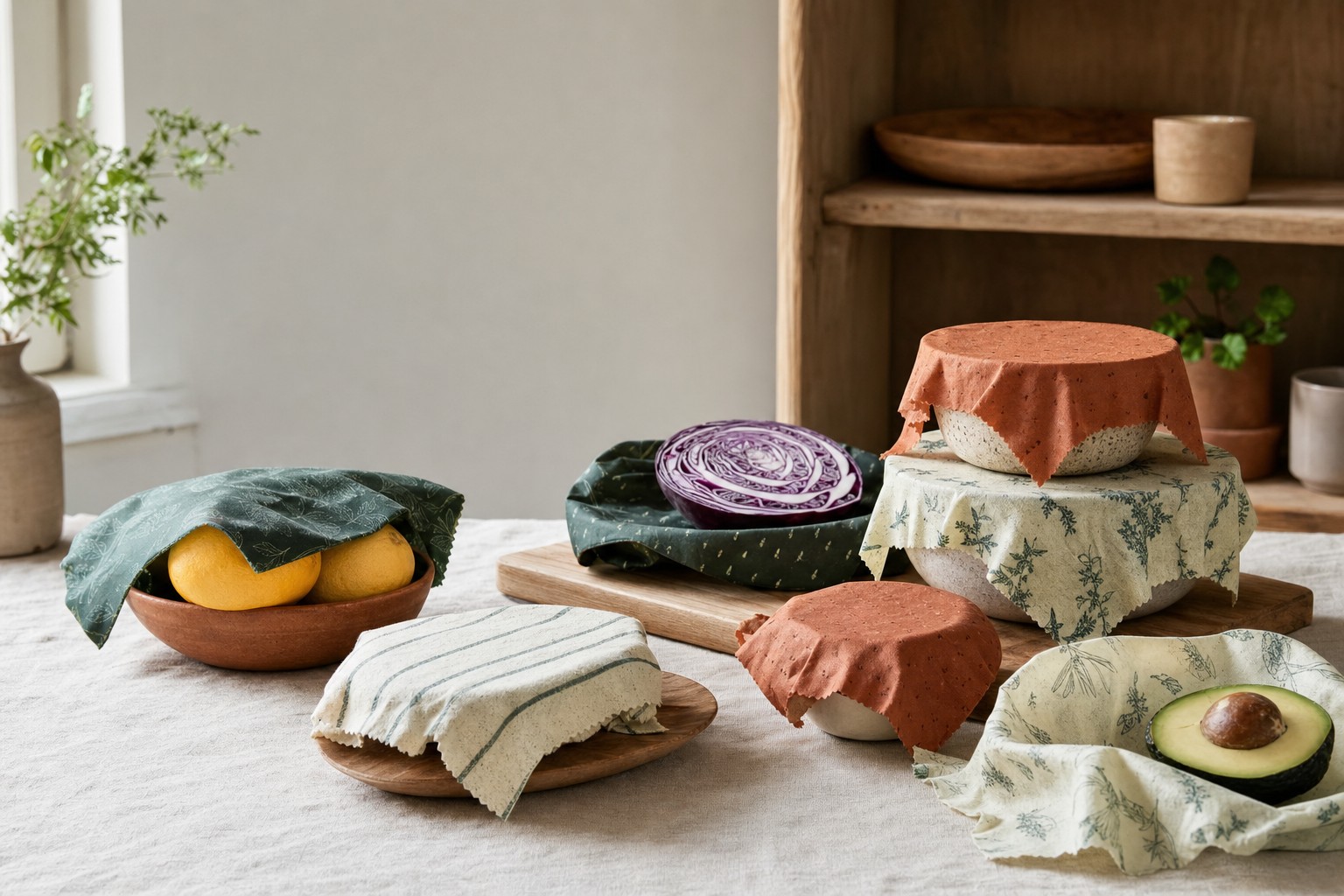
Featured Options Compared in This Guide
Full specs & notes ↓This post may contain affiliate links. If you make a purchase through these links, we may earn a small commission at no extra cost to you. Learn more.
Reusable beeswax wraps make the most sense when you regularly cover produce or dishes and can hand-wash the wraps in cool water. Their limitations matter just as much as their sizes: they cannot tolerate hot cleaning, and coating ingredients affect which foods are suitable for direct contact.
Before buying a large assortment, identify the foods you actually want to wrap. Cheese deserves particular attention: Bee’s Wrap recommends its wraps for cheese, while Germany’s Federal Institute for Risk Assessment (BfR) advises against using beeswax cloths with additional coating substances for fatty foods. That difference changes the buying decision. (Bee’s Wrap FAQ, BfR guidance)
Match the wrap to the food
Warm pressure from your hands helps shape a beeswax cloth around food or a container. This makes it useful for flexible wrapping, but it does not remove the food-contact and cleaning limits identified by BfR. (BfR guidance)
| Storage task | Practical decision |
|---|---|
| Fruit and vegetables | A reasonable starting use. BfR identifies these as suitable for wraps with additional coating substances, while noting that plant foods can also carry pathogens. |
| Cheese, sausage or fatty pastries | Prefer a washable food container when the wrap contains oil, resin or other coating additives. BfR recommends against these wraps for fatty foods. |
| Raw meat, fish or other raw animal foods | Use a food container suitable for thorough cleaning. BfR advises that reusable beeswax cloths should especially avoid contact with raw animal foods because they cannot be cleaned at high temperatures. |
| Hot leftovers | Do not put the wrap directly onto hot food. Bee’s Wrap instructs users to let food cool before wrapping. |
| Bowls and dishes | Measure the opening and allow material to extend over the edges so you can shape it into place. Bee’s Wrap lists covering bowls and dishes among its uses. |
Food-use guidance: BfR and Bee’s Wrap.
For a kitchen that mainly stores meat or fatty leftovers, wraps have a narrower role. Put your budget toward containers for those tasks and reserve wraps for suitable produce or bowl covers. See the plastic-free food storage guide for related storage choices.
Ingredients matter more than the pattern
BfR describes typical beeswax cloths as fabric coated with beeswax, oil and sometimes resin. It recommends food-contact-suitable textiles and beeswax meeting food-additive requirements. This also matters for homemade wraps: decorative fabric scraps are not automatically appropriate for touching food. (BfR guidance)
Pay attention to the oil. BfR does not recommend jojoba oil in beeswax cloths pending the studies needed for a health risk assessment. It considers transfer into fatty foods likely. This is an evidence gap underlying precautionary advice, not proof that every use causes harm. If a maker lists only “plant oil,” ask which oil it uses before choosing that wrap. (BfR guidance)
Bee’s Wrap lists organic cotton, beeswax, organic plant oil and tree resin for its beeswax formula. Its FAQ describes the cotton as GOTS-certified, but does not identify the plant oil in that formula. Treat the cotton statement as a claim about the textile; it does not answer the separate questions about coating composition or fatty-food contact. (Bee’s Wrap product page, FAQ)
If avoiding animal-derived wax is your priority, Bee’s Wrap also describes a vegan formula using candelilla wax, soy wax, organic coconut oil and tree resin. That is a different formulation, not evidence of better durability or broader food suitability. The Assorted 5 Pack discussed below is specifically listed as beeswax, so do not assume a general vegan description applies to that pack. (Bee’s Wrap FAQ, product page)
Choose dimensions before pack count
A larger pack is useful only if its pieces fit your routine. Make a short list of the produce, bowls or dishes you regularly cover, then compare those dimensions with the included wraps.
As a concrete sizing example, Bee’s Wrap lists its Honeycomb and Meadow Magic Assorted 5 Packs as containing:
- Three medium wraps measuring 10 × 11 inches.
- Two large wraps measuring 13 × 14 inches.
This assortment repeats two sizes; it does not include a small wrap or a dedicated bread wrap. It may suit someone who needs several medium and large covers at once. Someone mainly covering small produce or wrapping whole loaves should compare other size configurations. These are the manufacturer’s listed dimensions, not a fit guarantee for a particular bowl or loaf. (Assorted 5 Pack)
For irregular dishes, Bee’s Wrap describes a roll that can be cut to size. Plan the cuts around your dishes before choosing a roll; for repeated everyday sizes, pre-cut pieces may be simpler. (Bee’s Wrap FAQ)
You can browse reusable beeswax wraps on Amazon. This is an affiliate search link, not a recommendation of every result. Compare the actual dimensions and coating ingredients rather than relying on the number of pieces or words such as “eco-friendly.”
Care determines whether wraps fit your routine
Bee’s Wrap instructs users to wash its wraps by hand with cool water and mild dish soap, then air-dry them before storage. It advises avoiding hot water, dishwashers, microwaves, ovens and other heat sources; its product page also mentions hot cars. If your normal cleanup depends on the dishwasher, these wraps require a separate routine. (Bee’s Wrap FAQ, product page)
Cool washing is also a limitation: BfR explains that high-temperature cleaning would melt the coating. Do not treat a rinse as a way to make a wrap suitable for reuse after raw-animal-food contact. (BfR guidance)
Bee’s Wrap estimates up to a year of use with proper care. That is manufacturer guidance, not a promised replacement interval. Its stated wear signs include thinning and difficulty sticking to itself. Use those condition cues rather than assuming every wrap lasts a fixed number of months. The cited care instructions do not provide a reheating procedure, so avoid improvising one in an oven or microwave. (Bee’s Wrap FAQ)
Reuse and disposal: make the benefit specific
Start with enough wraps for recurring tasks where they will replace disposable wrapping. If a container you already own handles the job well, there is no need to buy a wrap for it. Pack count alone does not establish savings or reduced waste.
Bee’s Wrap says its worn wraps can be composted and suggests cutting them into strips for a compost pile. That is the manufacturer’s disposal guidance, not a category-wide guarantee. For a collection service, confirm that the operator accepts the finished wrap before adding it. (Bee’s Wrap product page)
The FTC says compostability claims need evidence covering all materials in the product and should explain relevant home-composting or facility limitations. It also cautions against broad, unqualified environmental claims. Cotton and beeswax in an ingredient list do not, by themselves, establish how the complete wrap will break down under your disposal conditions. (FTC Green Guides summary)
Sources
Products Compared in This Guide
Reusable beeswax wraps
Compare current manufacturer specifications, materials, and package options for Reusable beeswax wraps.