Branch Basics vs Blueland: Which Cleaner to Buy
Branch Basics vs Blueland: buy Branch Basics for one fragrance-free concentrate, or Blueland for premeasured tablets. Dilutions, refills, and spray costs.
Featured Options Compared in This Guide
Full specs & notes ↓Branch Basics vs Blueland comes down to one choice: buy Branch Basics if you want one fragrance-free concentrate for counters, bathrooms, and glass. Buy Blueland if you want a premeasured tablet per spray and can accept scented counter and bathroom formulas. The practical tradeoff is measuring different liquid doses versus stocking separate tablet formulas and waiting for them to dissolve. Branch Basics dilution directions, Branch Basics fragrance FAQ, Blueland preparation, Blueland fragrance options.
These differences support a choice about your routine; they do not establish superior cleaning performance or safety for either brand.
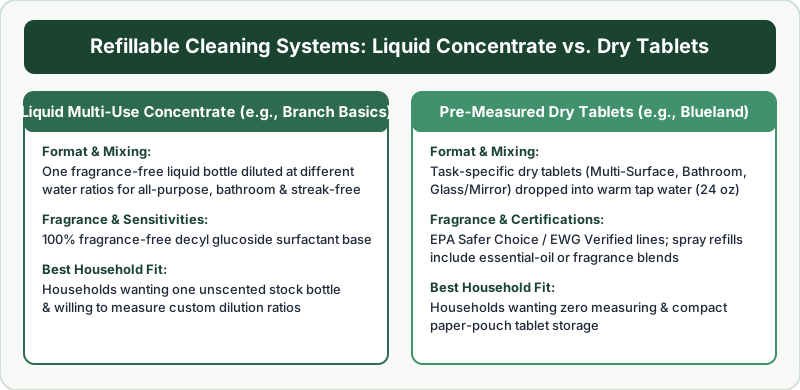
Match the system to your cleaning jobs
| Job or preference | Branch Basics | Blueland |
|---|---|---|
| Everyday counters and tables | All-Purpose dilution made from the shared Concentrate. | Separate Multi-Surface tablet; listed uses include counters, sealed wood and sealed stone. |
| Tubs and showers | Bathroom dilution uses more Concentrate than All-Purpose. | Separate Bathroom tablet for tubs, sealed tile, sealed stone and shower surfaces. |
| Glass and mirrors | Streak-Free preparation uses one drop of Concentrate with distilled water. | Dedicated, unscented Glass + Mirror tablet for glass, mirrors and windows. |
| Fragrance-free counter and bathroom routine | The manufacturer describes the Concentrate as fragrance-free. | Multi-Surface and Bathroom sprays are available only scented. |
| Routine mopping | Separate floor instructions are available, with dilution and surface precautions. | Multi-Surface is not indicated for general floor cleaning; sealed-floor spot cleaning is permitted. |
Sources: Branch Basics usage guide, dilution guide, fragrance FAQ, Blueland spray FAQ, unscented options.
For a household avoiding added fragrance across these spray-cleaning jobs, Branch Basics is the more direct fit. Its manufacturer notes a subtle ingredient smell that becomes less noticeable with dilution. Blueland’s unscented glass cleaner does not solve the counter-and-bathroom fragrance limitation: those are different formulas with different listed applications. Branch Basics scent explanation, Blueland fragrance availability.
What refilling actually involves
Both brands allow you to use your own refillable bottles. Buying branded bottles is therefore a convenience decision rather than a prerequisite.
For Branch Basics in your own 24-ounce spray bottles, use these documented preparations:
| Solution | Concentrate dose | Water instruction |
|---|---|---|
| All-Purpose | 2 fluid ounces | Add water to complete the 24-ounce preparation: 22 fluid ounces of water. |
| Bathroom | 4 fluid ounces | Fill the remaining volume with water: 20 fluid ounces of water. |
| Streak-Free | One drop | Add to 24 fluid ounces of distilled water. |
All-Purpose uses one part Concentrate to eleven parts water; Bathroom uses one part Concentrate to five parts water. Streak-Free has a distinct drop-based instruction—do not substitute either spray dilution for it. Own-bottle instructions.
With Branch Basics bottles, follow each bottle’s water and concentrate fill marks, top off with water, then shake gently. The brand permits tap water for All-Purpose and Bathroom and recommends distilled water for Streak-Free. Keeping the prepared bottles labeled makes the different strengths easier to distinguish. Bottle preparation.
For Blueland, fill its bottle with warm water to the half-moon mark, or put 24 ounces of warm water into your own bottle. Add one tablet of the appropriate spray formula and wait until it dissolves completely before attaching the nozzle. Here, 24 ounces refers to the water added. Spray preparation instructions.
Branch Basics lets you draw counter, bathroom and glass refills from one concentrate supply, but each preparation needs its own dose. Blueland removes liquid-dose measuring, while requiring you to keep the appropriate tablet type available for each job.
Surface precautions that affect the choice
Branch Basics recommends testing an inconspicuous area before use to check for water marks or fabric lightening. For sealed hardwood, its guide warns that overly concentrated solutions can damage the finish. Its bucket-mopping instruction is 1–2 teaspoons of Concentrate per gallon of water, with testing first and minimal moisture left on the wood. Do not use the bathroom spray recipe as a floor-mopping mixture. For natural stone, Branch Basics advises testing first and avoiding abrasive tools or powders that could scratch it. Surface and floor precautions.
Blueland lists sealed wood and sealed stone among Multi-Surface applications, but explicitly separates these uses from general floor cleaning. Its permission to spot-clean sealed floors does not extend to whole-floor mopping. If floors are central to your purchase, Branch Basics offers relevant preparation instructions; Blueland’s spray system leaves routine mopping as a separate decision. Blueland surface limits.
Branch Basics also states that its Concentrate is not a disinfectant or sanitizer. Its everyday cleaning uses should not be read as a disinfection claim. Concentrate FAQ.
Compare refill costs using the actual doses
Separate bottle purchases from recurring cleaning supplies. A kit total alone cannot show which system costs less to use.
For Branch Basics, let C be the delivered cost of a concentrate bottle and V its volume in fluid ounces:
- All-Purpose, 24-ounce preparation: C × 2 ÷ V.
- Bathroom, 24-ounce preparation: C × 4 ÷ V.
The listed Concentrate bottle contains 33.8 fluid ounces, so that size uses 33.8 as V. At the same concentrate purchase cost, a Bathroom preparation consumes twice as much Concentrate as an All-Purpose preparation. That is a dose comparison, not a claim about how well either cleans. Bottle size, documented doses.
Streak-Free uses one drop per 24 ounces of distilled water. Budget for that water separately; an exact concentrate cost per preparation would require a defined drop volume, which the directions do not provide.
For each Blueland spray formula:
Delivered refill-pack cost ÷ tablet count = cost of one preparation using 24 ounces of water. Blueland spray directions.
Compare All-Purpose with Multi-Surface and Bathroom with Bathroom. These are nominal bottle-size comparisons: Branch Basics specifies a filled 24-ounce bottle for its two stronger solutions, while Blueland specifies 24 ounces of water before the tablet is added. Neither calculation establishes cost per room or cleaning session; consumption depends on how often you clean and how much solution you use. Blueland consumption FAQ.
For subscriptions, use the ongoing delivered refill expense in your calculation. Blueland’s kit page distinguishes its introductory promotion from subsequent subscription orders. Purchase terms.
Decide whether you need a kit
If you already have suitable bottles and want one refill supply for several spray jobs, Branch Basics sells the Concentrate separately and provides own-bottle directions. Branded bottles add task-specific fill marks, which may be worthwhile if measuring is the main inconvenience. Concentrate and bottle instructions.
Blueland’s Clean Essentials Kit includes a bottle and one tablet for each of four products: Foaming Hand Soap, Multi-Surface, Bathroom, and Glass + Mirror. The listed scents are Perrine Lemon for hand soap, Fresh Lemon for Multi-Surface, and Eucalyptus Mint for Bathroom; Glass + Mirror is unscented. The kit fits someone who needs those four products and their bottles. If you only need counter spray, the separately listed Multi-Surface refills offer a more focused purchase. Kit contents.
For a fragrance-free routine across counters and bathrooms, choose based on Branch Basics’ fragrance description and your willingness to measure dilutions. For premeasured refills with scented counter and bathroom formulas, Blueland fits that preference. In either case, buy for the surfaces and preparations you will actually use.
Where to browse
Prices and availability change. These search listings are a place to check the current product.
Sources
- Branch Basics: Getting started and surface precautions
- Branch Basics: Dilution guide for your own bottles
- Branch Basics: Own-bottle dilution FAQ
- Branch Basics: Fragrance FAQ
- Branch Basics: The Concentrate
- Blueland: Spray Cleaners FAQ
- Blueland: Unscented options
- Blueland: Clean Essentials Kit
- Blueland: Multi-Surface tablet refills
Products Compared in This Guide
Branch Basics concentrate
Compare current manufacturer specifications, materials, and package options for Branch Basics concentrate.
Blueland cleaner tablet
Compare current manufacturer specifications, materials, and package options for Blueland cleaner tablet.
Frequently Asked Questions
Which system fits fragrance-free counter and bathroom cleaning?
Branch Basics describes its Concentrate as fragrance-free and uses it to prepare both All-Purpose and Bathroom solutions. Blueland offers its Multi-Surface and Bathroom sprays only in scented versions; its Glass + Mirror cleaner is unscented. Branch Basics notes that its ingredients can have a subtle smell, so fragrance-free does not necessarily mean odorless.
Can I use my own bottles with Branch Basics and Blueland?
Yes. For a 24-ounce bottle, Branch Basics specifies 2 ounces of Concentrate for All-Purpose or 4 ounces for Bathroom, with the remainder water. Its Streak-Free instruction is one drop in 24 ounces of distilled water. Blueland specifies one spray-cleaner tablet in 24 ounces of warm water; let it dissolve fully before attaching the nozzle.
Can either system cover routine floor cleaning?
Branch Basics supplies separate floor directions, including a very dilute mixture for sealed hardwood with testing and moisture precautions. Blueland does not indicate its Multi-Surface spray for general floor cleaning, although it permits spot cleaning on sealed floors.