How to Read Cleaning Labels: Claims, Ingredients, and Certifications
Read cleaner directions, compare ingredient disclosures, and distinguish Safer Choice and fragrance-free criteria from broad environmental claims.

Featured Options Compared in This Guide
Full specs & notes ↓Read the intended use before the environmental pitch. Then separate three questions: what each ingredient does, what a certification evaluates, and which part of the product an environmental claim actually describes.
A useful comparison is not simply one green-looking bottle against another. It is two products for the same job, with their directions, ingredient disclosures, and claim qualifications side by side.
Start with the job—not the seal
Match the product name, scent variant, and intended use to what you need. Check whether it requires dilution, whether your surface is included, and what warnings, rinsing instructions, or restrictions apply.
A concrete example: Seventh Generation’s Free & Clear dish liquid is intended for hand dishwashing, and its directions exclude automatic dishwashers. A certification or plant-based claim does not change that restriction. Seventh Generation product directions.
For a concentrate, compare the amount of usable cleaner at the instructed dilution rather than bottle volume alone. For a refill, check that it is intended for the bottle and formula you have. If the directions do not establish that a product fits your task, do not use an environmental claim to fill the gap.
Turn broad claims into answerable questions
The FTC advises marketers against unqualified environmental claims such as green or eco-friendly. It calls for specific, prominent explanations and says that a third-party seal does not remove the need to substantiate claims. FTC Green Guides summary.
| Label claim | What to establish before giving it weight |
|---|---|
| Green or eco-friendly | Identify the particular benefit. If it is a comparison, find the baseline rather than assuming an overall environmental advantage. |
| Non-toxic | Look for evidence addressing people and the environment. Do not treat the wording as permission to disregard directions. |
| Plant-based | Determine whether it describes particular ingredients, the formula, or the packaging. Do not assume every ingredient has the same origin. |
| Free of an ingredient | Ask whether that ingredient is relevant to the product category and whether the claim answers your actual concern. |
| Biodegradable | Identify whether the claim covers ingredients, the whole formula, or the package, along with the breakdown conditions. |
| Compostable | Establish whether home composting is covered or a facility is required; check whether your local program accepts the package. |
| Recycled content | Find the proportion and whether it applies to the bottle, another component, or the whole package. |
| Refillable | Find the refill product or collection-and-refill system, not just a bottle that can be opened. |
The FTC specifically requires scientific substantiation for non-toxic claims covering both people and the environment. Its guidance also cautions that a free-of claim can mislead when the absent substance was never associated with that product category, or when a substitute poses a similar environmental risk. An absence claim is therefore not a complete assessment of the formula. FTC guidance on non-toxic and free-of claims.
Keep liquid ingredients and packaging disposal separate. For solid waste, the FTC uses complete decomposition within one year after customary disposal as the benchmark for an unqualified degradable claim. It advises against unqualified biodegradable claims for items destined for landfill, incineration, or recycling. That solid-waste benchmark should not be presented as a universal test for liquid cleaning formulas. FTC degradability guidance.
Read ingredient roles, then compare exact names
An ingredient’s function and its source are different pieces of information. EPA explains that surfactants assist cleaning by lowering surface tension, solvents dissolve or suspend materials, and chelating agents reduce water hardness. These roles help explain why ingredients are present; they are not, by themselves, a hazard ranking. EPA ingredient criteria.
Two manufacturer disclosures show why the exact list matters:
| Disclosure detail | Seventh Generation Free & Clear dish soap | ECOS Free & Clear dish soap |
|---|---|---|
| Examples of cleaning ingredients | Sodium lauryl sulfate, lauramine oxide, and decyl glucoside, identified as plant-derived or plant-based cleaning agents | Sodium coco-sulfate, cocamidopropylamine oxide, lauramine oxide, and coco betaine, identified as plant-derived surfactants |
| Listed preservatives | Benzisothiazolinone and methylisothiazolinone, identified as synthetic preservatives | Phenoxyethanol and ethylhexylglycerin, identified as preservatives |
| Another disclosed function | Magnesium chloride is identified as a viscosity modifier | Tetrasodium glutamate diacetate is identified as a water softener |
These are selected entries, not complete ingredient lists or a performance ranking. Sources: Seventh Generation ingredients and ECOS ingredients.
The practical lessons are specific:
- Do not infer origin from the word sulfate. Seventh Generation identifies the sodium lauryl sulfate in this formula as plant-derived.
- Plant-derived cleaning ingredients do not mean an entirely plant-derived formula. The same disclosure includes synthetic preservatives.
- Free & Clear does not identify one shared recipe. These two products list different preservatives and cleaning-ingredient combinations.
If you need to avoid a particular ingredient, compare its exact name with the disclosure. For example, methylisothiazolinone appears in Seventh Generation’s listed formula, while ECOS lists different preservatives. That distinction can answer an ingredient-presence question; it does not establish that either product will suit everyone. If a disclosure is too broad to resolve your concern, ask the manufacturer before buying.
Know what Safer Choice adds—and what fragrance-free adds separately
EPA’s Safer Choice program evaluates formulation ingredients against criteria appropriate to their functions, considering human-health and environmental characteristics. The standard also includes product requirements, including packaging and performance. It is therefore more than a statement about whether ingredients began as plant materials. EPA Safer Choice standard.
Fragrance-free is an additional designation. EPA reviews qualifying products to establish that they contain no fragrance materials. Its criteria also exclude chemicals with multiple functions when those functions include fragrance. The ordinary Safer Choice label alone does not establish fragrance-free status. EPA fragrance-free criteria.
For scent avoidance, look for the exact variant’s disclosure and distinguish a manufacturer’s fragrance-free statement from EPA’s additional designation. Do not extend a claim from one scent variant to another.
For other environmental seals, identify the attribute being assessed. A claim about recycled bottle material is not evidence about the formula’s ingredients. The FTC says seals should communicate their basis clearly rather than imply environmental benefits beyond their support. FTC certification guidance.
Choose on the distinction that matters to you
Once two cleaners fit the same task, use your priority to break the tie:
- Avoiding a named ingredient: compare exact ingredient disclosures, not the length of a free-of list.
- Avoiding fragrance: distinguish the product’s fragrance statement from an additional EPA fragrance-free designation.
- Choosing a refill: confirm that a usable refill route exists and follow its mixing instructions, if any.
- Evaluating packaging: compare the stated material and recycled-content scope, then check the relevant local disposal route.
The strongest label is not the one with the most reassuring words. It is the one that answers your particular question with a clear scope, usable directions, and specific support.
Related reading: Biodegradable cleaning products · Fragrance-free laundry detergents.
Sources
Products Compared in This Guide
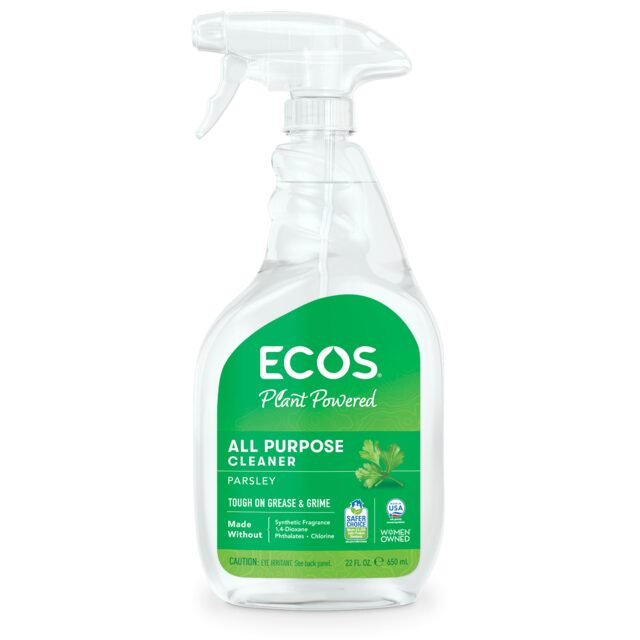
ECOS All-Purpose Cleaner
A label that matches reality: EWG-A rated, EPA Safer Choice certified, full ingredient disclosure. One of the few products where the 'plant-based' and 'natural' claims on the label are backed by verifiable third-party ratings.
Frequently Asked Questions
Should non-toxic claims be dismissed as meaningless?
No. The FTC's Green Guides say these claims need reliable scientific evidence supporting safety for people and the environment. Treat non-toxic as a claim requiring support, not a reason to disregard use instructions or warnings.
Does the Safer Choice label mean fragrance-free?
Not by itself. EPA offers an additional fragrance-free designation after reviewing a product for fragrance materials. Its criteria also exclude dual-function chemicals whose uses include fragrance.
Does Free & Clear mean two cleaners have the same ingredients?
No. Seventh Generation and ECOS publish different ingredient lists for their Free & Clear dish soaps, including different preservatives. Compare the exact formula rather than relying on the variant name.