Household Energy Efficiency: Practical Buys for 2026
Compare LEDs, weatherstripping, thermostats, energy monitors, and smart plugs by the household problem they solve and their installation requirements.
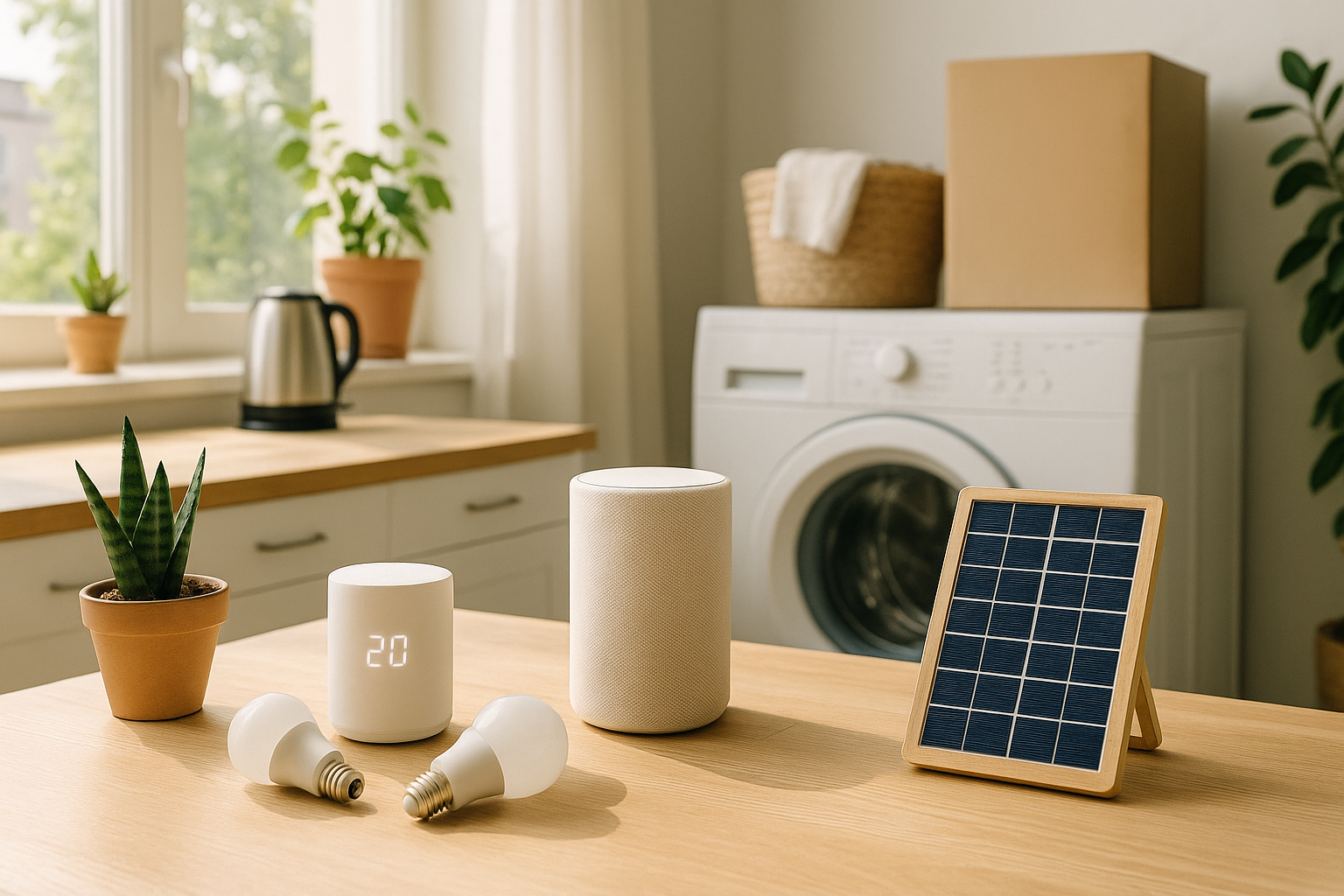
Featured Options Compared in This Guide
Full specs & notes ↓This article contains an affiliate search link. If you buy through it, GreenChoice may earn a commission at no extra cost to you.
A useful household energy-efficiency purchase starts with a specific problem: a leaking door seal, lighting due for replacement, heating that runs on an unsuitable schedule, or electricity consumption you cannot explain. Those problems call for different tools, so there is no single best purchase for every home.
The Department of Energy’s whole-house approach considers the building shell, heating and cooling, electrical systems, and appliances together. Its weatherization measures include efficient lighting, programmable thermostats, air sealing, insulation, and equipment repairs. That provides a useful buying principle: choose an upgrade that addresses the cause of waste. Source: DOE
Match the purchase to the problem
| Household problem | Option to consider | Main decision before buying |
|---|---|---|
| A lamp needs a replacement bulb | Philips UltraEfficient A19 E26 | Match brightness, light color, fixture requirements, and dimmer compatibility. |
| Heating or cooling settings do not follow occupancy | ecobee Smart Thermostat Premium | Establish compatibility with the HVAC equipment and its 24VAC controls. |
| Electric baseboard zones need separate schedules | Mysa for Baseboards V2 | Confirm heater type, supply voltage, wiring, and combined heater load. |
| Electricity use is unclear across several circuits | Emporia Vue 3 | Choose the sensor package and account for panel installation and internet dependence. |
| One plug-in device needs measurement or scheduling | Tapo P110M | Check the connected device against the plug’s electrical and motor ratings. |
| A door or window has a gap at its closing edge | Frost King Premium Rubber Foam | Choose the profile for the gap and prepare the contact surface. |
The sections below explain these choices using the manufacturers’ specifications. Treat energy-saving outcomes as dependent on what you change after installation.
Lighting: choose a suitable replacement before chasing a premium label
Philips lists its UltraEfficient Filament Bulb Clear 60W A19 E26 four-pack, product number 046677592417, at 850 lumens and 2700K. It describes the bulb as dimmable and directs buyers to check compatibility with their particular dimmer. These details make it a candidate when you want that brightness and warm light color in an A19/E26 format. Source: Philips
For an everyday lamp, start with the brightness you need. Then compare actual input wattage among suitable bulbs. For a dimmed fixture, compatibility matters alongside energy use: the presence of a dimmable claim alone does not establish that every switch will work with it.
Prioritize bulbs already due for replacement and places where lighting runs regularly. Before replacing a working LED solely for efficiency, calculate the electricity difference:
Annual electricity reduction in kWh = wattage difference × annual operating hours ÷ 1,000.
Multiply that result by your electricity rate to estimate the energy-charge reduction. Use the actual wattages of the two bulbs and your own operating hours; a product’s replacement-equivalent wattage is not its electricity consumption. DOE includes efficient lighting among its household weatherization measures. Source: DOE
Thermostats: the heating system determines the choice
ecobee Premium for compatible 24VAC HVAC
The ecobee Smart Thermostat Premium supports most 24VAC HVAC equipment, including specified furnaces, air conditioners, heat pumps, and boilers. It includes a room SmartSensor, scheduling, occupancy-based adjustments, and reports showing system runtime. Power comes through a C-wire connection or, for compatible installations, the included Power Extender Kit. Source: ecobee
Its clearest use case is a home where the heating or cooling schedule regularly misses the household’s routine. The room sensor also provides temperature and occupancy information from somewhere other than the thermostat’s location. Choose that feature when the room you use matters more to your comfort settings than the hallway.
Decide which control change you will actually use before buying: scheduled away periods, occupancy adjustments, vacation settings, or room sensing. If your existing thermostat already follows an appropriate schedule, identify the additional function you need before paying for a replacement.
Some features require more equipment. ecobee’s automatic pause when a door or window stays open requires its door/window sensors and a Smart Security subscription. Those are separate from the included room SmartSensor. Source: ecobee features and specifications
Mysa Baseboard V2 for supported high-voltage electric heat
Mysa for Baseboards V2 serves a different electrical system. The manufacturer lists support for electric baseboards, fan-forced heaters, self-contained hydronic baseboards, and radiant ceiling heaters using supported high-voltage supplies. It excludes 24V HVAC, central boiler-based hydronic systems, and electric in-floor heating. Source: Mysa
The practical benefit is scheduling each thermostat around the use of its heating zone. For example, consider a separate daytime schedule for an office and an evening schedule for a bedroom, where the existing wiring provides separate control.
Mysa specifies a Neutral or L2 connection and lists these V2 load requirements:
- Minimum connected load: 250W.
- Maximum load: 16A, with stated limits of 1,900W at 120V or 3,800W at 240V.
- When several heaters share one thermostat, their combined load must fit the limit.
Mysa says a two-wire switch-loop installation requires rewiring. Use a licensed electrician when the wiring is uncertain or local rules require one. Its smart features need 2.4GHz Wi-Fi; manual temperature control remains available without Wi-Fi. Source: Mysa compatibility and FAQs
Count the zones you want to control before budgeting. The V2 includes energy monitoring and a humidity sensor; Mysa’s listed Lite model provides scheduling and remote control without those additions. Choose the V2 when you intend to use the heating-use information, and compare Lite when scheduling is the main goal. Source: Mysa model comparison
Measurement: one connected load or several circuits?
Tapo P110M for a compatible plug-in load
The Tapo P110M measures connected-device energy use, accepts electricity rates for cost estimates, and provides scheduling, remote switching, and an automatic off timer. TP-Link also states that local control through the Tapo app remains available on the household LAN when internet access is unavailable. Source: TP-Link
Use it to answer a narrow question, such as how much electricity a desk lamp or compatible entertainment device uses during its normal routine. Observe ordinary use first, then decide whether an off schedule would remove unwanted operating hours. Measurement alone does not reduce consumption.
The US model lists 100–125V operation, a 15A/1,800W maximum for general or resistive loads, and a separate 1/6 HP motor rating. Do not treat the wattage limit as blanket approval for every appliance. Match both the load type and the appliance’s instructions before connecting or automating it. Source: TP-Link specifications
Search Amazon for Tapo P110M energy-monitoring plugs. This affiliate link opens search results; compare the model, regional version, and pack size before purchasing.
Emporia Vue 3 for household and circuit-level questions
The Vue 3 installs inside the electrical panel. Emporia offers a monitor-only package for total usage and packages with eight or sixteen branch-circuit sensors. Individual circuit readings require those additional sensors. The system requires an active internet connection for its key features and uses cloud storage; Emporia states that it does not support local data storage. Source: Emporia
Choose the sensor package around your question. If you want to compare several selected circuits, the eight-sensor package may cover the intended scope. If you want broader coverage, map the circuits against the sixteen-sensor package before ordering. Account for qualified installation when budgeting for equipment inside the panel.
A circuit reading describes the loads on that circuit. Where multiple devices share it, investigate their operating times before assigning the total to a single appliance. Emporia’s alerts can flag unusual usage, but the next step may be a schedule change, maintenance, or professional diagnosis—not another purchase.
Weatherstripping: fit matters more than the brand name
Frost King’s Premium Rubber Foam range uses self-adhesive EPDM and includes several profiles. Its V25WA is the white D-section version, listed as 5/16 inch wide, 1/4 inch thick, and 17 feet long, for medium gaps. The same page lists a thinner ribbed option for narrow gaps and a thicker cushioned profile for wide gaps. Source: Frost King
Identify where the door or window fails to seal before selecting tape. Choose a profile that contacts the closing surface while allowing normal closure; buying the thickest option does not establish a better fit. Frost King recommends cleaning away dust and oil before application to improve adhesion. Source: Frost King preparation guidance
For persistent discomfort or widespread drafts, consider a whole-house assessment. DOE’s approach includes air sealing alongside insulation, equipment condition, ventilation, combustion safety, and moisture evaluation. It specifically explains that roof leaks need attention before insulation that the leaks could damage. A roll of tape addresses a local gap; larger building problems call for a coordinated repair plan. Source: DOE
Decide what the purchase must accomplish
Write down one useful outcome before ordering: a sealed door edge, suitable replacement light, a heating schedule that follows room use, or an explanation for a circuit’s consumption. That makes the choice concrete and gives you something to assess afterward.
Keep electricity consumption and electricity cost separate. Moving operation to a cheaper time can lower energy charges without reducing kWh. When assessing a thermostat, also consider weather and occupancy changes; a different monthly bill alone does not isolate the thermostat’s effect. ecobee’s own savings disclosure acknowledges variation by energy use and location. Source: ecobee savings disclosure
If the problem points toward insulation, heating equipment, or major appliances, use the small-device findings to guide a larger assessment. DOE’s whole-house framework includes repair and replacement decisions across these systems. For broader planning, see the energy-efficient home guide. Source: DOE
Sources
Products Compared in This Guide
Tapo P110M energy-monitoring plugs
Compare current manufacturer specifications, materials, and package options for Tapo P110M energy-monitoring plugs.
Emporia Vue 3 Home Energy Monitor
A strong pick if you want circuit-level detail, but it takes panel access and may need a qualified electrician.
ecobee Smart Thermostat Premium
Best for most forced-air homes because the room sensor helps reduce hot and cold spots, though savings depend on your schedule and HVAC habits.
Mysa Smart Thermostat for Electric Baseboard Heaters V2
One of the better options for line-voltage electric heat, but you need to confirm wiring compatibility before buying.
Frequently Asked Questions
What should I buy first for household energy efficiency?
Match the purchase to a specific problem: weatherstripping for a door or window gap, suitable efficient lighting for a bulb replacement, or compatible heating controls for an unused scheduling opportunity. If the cause of high consumption is unclear, choose measurement or a home energy assessment first.
Should I choose a smart plug or a panel energy monitor?
A smart plug measures a compatible connected load. A panel monitor can measure total household electricity and, with branch sensors, selected circuits. Choose based on whether your question concerns one plug-in device or several circuits.
Are ecobee Premium and Mysa Baseboard V2 interchangeable?
No. ecobee Premium supports compatible 24VAC HVAC equipment. Mysa Baseboard V2 controls supported high-voltage electric heating and has specific wiring and load requirements.