Eco Mattress Pads and Toppers: Wool, Latex, and Cotton Compared (2026)
Compare latex toppers, wool pads, and cotton-filled layers by comfort goals, construction, certification, cleaning, and handling.
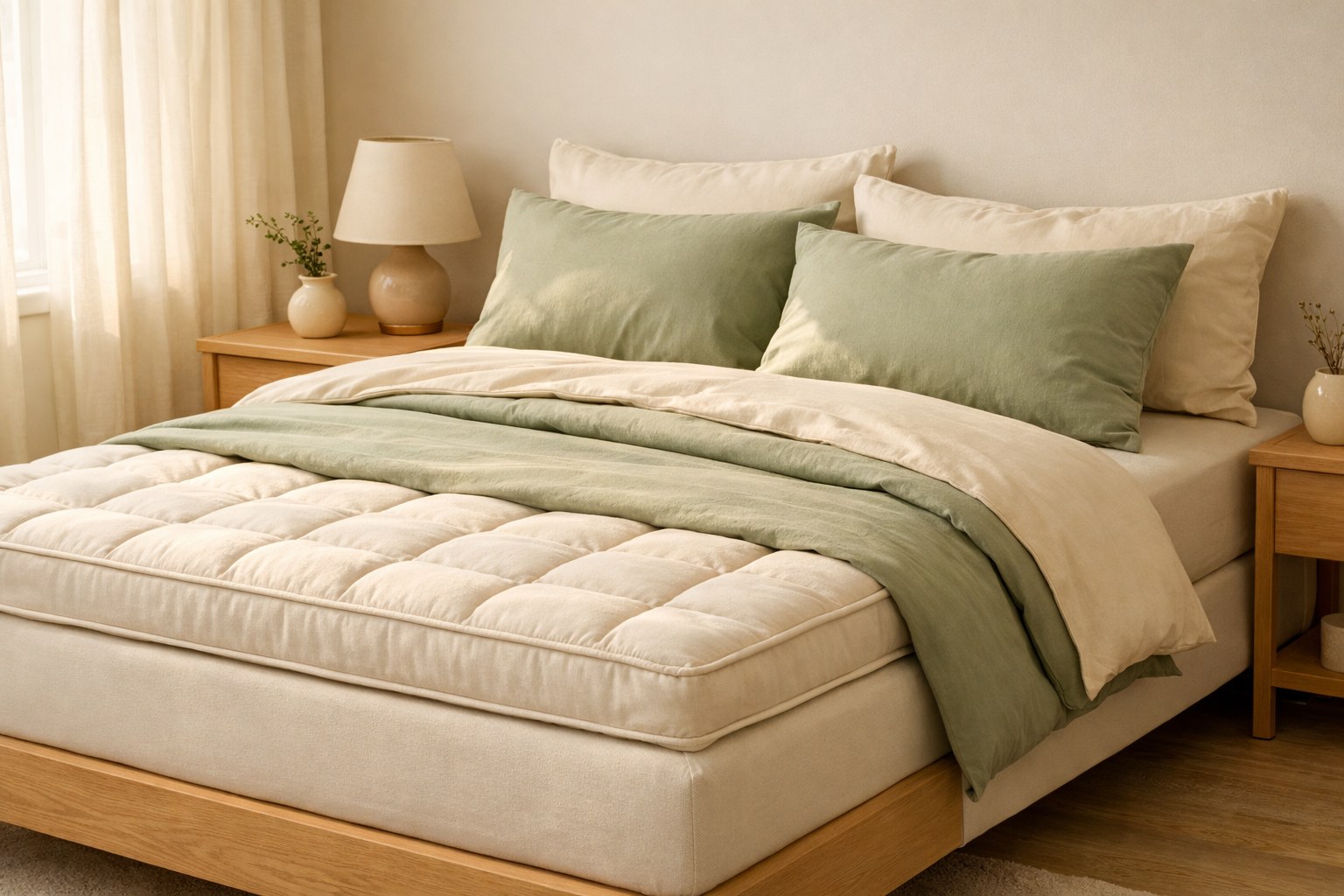
Featured Options Compared in This Guide
Full specs & notes ↓Choose a mattress layer around the change you want. For a firm mattress that still supports you properly, compare latex topper thickness and firmness. For a wool surface or a cotton-filled quilted layer, compare pad construction and laundry requirements.
A cotton cover does not tell you what provides the cushioning. Avocado’s latex topper has a cotton-blend cover around latex; Turmerry’s reversible pad combines a cotton-facing side with wool filling and fleece. Separating cover, filling, and core makes these purchases easier to compare. Avocado construction, Turmerry construction
Which layer fits your goal?
| Your priority | What to compare | Practical trade-off |
|---|---|---|
| Adjust a firm mattress’s surface feel | Latex toppers with specified thickness and firmness | More substantial cushioning can also mean more weight to handle |
| Add a wool surface | Exposed fleece versus wool filling beneath fabric | Surface texture and drying requirements vary by construction |
| Choose cotton filling | Pads explicitly identifying cotton inside | A cotton cover may instead surround wool or latex |
| Wash the entire added layer | Pads with whole-item washing instructions | Avocado’s latex topper permits spot cleaning only |
| Deal with structural sagging | The mattress and its underlying support | Another comfort layer cannot restore failed mattress support |
The construction and care distinctions above come from the manufacturers’ product and care descriptions. Avocado also explicitly separates surface comfort from structural support: its topper cannot repair a sagging or broken-down mattress. Investigate that problem before spending on another layer. Avocado topper, Turmerry pad, Avocado pad care
Latex: choose thickness and firmness together
Avocado offers its Eco Organic Latex Mattress Topper in 2-inch and 3-inch heights, with Medium Dunlop and Plush Pure Talalay options. Avocado describes Medium Dunlop as the firmer of these two options and Plush Talalay as softer. That comparison applies to this product range; it does not establish how every Dunlop topper compares with every Talalay topper. Product details
Avocado describes the 2-inch version as making a smaller change to surface comfort, and the 3-inch version as providing a more pronounced cushioning change. Use that manufacturer guidance to decide which height to consider, alongside firmness. It is not a guarantee of comfort or pain relief for an individual sleeper. Avocado’s thickness guidance
Weight makes the thickness decision more concrete. Avocado publishes these queen-size specifications:
| Latex option | 2-inch height | 3-inch height |
|---|---|---|
| Medium Dunlop | 32.5 lb | 46 lb |
| Plush Pure Talalay | 23 lb | 32 lb |
These are manufacturer specifications. If you will move the topper alone, consider the lifting involved in airing it, accessing the mattress, or packing a return. The thicker Medium option may be a poor practical fit if managing a large, heavy layer would be difficult. Dimensions and weights
Material preferences narrow the choice further:
- Organic latex priority: Avocado identifies the Medium Dunlop latex as GOLS-certified, with at least 95% certified organic material.
- Softer option within this range: Avocado describes the Plush Pure Talalay as FSC-certified and explicitly says that latex is not certified organic.
- Cover composition: The detailed specification lists 97% organic cotton and 3% elastane. The cover is sewn closed and cannot be removed for washing.
The topper is spot-clean only; Avocado prohibits machine washing and says to dry it fully after cleaning. If laundering the whole layer is essential, this construction does not meet that requirement. Materials and care
Avocado advertises a 100-night trial, with at least 30 days of use before requesting a return, subject to its return policy. Its product page gives conflicting manufacturer warranty durations: one year in the warranty section and ten years in the FAQ. Obtain the applicable written terms before counting warranty coverage toward purchase value. Trial and warranty information
A known latex allergy changes the material decision. MedlinePlus explains that proteins in natural latex can trigger allergic reactions and recommends avoiding latex. Discuss suitable alternatives with your clinician; an organic or emissions certification does not establish suitability for someone with that allergy. MedlinePlus
Wool: compare surface texture and drying requirements
Turmerry’s Reversible Fleece And Cotton/Wool Quilted Mattress Pad has wool fleece on one side, cotton percale on the other, and wool filling. The manufacturer lists an approximately 1-inch fleece pile. That pile measurement should not be treated as equivalent to the thickness or cushioning performance of a solid latex core. Turmerry product details
This construction suits a shopper who wants to choose between fleece and a cotton-facing surface. It does not meet a preference for cotton filling: the cotton is on the outside, while wool supplies the fill. Turmerry permits cold machine washing and either low-heat drying or air drying, making the specified care routine more flexible than a line-dry-only wool pad. Construction and care
Turmerry lists Woolmark certification for the wool filling and OEKO-TEX certification for the cotton cover. Its description does not identify this pad as GOTS-certified organic. Keep those component claims separate from a finished-product organic claim. Certification details
Wool’s moisture behavior also needs context. Woolmark explains that wool fibers absorb moisture vapor and allow it to evaporate, while their crimp holds insulating air. Its discussion focuses on clothing and exercise. Those properties explain why wool deserves consideration, but they do not predict a mattress pad’s sleeping temperature or establish that wool always feels cool. Avoid choosing between these layers on an assumed cooling advantage alone. Woolmark’s fiber explanation
For marketplace browsing, use this Amazon search for Turmerry wool mattress pads. Results may include different constructions and are not necessarily the reversible pad discussed here. This is an affiliate link; GreenChoice may earn a commission from qualifying purchases.
Cotton: distinguish filling from the cover
A cotton-filled pad is a different material choice from either a cotton-covered latex topper or a cotton-covered wool pad. Avocado’s care guide explicitly identifies cotton filling in its earlier standard and deep-pocket quilted designs. It separately describes a cotton/wool design. The entry for its current design gives cleaning directions without identifying the filling, so it cannot support assuming that design has the same cotton interior. Avocado care guide
For someone keeping an existing pad, the design dates are especially useful:
| Design identified in Avocado’s guide | Routine washing | Drying |
|---|---|---|
| Cotton-filled standard, January 17, 2019–March 11, 2024; deep pocket, April 30, 2021–March 11, 2024 | Cold machine wash or spot clean | Low tumble dry or line dry |
| Cotton/wool, July 11, 2024–March 25, 2025 | Cold machine wash or spot clean | Line dry; no tumble drying |
| Current design, identified from March 25, 2025 | Wash separately in cold water or spot clean | Low tumble dry or line dry |
Avocado warns that tumble drying its cotton/wool design can excessively shrink the wool inside. If you lack space to hang a mattress-sized pad until completely dry, that design’s care requirement is a meaningful drawback. These instructions apply to the specified pads, not the spot-clean-only latex topper. Design-specific care instructions
Match the certification to your material priority
GOTS helps with organic textile choices. Global Standards explains that correct product labeling identifies the certification body and certification number. A certified company can also sell products that are not certified, and certified yarn or fabric alone does not establish certification of the finished pad. For a cotton or wool pad, seek a claim that clearly applies to the finished item. Global Standards Q&A
GOLS concerns organic latex and its production chain. Control Union describes requirements addressing organic raw materials, processing, manufacturing, packaging, labeling, trade, and distribution, as well as health, welfare, and environmental considerations in manufacturing. This is the relevant distinction when comparing Avocado’s organic Dunlop latex with its non-organic Talalay option. Control Union, Avocado material specifications
GREENGUARD concerns chemical emissions. UL describes manufacturing review and routine testing, with lower VOC emission limits for GREENGUARD Gold. That scope does not establish organic content or guarantee an odorless product. UL also explains that some VOCs have noticeable odors while others do not, so smell is not a reliable substitute for emissions information. UL Solutions
Before ordering, add the proposed layer’s height to your mattress height and compare the total with your fitted sheets’ stated capacity. Decide who will handle the layer and where it will dry. For these purchases, the useful combination is the desired surface change, the actual filling or core, and a maintenance routine you can manage.
Sources
- Avocado: Eco Organic Latex Mattress Topper
- Turmerry: Reversible Fleece And Cotton/Wool Quilted Mattress Pad
- Avocado: Mattress pad care by design
- Global Standards: GOTS questions and answers
- Control Union: Global Organic Latex Standard
- UL Solutions: GREENGUARD Certification
- Woolmark: Wool breathability
- MedlinePlus: Latex allergy
Products Compared in This Guide
Amazon search for Turmerry wool mattress pads
Compare current manufacturer specifications, materials, and package options for Amazon search for Turmerry wool mattress pads.
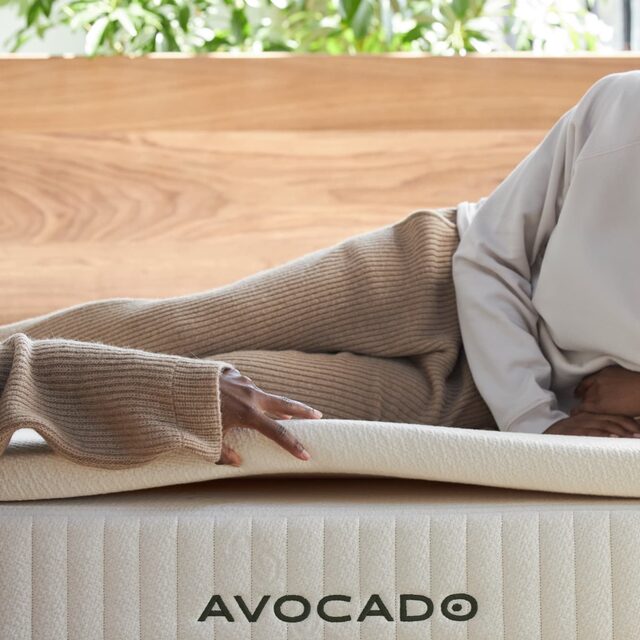
Avocado Green Organic Mattress Topper (Queen)
GOLS-certified natural latex topper, GOTS-certified organic cotton cover. 2-inch profile — enough pressure relief without changing mattress firmness significantly. No off-gassing after 48 hours of airing. Stays in place with the elastic skirt. Most durable topper in the test — no indentation at 6 months.
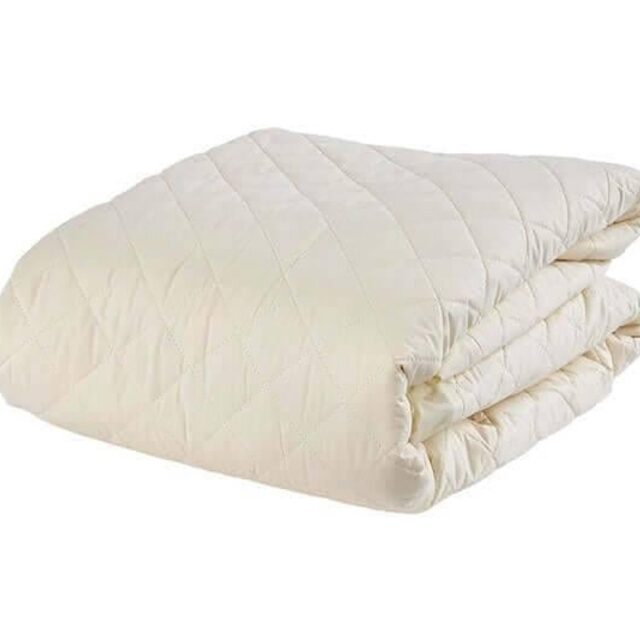
Turmerry Organic Wool Mattress Pad (Queen)
GOTS-certified organic wool fill, organic cotton cover. Temperature regulating — the wool fill wicks moisture and adapts to body temperature. Thinner profile than latex (adds comfort, doesn't substantially change support level). Best for hot sleepers who want temperature management without pressure relief.
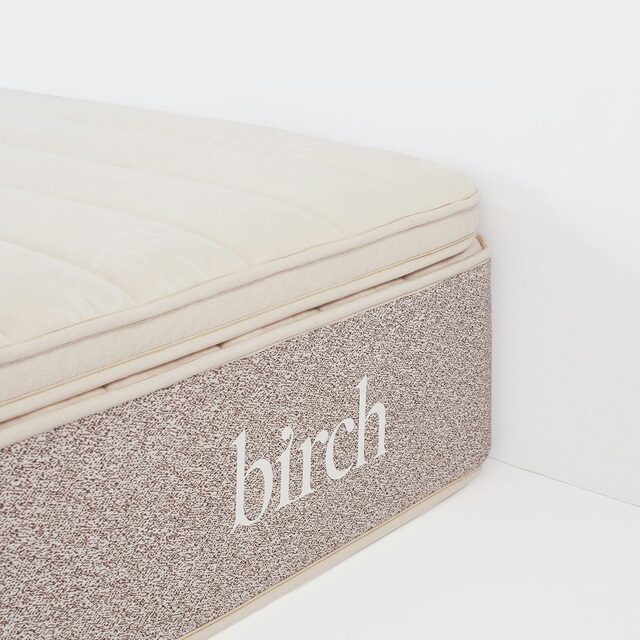
Birch Plush Organic Mattress Topper (Queen)
Natural latex core with GOTS-certified wool and organic cotton. Hybrid approach — latex provides pressure relief, wool layer adds temperature regulation. The best combination topper in the test for mixed-requirement households (one person runs hot, one needs pressure relief).
Frequently Asked Questions
Will a topper fix a sagging mattress?
Avocado says its latex topper can change surface comfort but cannot restore support to a mattress that has structurally deteriorated. Address the mattress and its support before buying another layer.
Are wool mattress pads machine washable?
Some are. Turmerry permits cold machine washing and low-heat or air drying for its reversible wool pad. Avocado's July 2024–March 2025 cotton/wool pad requires line drying. Follow the directions for the exact design.
Is every natural latex topper certified organic?
No. Avocado describes its Medium Dunlop latex as GOLS-certified organic, while its Plush Pure Talalay latex is described as FSC-certified and explicitly not certified organic.