TENCEL Clothing: How to Choose Lyocell and Modal Garments
Compare TENCEL lyocell and modal clothing, weigh blend choices, and distinguish fiber-production claims from garment fit and care.
Featured Options Compared in This Guide
Full specs & notes ↓Choosing TENCEL clothing involves two separate decisions: which fiber-production route you prefer, and which finished garment works for your wardrobe. The trademark helps with the first decision. It does not settle whether a particular tee has enough coverage, a shirt fits across your shoulders, or a dress suits your laundry routine.
Start with the kind of clothing you need, then compare the full composition and the actual garment—not just the TENCEL name.
What lyocell and modal tell you
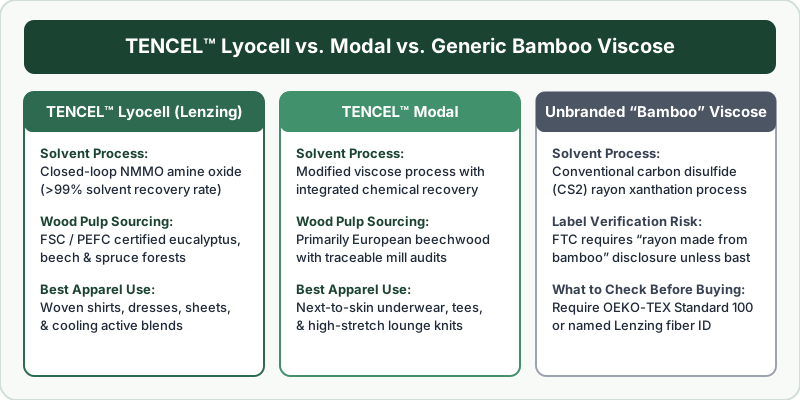
TENCEL is Lenzing’s textile brand, covering TENCEL Lyocell, TENCEL Modal and TENCEL Lyocell Filament. “TENCEL” alone therefore does not identify a single fiber type or fabric.
Lenzing describes two different manufacturing routes:
- Lyocell: cellulose is dissolved directly using N-methylmorpholine-N-oxide, or NMMO. Lenzing reports recovering and reusing approximately 99.8% of this solvent in its closed-loop process.
- Modal: production follows a modified viscose process, including a chemical reaction before dissolution. Lenzing says changes to the spinning solution and process settings give its modal fibers characteristically high wet strength.
These are manufacturer descriptions of fiber production and properties. The solvent-recovery percentage is not a garment-wide water-saving figure; modal’s wet strength is not a head-to-head durability rating against lyocell clothing. Source: Lenzing production technologies.
LENZING ECOVERO is branded viscose, not another name for TENCEL Lyocell or Modal. Keep those distinctions when comparing otherwise similar listings.
Choosing between a modal tee and a lyocell tee
For an everyday tee or layering top, make the comparison concrete:
- Compare coverage in the same intended use. Try each with the undergarments and jacket you expect to wear. Check the neckline, armholes and whether you are comfortable wearing it without another layer.
- Compare movement and shape. Sit down, reach forward and check the hem and sleeve fit. Decide whether you want close body contact or a looser silhouette rather than treating either fiber name as a fit recommendation.
- Compare the complete care instructions. Choose the washing and drying requirements you are willing to follow for a frequently worn top.
If a modal tee meets those needs and a lyocell alternative does not, there is no reason to choose the lyocell garment solely because of its fiber name. Modal’s documented wet-strength characteristic is useful background, but it is not permission to machine-wash any modal garment. Source: Lenzing production technologies.
If both garments meet your needs and solvent recovery is your deciding criterion, TENCEL Lyocell is the direct match to Lenzing’s disclosed NMMO-recovery process. That is a specific production-based preference, not proof that the finished tee is more durable or has a lower total environmental impact.
For an office layer, also decide whether you need a stand-alone top or something worn only under a jacket. That distinction can matter more to the purchase than choosing modal over lyocell. The sustainable workwear guide can help with that wardrobe decision.
For a flowing shirt or dress, look beyond the broad fiber name
Lenzing links its Micro technology to very fine TENCEL fibers and lightweight fabrics with flowing drape and a soft feel. It separately describes Lyocell Filament technology as producing smooth, uniform continuous yarn. These are narrower descriptions than a general TENCEL label; Micro technology should not be assumed for every modal or lyocell garment. Source: Lenzing production technologies.
If a clothing maker explicitly identifies one of these technologies, use it as a reason to examine the fabric—not as a substitute for doing so. For a dress, compare how the skirt hangs while standing and seated, whether you want a lining, and whether the neckline stays where you want it. For a button-front shirt, prioritize shoulder room, button gaping and the appearance of pockets against the body.
Neither “lyocell” nor “modal” alone should decide whether you buy the piece for its drape.
Blend choices: what you gain in specificity, and what remains unknown
Lenzing offers TENCEL fibers for a variety of blends. A blend composition identifies what is in the fabric; it does not by itself establish how a particular garment will perform. Source: Lenzing’s TENCEL brand overview.
| If the fabric is described as… | Useful purchasing distinction | What to assess in the garment |
|---|---|---|
| Lyocell or modal with no other fabric fibers listed | Fits a preference for a single-fiber fabric rather than a blend | Coverage, movement and acceptable care; do not select it simply for the highest TENCEL percentage |
| Cotton/lyocell denim | Identifies a different composition from cotton-only denim, without establishing a softness advantage | Compare feel directly, along with waist, rise, thigh room and comfort when seated |
| Lyocell or modal blended with elastane or spandex | Makes the additional fiber part of your material choice, rather than treating the garment as entirely TENCEL | If stretch matters, assess comfortable movement and ask for garment-specific stretch information |
| TENCEL blended with several other fibers | Requires considering the whole composition, not just the branded ingredient | Decide whether the fit and intended use justify the blend for you |
The practical trade-off is composition preference versus demonstrated usefulness. If avoiding a particular blend component is your priority, use the full percentages to rule it out. If fit is your priority, compare the garments directly rather than assuming that a higher TENCEL share is better. Do not extend a claim about TENCEL fiber production to every component of a blend.
Make care a purchase decision, not an experiment
Before buying a daily-use top, check both washing and drying instructions. For an occasional dress or tailored piece, decide whether you will realistically arrange the specified care. A washing instruction for one garment is not an instruction for everything carrying the same fiber name.
For secondhand clothing, ask for clear photographs of the composition and care labels. If the care label is missing, seek item-specific guidance from the maker or a professional cleaner before choosing a cleaning method. Do not substitute a generic TENCEL washing recipe for instructions about the actual piece.
How much weight should the environmental story carry?
Lenzing’s solvent-recovery disclosure is relevant to choosing a production route. It does not, on its own, rank a finished lyocell shirt against a modal, cotton or linen alternative.
Likewise, Lenzing’s compostability statement concerns tested lyocell and modal fibers. Do not treat it as disposal guidance for a complete garment or blend. Source: Lenzing’s TENCEL brand overview and footnotes.
Keep a usable shirt rather than replacing it just to change fiber labels. When you need another piece, choose the garment that fills the wardrobe gap, then use the material evidence to distinguish suitable options. For a broader comparison, see the sustainable fabric guide.
Sources
Products Compared in This Guide
TENCEL Clothing — Top-Spec Options
Compare current model specifications, material disclosures, and third-party certifications for tencel clothing for sustainable style.
Certified Tencel Clothing For Sustainable Style Alternatives
Check verified certification scope, replacement parts, and packaging details across ethical fashion listings.