Foldable Solar Chargers: USB Output, Weight and Trail Use
Compare BigBlue SolarPowa 28 and Goal Zero Nomad 10 and 50 by USB output, packed size and weight, with practical advice for charging on trips.
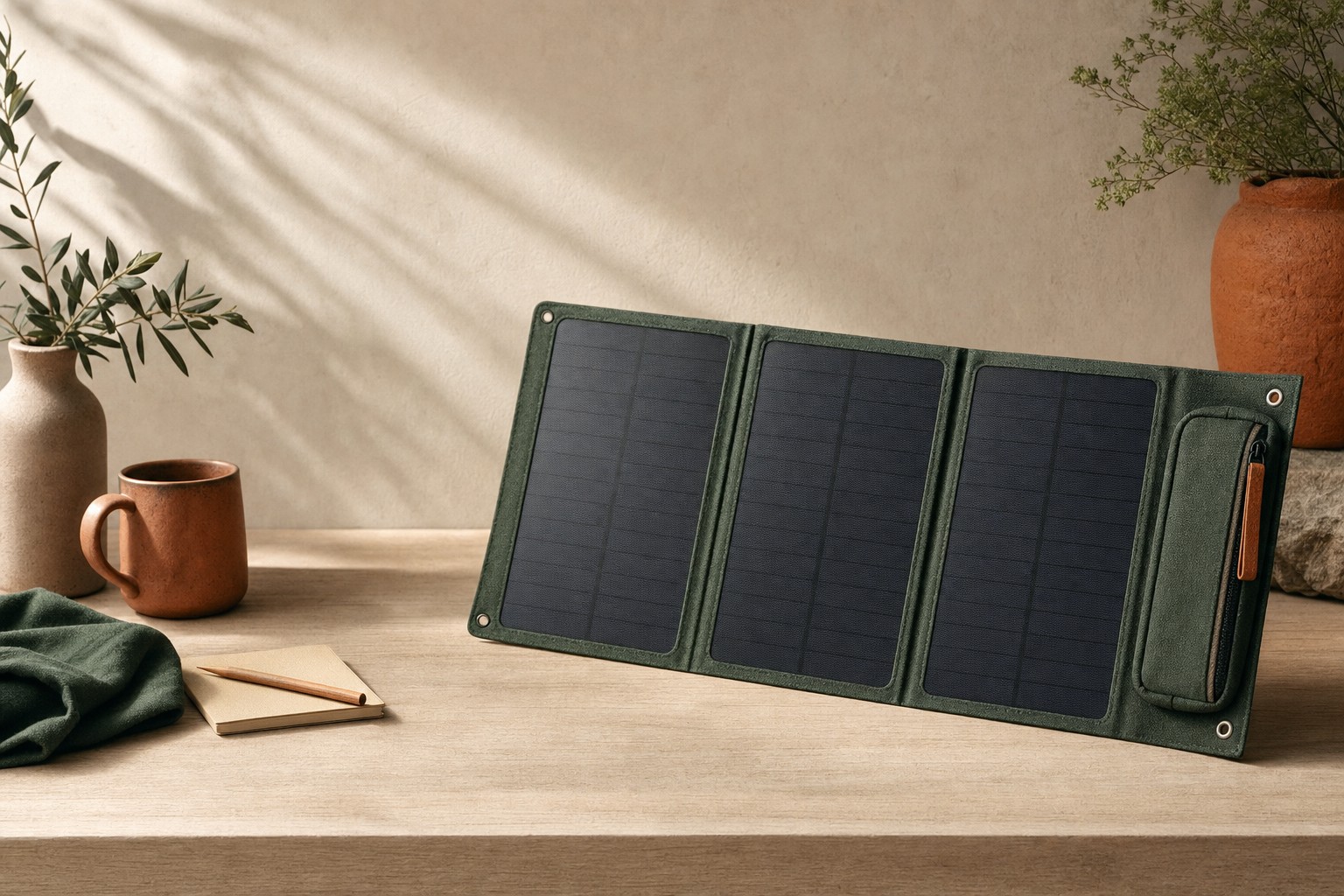
Featured Options Compared in This Guide
Full specs & notes ↓For phone charging, compare the USB output before the panel’s headline watts. Among these three options, the BigBlue SolarPowa 28 with ammeter offers the highest combined USB output. The Goal Zero Nomad 10 weighs less, while the Nomad 50’s main advantage is its separate solar connection for compatible batteries. Their manufacturer specifications show why a larger panel rating does not necessarily mean a higher USB charging limit.
For a short trip with few sunny stops, consider whether a charged power bank already covers your needs. A folding panel makes more sense when your itinerary gives you repeated opportunities to leave it positioned toward the sun.
Three options, three different compromises
These figures are manufacturer specifications, not measured trail performance. The use cases are recommendations based on the listed ports, weight and dimensions.
| Charger | Panel rating | USB output limit | Weight | Suggested use |
|---|---|---|---|---|
| BigBlue SolarPowa 28, with ammeter | 28W | One USB-A and one USB-C; 12W maximum per port, 20W shared total | 1.48lb / 0.67kg | USB devices or a compatible power bank during sunny stops |
| Goal Zero Nomad 10 | 10W | 5V USB, up to 1.5A: 7.5W maximum | 1.12lb / 0.51kg | Modest USB charging when carrying weight matters |
| Goal Zero Nomad 50 | 50W | USB-A, 5V up to 2.4A: 12W maximum | 6.85lb / 3.1kg | A compatible battery with an 8mm solar input at a vehicle-based camp |
Sources: BigBlue SolarPowa 28 specifications, Goal Zero Nomad 10 specifications, Goal Zero Nomad 50 specifications.
BigBlue: more shared USB output, with a variant caveat
The SolarPowa 28 discussed here is the with-ammeter version, UPC 768390608519. BigBlue also lists a version without an ammeter, so a listing titled simply “BigBlue 28W” is not enough to establish that it has these ports.
Both ports are specified at 5V and up to 2.4A each. The USB-C connector therefore should not be taken as evidence of higher-voltage laptop charging support. If your device requires a voltage above 5V, this specification does not meet that requirement. Two connected devices share a 20W ceiling; they cannot both receive the individual 12W maximum at once.
The folded size is 11.1 × 6.3 × 1.3 inches. Choose it over the Nomad 10 when the extra USB capacity or second port matters more than the additional carrying weight. These limits and dimensions come from BigBlue’s specification table.
BigBlue describes an automatic restart feature and an ammeter that helps with positioning. Its FAQ also acknowledges that sunlight fluctuations can stop devices from charging. After a cloud passes or you move the panel, check that the connected device has resumed charging rather than relying solely on the restart claim. Source: BigBlue features and troubleshooting.
Nomad 10: lower weight and a lower USB ceiling
The Nomad 10 folds to 9.5 × 7.2 × 1.25 inches and includes an adjustable kickstand. Its 7.5W USB limit is lower than either of the other panels’ individual USB port limits, but it is also the lightest option here.
This is a reasonable tradeoff for someone prioritizing pack weight and charging small USB devices during stops. It is less appealing if your main goal is the highest available USB output. Goal Zero explicitly says the Nomad 10 cannot be chained, so buying a second one does not create a supported combined panel setup. Source: Nomad 10 specifications and FAQ.
Nomad 50: choose it for the solar input on your battery
The Nomad 50 has a blue 8mm solar output specified at 14–21.5V, up to 3.3A and 50W maximum. Its USB-A output remains capped at 12W—the same single-port ceiling listed for the BigBlue.
At 6.85lb and a folded size of 17 × 11.25 × 2.5 inches, it is difficult to justify for a phone-only packing list. Its stronger case is a camp setup with a compatible power station or power bank that can use the separate solar output. Match the receiving battery’s connector and accepted input voltage to the panel’s specifications before choosing it. Source: Nomad 50 specifications.
For a broader comparison of camping panel formats, see the portable solar panel guide.
Direct charging or a power bank?
A solar panel produces electricity in sunlight; it does not store a charge. Goal Zero describes both direct device charging and pairing a panel with a power bank. A separate bank lets you collect energy during a sunny stop and use it later. Sources: Nomad 50 usage guidance and Nomad 10 charging options.
Choose direct charging when the device can remain connected during your stop. Choose a bank when your charging opportunity and your phone use happen at different times. Plan to charge the bank first and the phone later unless the bank’s own instructions explicitly support simultaneous charging and output.
For an arithmetic illustration, 15Wh ÷ 5W = 3 hours: adding 15Wh at a constant net rate of 5W would take three hours. Those are hypothetical inputs, not a charging-time estimate for any phone or panel here.
Real charging need not maintain that rate. Apple, for example, describes faster charging to 80% followed by a slower stage for its lithium-ion batteries; that statement is specific to Apple’s batteries. Separately, BigBlue warns that weather and shade can reduce or interrupt panel output. A panel’s rated watts alone cannot establish a phone’s full-charge time. Sources: Apple battery charging explanation and BigBlue output FAQ.
Let your route decide whether to carry one
Plan around places where you can stop and aim the panel toward the sun. Goal Zero advises angling the Nomad 50 toward sunlight and adjusting it as the sun moves; BigBlue likewise recommends direct sunlight and changing the panel’s orientation. A sunny camp or lunch stop gives you a practical opportunity to make those adjustments. Sources: Nomad 50 positioning advice and BigBlue troubleshooting.
Keep the receiving battery sheltered from rain, snow and dust. Goal Zero specifically instructs users to protect the devices being charged and warns that permanent outdoor exposure accelerates wear on the fabric enclosure of larger Nomads. Treat a folding panel as equipment to deploy and pack away, rather than a permanent outdoor installation. Source: Nomad 50 weather and care FAQ.
For a brief, shaded route, prioritize enough stored energy for the trip. For repeated sunny stops, the Nomad 10 favors lower carrying weight, the BigBlue favors greater shared USB capacity, and the Nomad 50 earns consideration when you can use its separate solar output.
Sources
Products Compared in This Guide
Foldable Solar Chargers — Top-Spec Options
Compare current model specifications, material disclosures, and third-party certifications for foldable solar chargers for outdoor adventures.
Certified Foldable Solar Chargers For Outdoor Adventures Alternatives
Check verified certification scope, replacement parts, and packaging details across solar & off-grid listings.