Solar Panel Kits Under $500: What the Budget Actually Includes
Compare solar charging options against a $500 total budget, including panel costs, battery storage and a Goal Zero panel-and-station example.
Featured Options Compared in This Guide
Full specs & notes ↓A $500 solar budget needs to cover the job you want done: daytime USB charging, stored energy or an installed battery system. A panel price alone cannot tell you whether the finished setup fits.
A concrete example shows the difference. Goal Zero displayed its Nomad 50 panel at $187.89 and recommended Yeti 300 power station at $349.95 on September 5, 2026. Together, they total $537.84 before tax, shipping or extras—already $37.84 over budget. The panel also showed sold out. These are dated page prices, not guaranteed checkout offers. Source: Goal Zero Nomad 50.
What fits within $500—and what still needs funding
| Purchase | Displayed price on September 5, 2026 | What the purchase provides | Budget implication |
|---|---|---|---|
| BigBlue SolarPowa 28 with ammeter | $69.99 | Solar charging through USB-A and USB-C | Storage requires a separate compatible power bank; no AC outlet |
| Goal Zero Nomad 50 | $187.89 | Folding panel with 8mm solar output and USB-A | Fits as an addition to compatible storage you already own |
| Nomad 50 plus Yeti 300, priced separately | $537.84 combined | Solar generation, battery storage and power-station outputs | Exceeds $500 before additional charges |
Sources: BigBlue with-ammeter model, Nomad 50 and recommended accessories, Yeti 300.
The useful comparison is between complete costs for the same need. A USB charger and a panel-plus-power-station setup provide different outputs and storage capabilities; the cheaper purchase does not replace every function of the larger system.
Starting from zero: the panel-and-battery calculation
The Nomad 50 and Yeti 300 pairing illustrates what buying storage adds. Goal Zero lists the Yeti 300 with a 297Wh battery, an AC inverter rated for 350W continuous output and 600W surge, and a 100W USB-C PD port. Its listed box contents include the station and an AC power cord. Those are manufacturer specifications, not promises of runtime for a particular appliance. Source: Yeti 300 specifications and contents.
For a firm $500 cap, the $537.84 component total rules out this pairing at those prices. Buying only the station would provide storage and outlets, but solar charging would remain a later purchase. Buying only the panel would leave you without stored energy for nighttime use.
Goal Zero also displayed a separate Yeti 300 + Nomad 50 bundle at $539.95, marked sold out. That bundle price is distinct from the sum of the individual prices; neither fits this budget. Source: Yeti 300 page, solar-generator bundle listing.
Before choosing a cheaper alternative, write down the outputs your devices need and how much energy you need between charging opportunities. For AC loads, compare both running demand and startup demand with the station’s limits. A larger battery capacity does not by itself establish that an inverter can start an appliance.
Already own a compatible station? Consider the Nomad 50 alone
Goal Zero specifies a 50W maximum solar output through the blue 8mm connector, with a published range of 14–21.5V and up to 3.3A. Its separate USB-A output is limited to 12W. The panel weighs 6.85lb and folds to 17 × 11.25 × 2.5 inches. Source: Nomad 50 specifications.
That makes the purchase most straightforward when you already own a manufacturer-supported receiving device. For another brand’s station, establish electrical and connector compatibility before spending part of the budget on an adapter.
Recharge time matters as much as the panel price. Goal Zero’s Nomad page estimates 7–14 hours for the Yeti 300, with solar charging dependent on conditions and placement. Treat that as a planning range from the manufacturer, not a guaranteed single-day refill. The same page says the panel stores no energy and that its fabric enclosure wears faster when left outside permanently. It is therefore a different purchase from a panel intended for permanent mounting. Source: Nomad 50 charging guidance and FAQ.
Small USB loads: keep the charger and storage budget separate
For compatible phones, GPS devices or a power bank, the $69.99 BigBlue SolarPowa 28 with ammeter is a lower-cost starting point. Its published specifications distinguish the 28W panel rating from the USB output: 20W maximum shared between two ports, with 5V/2.4A—12W maximum—on either individual port. Connecting two devices does not give each one 12W simultaneously. Source: BigBlue specifications.
The USB-C connector does not establish laptop compatibility: this model’s published output is 5V. Choose it only when the receiving device accepts that supply. BigBlue also explains that real output is below the panel’s nominal rating and that insufficient sunlight can slow or prevent charging. Plan around sunny charging opportunities, with separate storage if you need energy later. Source: BigBlue output specifications and charging FAQ.
At the displayed charger price, $430.01 remains within a $500 cap before taxes and shipping. That is a spending ceiling for storage and other needs, not the price of a completed package. Avoid spending the remainder on a larger USB setup if your actual requirement is an AC appliance.
For an RV or shed, price the installed system first
For a component-based installation, build a budget around the required functions:
- Panels and mounting appropriate to the location.
- A charge controller matched to the array and battery.
- Battery storage sized for the intended use.
- An inverter if AC output is required.
- Cables, connections, protection and any installation labor.
Count existing equipment only after establishing that it can work with the proposed additions. Get the component and installation costs together before committing to the panels; an attractive panel price does not establish an affordable finished system.
Cable length and current affect cable selection. Fuse selection also involves DC voltage and fault-interrupt capacity, beyond its amperage rating. These requirements can change the accessory budget, particularly with lithium batteries. Source: Victron DC wiring guidance.
Decide array wiring from the exact panel and controller documentation. Likewise, an MPPT upgrade payback estimate requires supported assumptions about its added cost, additional usable energy and that energy’s value. A controller label alone establishes neither savings nor compatibility.
For a fixed $500 limit, start with the smallest setup that meets your actual output and storage needs. Existing compatible storage can make a panel purchase practical; starting without storage requires a complete-system price. For a larger installed project, use the off-grid solar kit planning guide to organize the purchase.
Sources
- Goal Zero Nomad 50: dated price, recommended pairings, outputs, dimensions and charging guidance
- Goal Zero Yeti 300: dated station and bundle prices, battery capacity, outputs and box contents
- BigBlue SolarPowa 28 with ammeter: dated price, USB specifications and sunlight limitations
- Victron Wiring Unlimited: cable selection and DC fuse requirements
Products Compared in This Guide
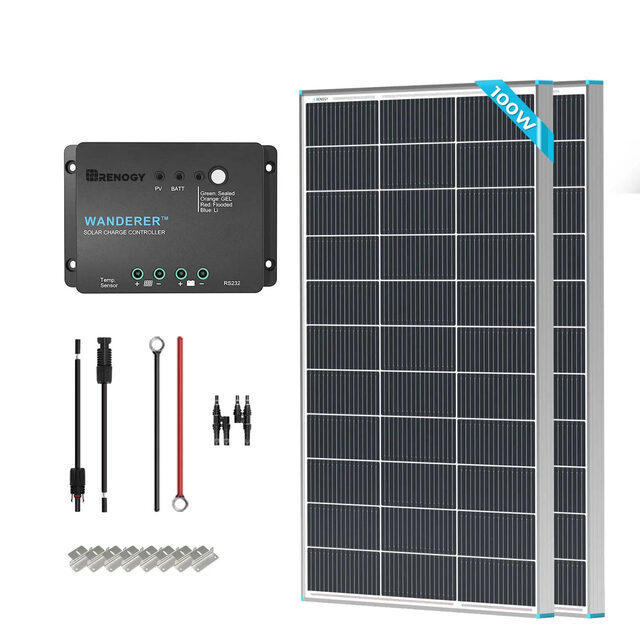
Renogy 200W 12V Starter Kit
The best starter kit for a first permanent installation. Includes 200W monocrystalline panel, 30A PWM charge controller, 20A inline fuse, mounting Z-brackets, and all cables. Everything you need except a battery. Pair with a 100Ah AGM or LiFePO4 battery and you have a complete 12V system.
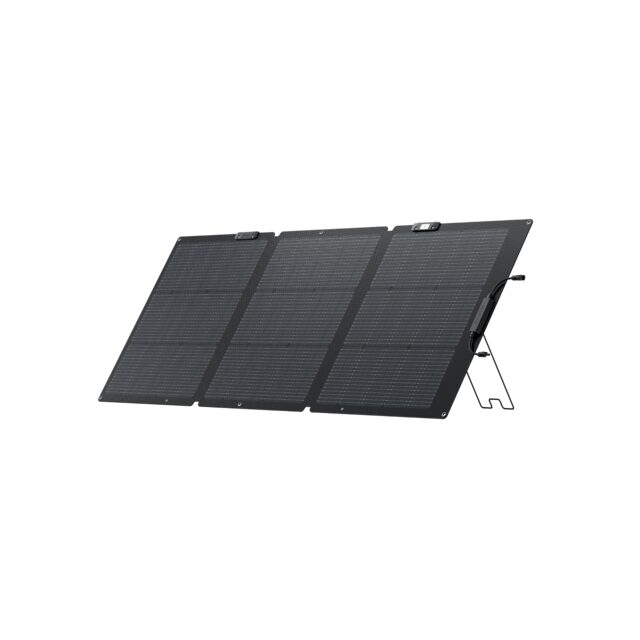
EcoFlow 160W Portable Solar Panel
The best budget portable panel for EcoFlow station owners. 160W, 21.4% efficiency, XT60 connector for native EcoFlow integration. Folds to 24×21 inches. Good value if you're in the EcoFlow ecosystem; lower output-to-dollar ratio than a rigid Renogy panel.
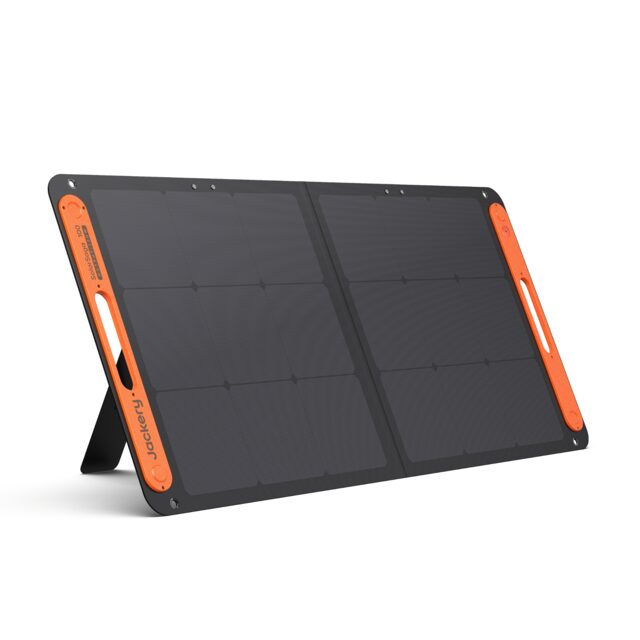
Jackery SolarSaga 100W
The entry-level Jackery panel. 100W, lightweight (4 lbs), USB-A port for direct device charging. Pairs cleanly with Jackery stations. For a first camping panel, it's solid. The step to 200W makes more sense if you'll use it often.
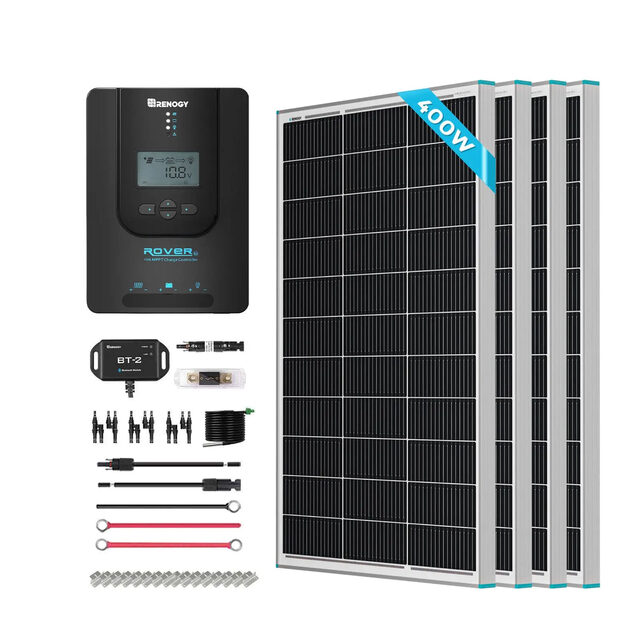
Renogy 400W 12V Premium Starter Kit
The full kit for a serious RV weekend build—two 200W panels, 40A MPPT Rover controller, fuse kit, branch connectors, and all cables. Upgrade from the 200W kit if you're running a 12V cooler, laptop, and fan simultaneously. Best value complete kit under $500.
Frequently Asked Questions
Does a solar panel purchase under $500 include a battery?
Not necessarily. The Goal Zero Nomad 50 contains no storage. At the September 5, 2026 displayed prices, adding the recommended Yeti 300 brings the two-item total to $537.84 before tax, shipping or extras.
Can the BigBlue SolarPowa 28 power AC appliances?
The with-ammeter model provides USB-A and USB-C outputs, not an AC outlet. BigBlue specifies up to 12W per port and 20W shared, with actual output dependent on sunlight.
Should I budget for an MPPT controller upgrade?
Price the required system components first. An upgrade payback estimate needs supported purchase-cost and additional-energy assumptions; compatibility requires the exact panel, controller and battery documentation.