Portable Power Stations for RVs: Size the Battery and Check the Connection
Plan RV battery capacity, appliance loads and recharging, with an EcoFlow specification example and practical limits for shore-power connections.
Featured Options Compared in This Guide
Full specs & notes ↓For dry camping, choose the connection method first, then size the battery around energy use between dependable recharge opportunities. A station supplying a cooler and electronics has a different job from one supplying the RV’s fixed circuits or overnight air conditioning.
Decide what the station will power
For direct appliance supply, connect compatible appliances to the station’s own outlets. List the cooler, laptop, lights and other devices you will actually use, including their required voltage, connector and power demand.
For RV electrical integration, have a qualified RV electrical professional confirm the station’s suitability before buying adapters. Ask them to assess the shore-power connection, source switching, converter operation, grounding and protective devices. A plug that fits does not establish electrical compatibility or increase the station’s output.
Victron’s electrical-safety guide explains that mobile installations can have different grounding arrangements when connected to shore power and when operating independently. It also explains why neutral-to-ground arrangements affect ground-fault protection. These are installation design questions; do not improvise bonding changes from a general buying guide.
A station’s accessory DC socket also has a specific limit. EcoFlow lists the DELTA 2 Max car output at 12.6V, 10A, 126W maximum. Treat it as a rated appliance outlet, not a substitute for the RV’s battery terminals. Check both the voltage compatibility and combined demand of anything connected to it.
Budget for the stay, not just one appliance
Watts describe power at a moment; watt-hours describe energy over time. For a steady load, watts × hours = watt-hours, as explained by the U.S. Energy Information Administration.
The following is a hypothetical planning example, not measured appliance consumption:
| Load | Assumption | Energy per day |
|---|---|---|
| Compressor cooler | Assumed daily energy total | 500Wh |
| Laptop | 50W for four hours | 200Wh |
| LED lights | 10W for five hours | 50Wh |
| Fan | 15W for eight hours | 120Wh |
| Phones | Assumed daily total | 40Wh |
| Total | 910Wh |
Two days require 1,820Wh at the devices. Compared with a nominal 2,048Wh battery, the arithmetic leaves only 228Wh before accounting for conversion losses, station consumption or reserve. That is too little information to promise a two-day runtime. Reduce demand, arrange dependable recharging, or consider additional storage.
Replace the assumptions with readings from your appliances over the intended operating period. Virginia Cooperative Extension explains that appliance settings affect power consumption and refrigerators cycle rather than continuously drawing their maximum wattage. A daily energy reading is therefore more useful for a cooler than one instantaneous power reading. Record its thermostat setting, ambient conditions and placement alongside that reading.
If supplying fixed RV circuits, add every load that will remain active, including the converter, furnace blower or electric water heating where applicable. A budget for portable appliances does not describe the whole RV.
What the DELTA 2 Max ratings mean for an RV
The 2,048Wh DELTA 2 Max provides a concrete sizing example. The figures below are EcoFlow’s published specifications, not independently measured usable capacity, runtime or performance.
| EcoFlow specification | RV buying implication |
|---|---|
| 2,048Wh nominal capacity | Compare with total energy needed between recharges; do not equate nominal capacity with energy delivered to appliances. |
| 2,400W total AC output across six outlets | Add simultaneous appliance loads. Six outlets share the total output rating. |
| 4,800W surge rating | Check the actual appliance’s starting requirements separately; this figure alone does not establish compatibility. |
| 50lb listed weight | Plan how you will lift it into the RV and move it to the intended operating location. |
| 19.6 × 9.5 × 12in listed dimensions | Check storage and operating space, including the clearance required by the manufacturer’s instructions. |
| Up to two DELTA 2 Max Smart Extra Batteries; 6,144Wh advertised total capacity | Expansion addresses stored energy. EcoFlow’s listed 4,096Wh bundle still specifies 2,400W output. |
The practical comparison is more storage versus more output. If your appliances run successfully but exhaust the battery before the next recharge, capacity or charging is the constraint. If their simultaneous demand exceeds the output rating, extra watt-hours alone do not solve that problem. Running discretionary appliances at different times may avoid the need for higher simultaneous output.
For short stays with only electronics and lighting, calculate that smaller budget before accepting a 50lb station. For longer stays, compare the added carrying and storage burden of extra batteries with the recharge opportunities your route actually provides.
Air conditioning needs two separate checks
First, establish starting and running compatibility. Virginia Cooperative Extension notes that motors can draw more current during startup than during normal operation; its general guidance does not establish the starting demand of your particular RV air conditioner. Use the unit’s documentation and an appropriate assessment of its actual demand. Source
Second, calculate energy for the entire cooling period. An assumed steady 800W for eight hours requires 6,400Wh, before station losses. If 800W is already the average across operating cycles, the answer remains 6,400Wh. Applying a cycling reduction again would undercount consumption. EIA energy calculation
Record thermostat setting, indoor and outdoor temperatures, window shading and the RV configuration when measuring a cooling session. Dometic explains that insulation and window area influence cooling requirements, and that compressor operation depends on room temperature relative to the setting. One session should not become an unconditional overnight-runtime promise.
Micro-Air describes its EasyStart Breeze as reducing startup current. That manufacturer claim concerns starting demand; it does not provide additional stored energy or establish compatibility with a particular station and air conditioner. Assess any proposed installation separately from the overnight energy budget.
Match recharging to the campsite and route
For the DELTA 2 Max, EcoFlow specifies 11–60V, 15A and 500W per solar input port, with 1,000W across both ports. Match each panel group’s electrical specifications and proposed wiring to those requirements. A combined array wattage below 1,000W does not, by itself, establish compatibility. Nor does the dual-port ceiling mean one port accepts 1,000W. EcoFlow specifications
Compare portable and roof-mounted panels around your actual parking plan: whether you have a suitable place to deploy panels, how often you move, and whether you want repeated setup or a fixed installation. Account for the cable route as well as panel placement. Victron’s DC wiring guide explains how current, cable length and conductor size affect voltage drop, and why circuit protection requires more than selecting a fuse’s current rating.
For driving recharge, distinguish the station’s charging input from its accessory output. EcoFlow lists support for 12V/24V car charging at 8A; the 126W accessory-output rating is not a charging specification. Use compatible charging equipment within the vehicle circuit’s limits. EcoFlow specifications
As a separate hypothetical example, four hours at a steady 100W charging input supplies 400Wh before charging losses—less than half the 910Wh daily appliance budget above. Plan around energy actually replenished, not merely the presence of a charging cable.
Before departure, run the intended appliance combination through a representative day and recharge it using the planned equipment. Use the results to decide whether to carry more storage, reduce loads or change the recharge plan. The camping solar panel guide covers the panel side of that decision.
Sources
- EcoFlow: DELTA 2 Max specifications
- U.S. Energy Information Administration: Measuring electricity
- Virginia Cooperative Extension: Estimating Appliance and Home Electronic Energy Use
- Victron Wiring Unlimited: Ground, earth and electrical safety
- Victron Wiring Unlimited: DC wiring
- Micro-Air: EasyStart Breeze
- Dometic: Keeping Cool On The Road
Products Compared in This Guide
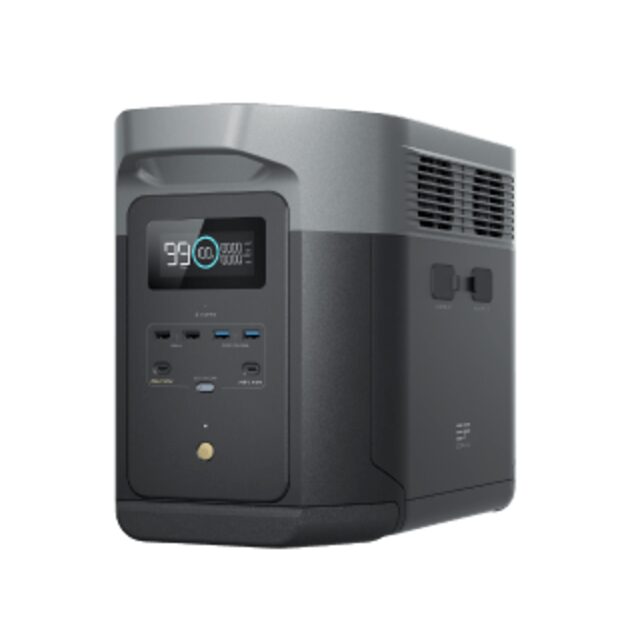
EcoFlow Delta 2 Max
The best portable power station for RV weekend use. 2,048Wh LiFePO4, 2,400W output, charges to 80% in 80 minutes. At 31 lbs with a carry handle, it moves between storage and setup without assistance. Handles a 12V compressor cooler, CPAP, and all device charging for a 2-night dry camp without solar.
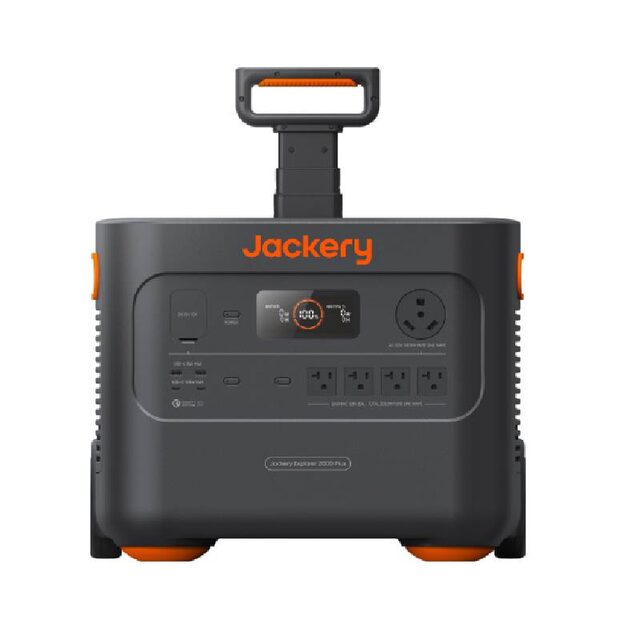
Jackery Explorer 2000 Plus
Best for full-timers who need to expand capacity over time. 2,042Wh LiFePO4 expandable to 12kWh via Jackery battery packs. 3,000W output handles a small window AC unit. The only station that grows with your power needs without replacing the base unit.

EcoFlow DELTA Pro
The right choice when you need whole-vehicle power independence. 3,600Wh expandable to 25kWh, 3,600W output, solar input up to 1,600W. Handles a small window AC unit on a sunny day with 800W of panels. Overkill for weekend trips; exactly right for full-time RV living.
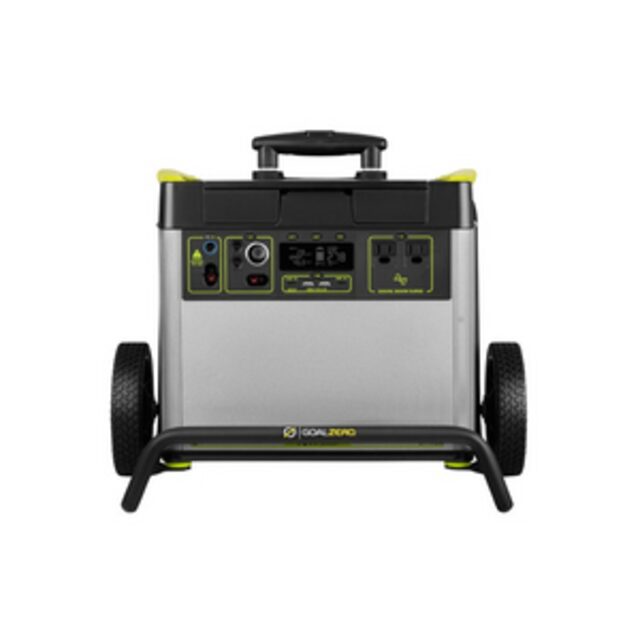
Goal Zero Yeti 3000X
Goal Zero's flagship for serious RV and van use. 3,032Wh, 2,000W output, Goal Zero Tank expansion batteries, and the best app for monitoring real-time RV power draw. The premium option for those who value app quality and long-term brand support over lowest cost per watt-hour.
Frequently Asked Questions
Can a portable power station replace an RV house battery?
Do not assume so. Supplying compatible appliances directly is a different task from replacing the house battery. Have a qualified RV electrical professional assess the converter, distribution, grounding and protection before integrating a station.
Can any 1,000W solar array charge the DELTA 2 Max?
Combined wattage alone does not establish compatibility. EcoFlow specifies 11–60V, 15A and 500W per solar input port, with 1,000W across both ports. Match each panel group and its connections to the manufacturer's requirements.
Is a 2kWh battery enough for air conditioning overnight?
Not for an assumed steady 800W load over eight hours: that requires 6,400Wh before station losses. The result is also 6,400Wh if 800W is the average across all operating cycles; do not reduce it again for cycling. Starting demand needs a separate compatibility check.