Outdoor Compost Bins: Stationary Bins, Tumblers and What to Buy
Compare stationary outdoor compost bins and dual-chamber tumblers by capacity, mixing effort, unloading access and space for finishing compost.
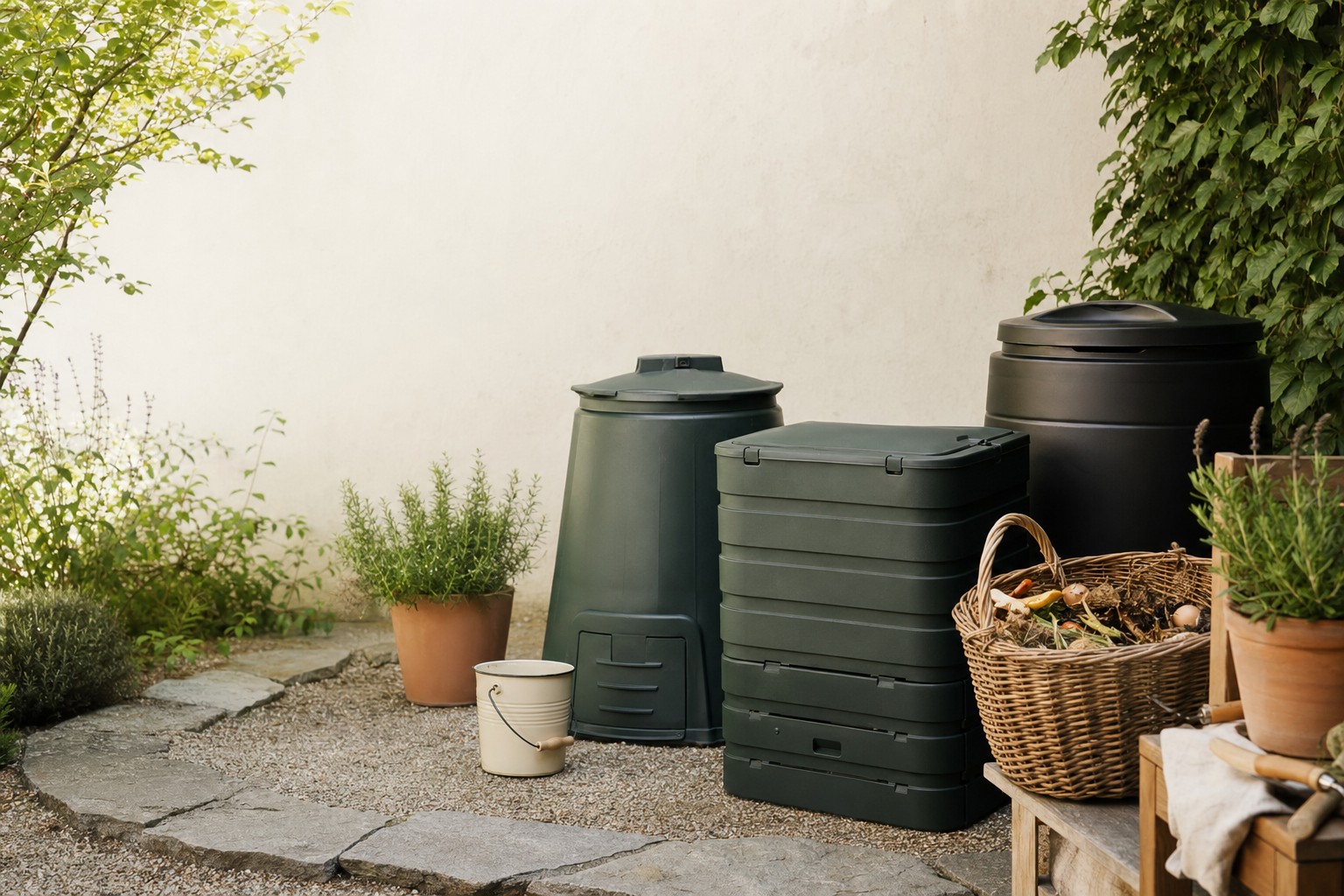
Featured Options Compared in This Guide
Full specs & notes ↓Choose a roomy stationary bin for regular garden waste, and consider a dual-chamber tumbler for smaller batches when rotating and unloading the drum are manageable. The deciding factors are the material you generate, the work you can comfortably do and where each batch will finish.
University of Maryland Extension describes tumblers as useful for small spaces and aeration, but warns that filling and harvesting can be awkward and their volume is usually insufficient for hot composting. A stationary bin can support either active or slower composting, depending on its size and management. Maryland Extension composting guide.
Which format fits your yard?
| Format | A practical fit when… | Check before choosing |
|---|---|---|
| Stationary enclosed bin | You have food scraps, garden trimmings and room to mix them | Can a fork reach the contents? Can you remove finished material through the opening? How are the lid and base protected against rodents? |
| Dual-chamber tumbler | You want to separate incoming material from a finishing batch | Compare each chamber’s capacity, rotation clearance and unloading access—not just total capacity |
| Open bay or wire enclosure | Leaves and plant debris make up most of your material | Allow room for turning and harvesting; an open enclosure offers less control over animal access |
| Multiple stationary bins | You have enough material and space to keep batches at different stages | Account for the working area between bins as well as their footprints |
EPA describes wood, wire and block bins, enclosed barrels and tumblers as composting options. It also explains how a three-bin arrangement separates fresh material from compost at later stages. These are layout choices, not guarantees of processing speed. EPA composting approaches.
A stationary bin does not have to mean frequent heavy turning. Maryland Extension’s passive method accepts material as it arrives and uses occasional turning, but can take a year or more. Choose it if a slower harvest is acceptable; choose an actively managed system only if you can sustain the mixing and moisture checks.
Capacity includes leaves, working space and a finishing batch
Before buying, observe a week of suitable kitchen scraps and consider seasonal peaks in garden waste. Then allow for browns: EPA recommends adding at least two to three volumes of dry leaves or other carbon-rich material for each volume of greens. A container sized only around food scraps misses a substantial part of the mixture. EPA home-composting guidance.
For a dual-chamber tumbler, plan around the chamber receiving fresh material while the other finishes. Do not treat the combined capacity as continuously available for new scraps. If the filling side becomes full first, you need another managed composting area or a collection or drop-off option.
For a stationary bin, leave enough access to turn material and remove older compost. A small bottom hatch may help with harvesting, but assess whether its position and opening suit your tools and reach. For a tumbler, measure the full rotation envelope and the space for a tub or tarp beneath the door.
Reserve a separate place for dry leaves. EPA recommends an accessible, well-drained composting location with water nearby and some separation from a fence; either sun or shade can work. Convenience matters because adding scraps, balancing moisture and harvesting all require repeated access. EPA siting and storage guidance.
FCMP Outdoor IM4000: consider the assembly and access
The IM4000 provides a concrete example of a divided tumbler. FCMP’s assembly instructions show a stand, an axle, a center divider, body panels and a sliding door. Assembly involves multiple screws and nuts, and the manufacturer emphasizes aligning the end caps correctly before attaching the panels; incorrect alignment can require removing the panels and starting again. FCMP IM4000 assembly instructions.
That assembly commitment belongs in the buying decision alongside chamber capacity and unloading clearance. If possible, try rotating a display model and reaching the door. An empty drum demonstration will not establish how comfortably you can handle a loaded one.
You can search Amazon for the FCMP Outdoor IM4000 to compare listings. This is an affiliate search link, not a specific offer; purchases through it may earn us a commission.
Match the enclosure to the contents
For vegetable scraps and other food inputs, prioritize a secure lid and protection at the base. EPA recommends that gaps in a bin be no larger than a quarter inch as part of rodent prevention, along with burying scraps and maintaining enough browns. A lid alone does not address openings beneath the bin. EPA rodent-prevention guidance.
For a basic backyard system, use fruit and vegetable scraps, coffee grounds, dry leaves and suitable untreated plant material. Leave out meat, fish, bones, dairy, fats, pet waste, treated wood, diseased plants and weeds with seeds. Remove produce stickers and packaging before adding scraps. EPA’s home guide provides the full inclusion and exclusion lists.
Compostable bags need a separate decision. BPI now distinguishes Commercial Only certification from Commercial & Home certification; the latter includes breakdown in properly managed home bins. Commercial certification alone does not establish backyard suitability. EPA’s general backyard guidance excludes compostable bags and foodservice ware, so loose scraps are the straightforward default. For collection services, follow the receiving program’s accepted-material rules. BPI certification scopes; EPA backyard inputs.
What makes either bin work
Chop tough scraps and break down plant material before adding it. Keep the mixture damp enough to resemble a squeezed-out sponge, and mix to admit air. Maryland Extension specifically warns that tumblers can become waterlogged and oxygen-poor when kitchen scraps outweigh the available browns. Rotation does not replace a balanced mixture. Maryland Extension maintenance guidance.
| What you notice | Practical adjustment |
|---|---|
| Rotten odor or a soggy mixture | Add dry browns and mix to improve aeration |
| Dry material with little activity | Add water gradually and mix it through |
| A cool batch | Check moisture and ingredients; small or passive systems can decompose without becoming hot |
| Fresh scraps mixed into material you want to harvest | Stop feeding that batch or separate the older material for curing |
These adjustments follow EPA’s maintenance guidance and Maryland Extension’s distinction between cool and hot composting. A cool bin is not evidence that weeds, pathogens or unsuitable inputs have been treated adequately.
Make room to finish before you harvest
EPA advises at least four weeks of curing once a pile no longer reheats after mixing and food scraps are no longer visible. Its estimate for a well-maintained backyard pile is about three to five months overall; that is guidance for a managed pile, not a promised deadline for a particular tumbler. Finished compost should have a dark, crumbly texture and an earthy smell. Return undecomposed woody pieces to the active batch and discard contaminants. EPA harvesting guidance.
Use the result as a soil amendment. For a new raised bed, University of Minnesota Extension recommends a mixture of topsoil and plant-based compost, and warns that too much compost can create moisture-management problems. Existing beds should receive additions according to soil needs. See our raised-bed buying guide for planning the planting area. Minnesota Extension raised-bed guidance.
If you cannot accommodate browns, mixing access and a finishing batch outdoors, consider a collection program or explore apartment composting options before committing to an outdoor bin.
Sources
Products Compared in This Guide
The FCMP Outdoor IM4000
Compare current manufacturer specifications, materials, and package options for The FCMP Outdoor IM4000.
Frequently Asked Questions
Is a countertop compost bucket an outdoor composter?
No. A kitchen caddy holds scraps until you transfer them to a composting system or collection service. It does not replace a managed outdoor bin.
Does a tumbler finish compost in two weeks?
Do not plan around a two-week harvest. Decomposition depends on ingredients, moisture, air and management, and compost needs time to finish. EPA gives about three to five months for a well-maintained backyard pile, including curing.