Rainwater Harvesting Kits: Choose a Barrel, Diverter and Overflow
Compare complete barrels, diverter kits and gravity drip add-ons. Plan storage, downspout connections, overflow and practical garden watering.
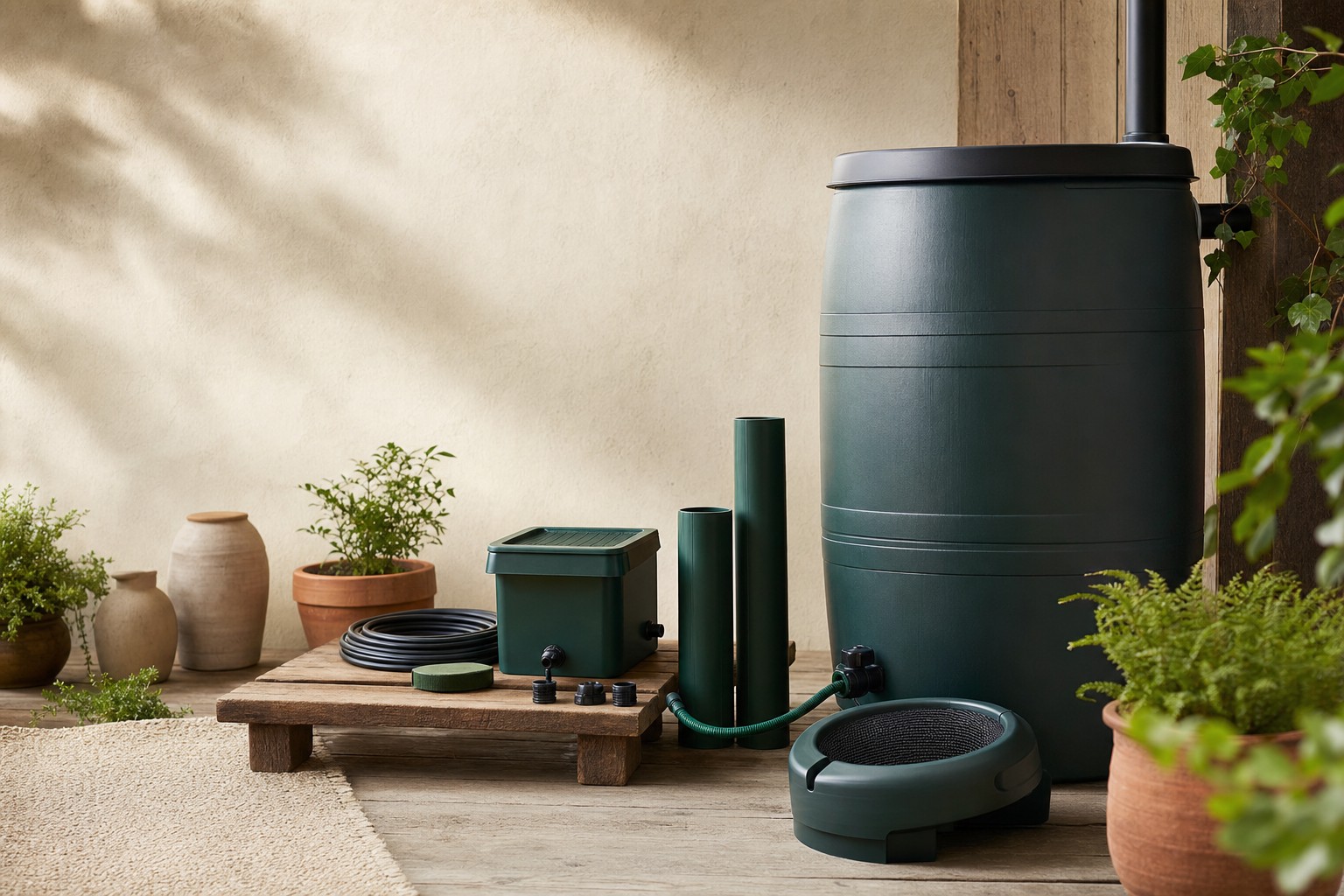
Featured Options Compared in This Guide
Full specs & notes ↓For a small ornamental garden, start with a storage barrel, a connection that fits your downspout, an accessible spigot and a planned overflow route. Buy these as a complete package if you need a vessel; consider a parts kit if you already have a suitable barrel. Decide how you will get water to the plants before paying for irrigation accessories.
A rain barrel has three essential water paths: entry, withdrawal and overflow. Virginia Cooperative Extension recommends locating it near the plants you intend to water and using the stored supply between storms. Those choices make capacity useful rather than simply adding a larger container beside the house. Virginia Cooperative Extension
Which kind of kit solves your problem?
| Purchase type | Choose it when | What to establish before buying |
|---|---|---|
| Complete storage barrel package | You need both a container and fittings | Whether the package includes the inlet connection, screen, spigot and overflow hardware |
| Downspout diverter and parts kit | You have a suitable container and can install the fittings | Downspout compatibility, barrel connection requirements and how excess water bypasses or exits the barrel |
| Linked barrels or a larger tank | You can use more stored water between storms | Space, support, connecting hardware and the final overflow destination |
| Gravity drip add-on | You already have elevated storage and want to distribute water to nearby plants | Outlet compatibility, filtration and emitter performance at the available pressure |
| Dry-well drainage kit | Your goal is to infiltrate runoff into the ground | Site drainage requirements; it serves a different purpose from garden-water storage |
Virginia Cooperative Extension describes both direct downspout entry and diverter connections, along with overflow into another barrel or a suitable landscape area. For a reused vessel, it recommends a clean, heavy-duty, commercial food-grade barrel. Include the container, support and missing fittings when comparing the total purchase, rather than comparing box prices alone. Rain-barrel components and installation
NDS Flo-Well belongs in the drainage category. Its manufacturer describes a system that collects, temporarily holds and infiltrates stormwater. A listed storage volume does not make it equivalent to a sealed barrel that retains water for later irrigation. Choose it for a drainage project, not as a substitute for a watering supply. NDS Flo-Well
Compare the inlet, spigot and overflow—not just capacity
Direct entry versus a diverter. A direct-entry arrangement sends the downspout into the barrel inlet. A diverter carries water through a connecting hose, which can allow some flexibility in barrel placement. Measure your downspout’s shape and dimensions, then match the connection requirements of the kit. A generic description such as “rain-barrel kit” does not establish that fit.
Spigot clearance versus drainage. A higher spigot leaves room for a watering can but also leaves water below the outlet. A lower spigot can make more water accessible if the barrel sits on a suitable platform. A separate bottom cleanout helps with draining and maintenance. Check clearance using the watering can you actually intend to fill.
Separate overflow versus downspout bypass. Virginia Cooperative Extension says many diverters allow runoff to continue down the downspout once the barrel fills. Other arrangements need an overflow opening and hose. Establish which design you are buying: a diverter is not, by itself, proof that no separate overflow is needed. Virginia Cooperative Extension’s component guidance
Route excess water away from buildings. A suitable garden bed or rain garden can receive overflow, but adding another barrel only increases storage—it does not eliminate the need for a destination when every barrel is full. University of Minnesota Extension specifically recommends checking that the package includes its screen, hose system and overflow tube. University of Minnesota Extension
Match storage to watering, then choose delivery
Virginia Cooperative Extension gives a useful scale comparison: a one-inch rainfall over 1,000 square feet of roof generates approximately 600 gallons of runoff. A small barrel cannot capture all of that, which makes overflow planning essential even for modest installations. This is a roof-runoff illustration, not a prediction of what a particular barrel will collect. Virginia Cooperative Extension
Before adding capacity, estimate how much water you normally use on the intended plants between rains. More storage is useful when you can fill it and draw it down; capacity alone does not ensure water remains available through a dry spell.
The Department of Energy’s calculator estimates monthly collection using roof area and precipitation data. Its related planning guidance explains that monthly averages can conceal long gaps between storms. Use those resources for an initial supply estimate, while keeping rainfall timing and watering demand separate from the annual total. DOE calculator · DOE planning guidance
For delivery, choose among three practical arrangements:
- Watering can: A straightforward starting point for a few nearby ornamental pots. Prioritize spigot access and barrel placement.
- Gravity drip: Useful when the storage elevation and irrigation layout provide enough pressure. Buy equipment explicitly intended for gravity supply, with compatible filtration.
- Pumped irrigation: Consider it when water must travel farther, uphill or to equipment needing consistent pressure. Pump selection depends on required flow, outlet pressure, elevation and losses through pipes, fittings and filters—not tank capacity alone. NC State Extension
The DIG GF100 illustrates the distinction between a harvesting kit and a watering add-on. DIG describes it as a drip kit for an elevated rain barrel; the barrel is excluded. Its listed components include a filter, distribution tubing, micro tubing and emitters. You still need the storage vessel and roof-water collection arrangement. DIG GF100
DIG also lists different emitter flows at different pressures. Consequently, an emitter’s nominal flow is not a promise of the same output from a slightly raised barrel. Confirm the intended layout and available elevation before buying; do not improvise a tall support merely to chase more pressure. Virginia Cooperative Extension calls for level ground or a sturdy, level platform beneath the filled barrel. DIG specifications · Barrel support guidance
Choose a system you can clean and empty
A useful barrel needs accessible screens, fittings and an interior you can clean. Virginia Cooperative Extension recommends checking gutters, outlets and connections for blockage or leaks, and using dark containers to limit algae growth. Screen openings to reduce mosquito access and use stored water between storms rather than treating the barrel as long-term storage. Maintenance guidance
Plan primarily around ornamental watering. University of Minnesota Extension explains that roof runoff can contain fecal contamination and substances from roofing materials. It recommends ornamentals as the lower-risk use and says rain-barrel water should not contact edible plant parts. Its limited allowance for some trellised crops and fruit trees depends on keeping that contact from occurring; drip hardware does not establish water quality. Rain-barrel water use
Where freezing is expected, plan for complete drainage and seasonal disconnection. Minnesota Extension recommends cleaning the barrel, removing the hose and screen, and storing the barrel covered or upside down. Restore a downspout extension so rain and snowmelt continue away from the house while the barrel is disconnected. Winter care
Before installation, check local collection rules and permit requirements; DOE notes that restrictions and permits vary. For a rental property, the rain-barrels-for-renters guide addresses that separate planning context. DOE planning considerations
Sources
- Virginia Cooperative Extension: Stormwater Management for Homeowners—Rain Barrels
- University of Minnesota Extension: Rain barrels in the home landscape
- NC State Extension: Choosing a Pump for Rainwater Harvesting
- DIG: GF100 Gravity Feed Drip Kit
- NDS: Flo-Well Dry Well System
- Department of Energy: Rainwater Harvesting Calculator
- Department of Energy: Rainwater Harvesting Tool
Products Compared in This Guide
Rainwater Harvesting Kits — Top-Spec Options
Compare current model specifications, material disclosures, and third-party certifications for rainwater harvesting kits for eco friendly gardens.
Certified Rainwater Harvesting Kits For Eco Friendly Gardens Alternatives
Check verified certification scope, replacement parts, and packaging details across sustainable gardening listings.
Frequently Asked Questions
Is the NDS Flo-Well a rain barrel?
No. NDS describes it as a stormwater detention and infiltration system. It releases collected runoff into surrounding ground rather than retaining it for routine garden watering.
Can I use rain-barrel water on vegetables?
University of Minnesota Extension recommends ornamental plants as the lower-risk use. Roof runoff may contain pathogens and chemical contaminants; it should not touch edible plant parts. The guidance allows limited use on some elevated crops when edible portions can be kept clear of the water.
Will a rain barrel power my existing irrigation?
Do not assume so. Gravity can serve a watering can or some nearby plants, but irrigation equipment needs adequate pressure and flow. A gravity-compatible drip kit still depends on elevation; equipment needing consistent pressure may require a correctly sized pump.