Energy-Efficient Appliance Trends That Matter When Buying
Compare heat-pump dryers, efficient washers, induction cooking, and connected controls, with practical checks for installation, energy use, and payback.
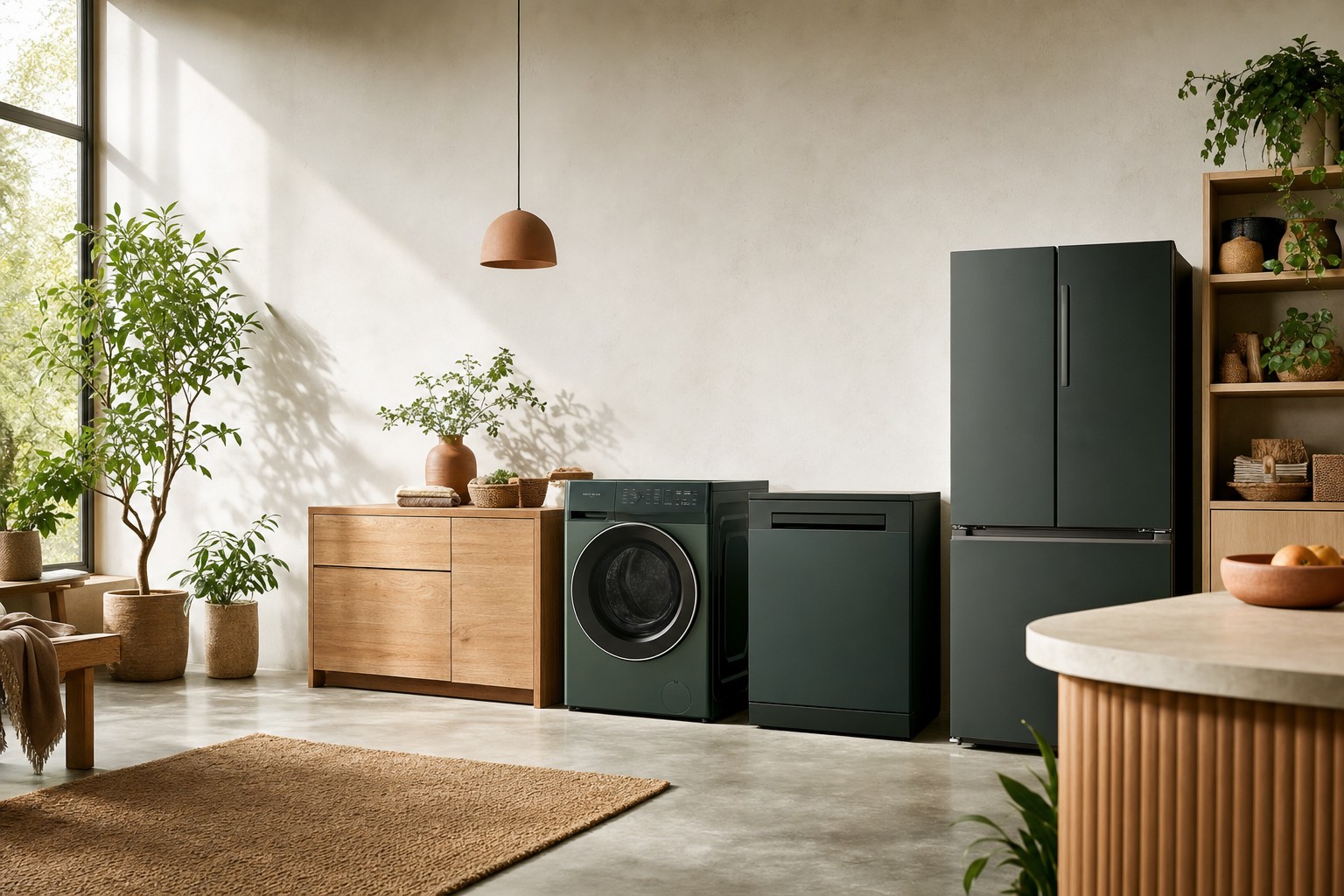
Featured Options Compared in This Guide
Full specs & notes ↓The appliance developments worth understanding include heat-pump drying, efficient washer designs, induction cooking, and sensor-based controls. Each changes a different part of the buying decision. An app is not proof of lower energy consumption, and a more efficient appliance is not automatically worth replacing a working one to obtain.
Start with the appliance nearing replacement. Compare options that fit the same space and workload, then separate energy savings from convenience and possible reductions in electricity cost.
Heat-pump dryers trade an exhaust route for water collection or drainage
A conventional dryer releases warm, moisture-laden air outdoors through a vent. A heat-pump dryer instead circulates air through a closed system, removes moisture, and reuses heat. That avoids the conventional exhaust duct. ENERGY STAR’s heat-pump dryer guide explains both the process and its lower electricity demand for heating.
This makes the technology worth considering when an exterior vent route is difficult. But the removed moisture still needs somewhere to go. Depending on the model’s supported arrangements, that may mean emptying a collection tank or connecting a drain hose. ENERGY STAR also recommends regular filter cleaning and using the moisture-sensor setting to stop drying when the load is ready. Source: ENERGY STAR
Compare the formats before comparing feature lists:
- Compact stacked appliances: Consider these when floor space is limited but a separate washer and dryer would suit your routine. Check the complete stacked dimensions and whether you can comfortably reach the controls and filters.
- A larger separate dryer: Consider this when your normal laundry includes larger loads. Compare the stated capacity with the loads you actually need to dry.
- An all-in-one washer-dryer: Consider this as another small-space option. Compare its washing and drying load limits and published program times with those of separate appliances; do not assume the combination format alone establishes efficiency or drying technology.
ENERGY STAR describes compact and larger heat-pump dryers, while its washer guidance identifies stackable and combination designs. Before ordering any format, check the model’s electrical requirements, clearances, drainage options, and maintenance access.
Washer efficiency includes the work left for the dryer
The washer’s motor is only part of laundry energy use. Water heating and subsequent drying also belong in the comparison. ENERGY STAR’s Integrated Modified Energy Factor (IMEF) accounts for washing, standby operation, water heating, and drying-related energy. A higher IMEF indicates greater efficiency under that metric. Its Integrated Water Factor (IWF) measures water use relative to capacity; lower is better. Source: ENERGY STAR clothes washers
Include front-load machines when replacing an agitator washer: ENERGY STAR identifies front-load designs as more energy- and water-efficient than both agitator and impeller top-load designs. That does not settle the whole purchase. Check door swing, loading reach, service access, and whether the capacity matches your regular loads rather than an occasional oversized item. Source: ENERGY STAR clothes washers
Several useful choices do not require buying a new machine:
- Use cold water when appropriate for the laundry, detergent, and care instructions.
- Choose a higher or extended spin setting when suitable for the garments, reducing moisture that the dryer must remove.
- Reserve sanitation cycles for situations that need them rather than making them the everyday default.
- Follow the appliance’s maintenance instructions instead of applying a universal cleaning recipe.
These practices follow ENERGY STAR’s washer-use guidance. They also help distinguish a purchase that improves the equipment from a change in how existing equipment is used.
Induction offers direct heating—with cookware and installation decisions
Induction uses an electromagnetic field to generate heat in compatible cookware, rather than relying on a flame or a conventional hot element to transfer heat into the pan. DOE describes improved cooking efficiency and responsive heating, but those benefits alone do not establish a particular household bill saving. Source: DOE’s induction overview
Start with your pans. DOE’s basic compatibility check is a flat bottom that attracts a magnet. Then compare the appliance’s stated pan-size requirements with the cookware you use most often.
A portable single-burner unit can be a practical way to try induction before replacing a range, including for renters; DOE specifically identifies this option. For a full replacement, budget for any cookware changes and ask an installer whether electrical work is needed before comparing total costs. Follow the portable appliance’s own power and placement instructions rather than assuming every location is suitable. Source: DOE
For more on choosing a cooking format, see the induction buying guide.
Connected controls and energy-saving sensors are different features
ENERGY STAR documents remote smartphone control on some dryer models. It also says certified dryers include moisture sensors that can reduce unnecessary drying and help avoid overdrying. Those are different functions: remote control offers another way to operate an appliance, while the sensor setting can stop a drying cycle when the laundry is ready. Source: ENERGY STAR heat-pump dryers
Keep three questions separate when assessing a feature:
| Question | What would establish its value? |
|---|---|
| Does it improve convenience? | A control you would actually use, such as supported smartphone operation |
| Does it reduce energy consumption? | A documented function that avoids unnecessary operation, such as sensor-controlled drying |
| Could it reduce electricity cost without reducing kWh? | Supported operating controls and an applicable tariff that makes the planned operation cheaper |
Paying less per kWh is not the same as using fewer kWh. Do not assume that remote control includes tariff-aware scheduling or that changing operating times would benefit your electricity plan.
Before paying extra for connectivity, ask whether essential functions work without internet access, whether any desired functions require a subscription, and whether the appliance remains a good choice without its app. These are buying checks, not features to assume from “smart” branding.
Use EnergyGuide and ENERGY STAR for different jobs
The yellow EnergyGuide label helps compare energy use and estimated operating costs among similar appliances. The ENERGY STAR mark identifies models meeting the program’s efficiency requirements. One provides comparison information; the other indicates qualification. Source: FTC’s EnergyGuide explanation
The FTC cautions that the label’s annual cost uses typical operation and a national average energy price. Your use and local prices may differ, and not every appliance category carries the label.
For each suitable option, record:
- Capacity and fit: dimensions, door or lid clearance, and the workload it must handle.
- Comparable energy information: annual consumption or the relevant category metric, using the same basis across options.
- Total installed cost: purchase, delivery, installation, and necessary alterations, less only incentives you qualify for.
- Ownership requirements: filter or drain care, repair support, and access for maintenance.
The FTC recommends checking space and clearance and asking about local efficiency incentives. Those practical checks belong alongside the energy figures, not after placing the order. Source: FTC
Replacement savings depend on the baseline
For a reliable appliance that still meets your needs, compare continued use and maintenance with replacement rather than assuming replacement is the better immediate choice. For a failing appliance, compare a repair quote with suitable replacement options.
If you plan to keep an old refrigerator as a second unit, compare the old-only scenario with the expected combined consumption of both refrigerators in their planned use. Energy savings exist only if that combined estimate is lower than the original baseline. The new refrigerator’s consumption alone cannot answer that question.
For two suitable new electric appliances, a preliminary electricity-only payback calculation is:
Annual electricity saving = (baseline annual kWh − alternative annual kWh) × applicable marginal electricity rate
Simple payback in years = additional installed cost ÷ annual electricity saving
Use this calculation only with comparable annual consumption estimates, positive annual savings, and a common applicable marginal rate—the price of the electricity actually avoided, excluding unchanged fixed charges. If the alternative costs no more to install, there is no installed-cost premium to recover. If annual savings are zero or negative, this calculation provides no positive electricity-savings payback.
A single rate does not capture different time-of-use schedules. For those, estimate each option’s consumption in each price period, multiply by the corresponding rates, total each option’s costs, and compare those totals. A switch between gas and electricity likewise requires separate fuel-cost estimates, not just a kWh difference.
This is simple arithmetic, not a prediction of lifetime value. It excludes financing, future energy-price changes, and differences in maintenance or service life. Add water and sewer savings separately when relevant, without counting them again as electricity savings.
For a 2026 purchase and installation, do not budget for the former federal Section 25C home-improvement credit. The IRS Form 5695 instructions state that eligibility ends for expenditures or property placed in service after December 31, 2025. Confirm any utility or state incentive separately before subtracting it from the purchase cost.
The useful trend is not simply a newer technology name. It is an option that meets your workload, fits the installation, and has a defensible cost comparison against what you would otherwise buy or keep.
Sources
Products Compared in This Guide
Energy-Efficient Appliance Trends That Matter When Buying — Top-Spec Options
Compare current model specifications, material disclosures, and third-party certifications for latest trends in energy efficient appliances 2.
Certified Latest Trends In Energy Efficient Appliances 2 Alternatives
Check verified certification scope, replacement parts, and packaging details across energy-efficient home listings.