Induction Cooktop Buying Guide: Portable, Built-In, or Range?
Compare portable induction burners, built-in cooktops, and ranges by kitchen fit, cookware, controls, ventilation, and installed cost.
Featured Options Compared in This Guide
Full specs & notes ↓Choose a portable induction burner to try the technology or add one cooking station. Choose a built-in cooktop when you want to retain a separate oven and can accommodate the installation. Choose an induction range when you want to replace the burners and oven together.
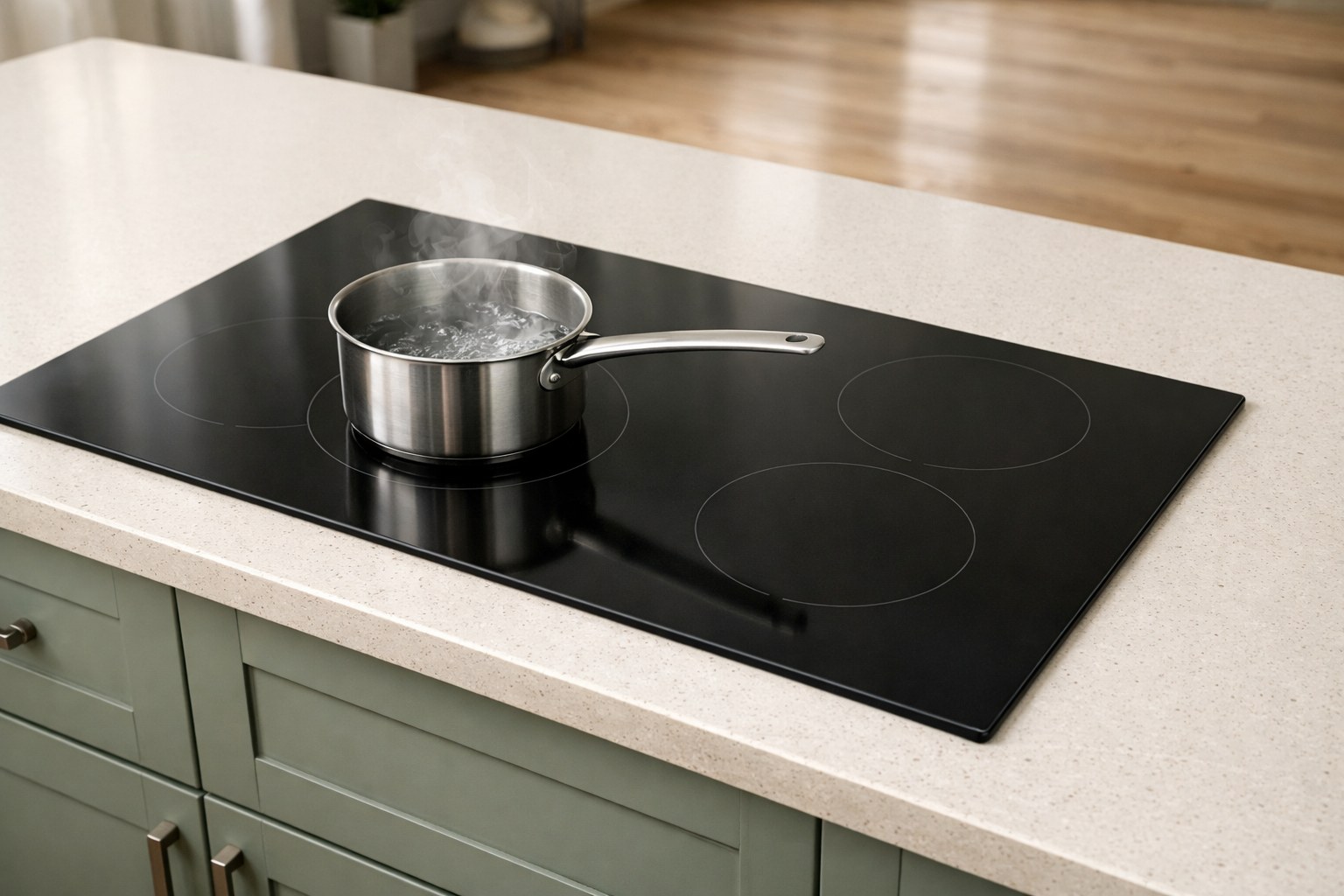
Induction uses an electromagnetic field to generate heat within compatible cookware rather than burning gas at the burner. That direct-heating mechanism is described in the Department of Energy’s induction overview. Start your decision with the kitchen project you actually need—not a headline efficiency figure or the highest advertised wattage.
Which format fits your kitchen?
| Format | Choose it when… | Resolve before ordering |
|---|---|---|
| Portable single burner | You want a trial or one additional cooking station without replacing the main appliance | Electrical requirements, permitted placement, counter space, cookware limits, and storage |
| Built-in cooktop | You want to keep a separate oven and replace only the cooking surface | Required cutout, cabinet clearances, electrical work, and access for installation |
| Induction range | You want the oven and cooking surface in one replacement appliance | Appliance dimensions, oven capacity, door clearance, electrical work, and installation requirements |
DOE specifically suggests a single-burner appliance for renters or people who want to try induction before replacing their cooktop. A trial is most useful when it covers something you cook regularly, such as a saucepan meal or a frying-pan dish. It is only a partial fit check if your usual dinner needs several pans at once. DOE
For a portable unit, use its manual to answer concrete placement questions: Which supporting surfaces are permitted? What clearance or cooling-opening requirements apply? What outlet and circuit does it require? Is your intended setting allowed, including outdoor use if that matters to you?
For a built-in cooktop or range, have the installer assess the location and electrical supply against the exact model’s installation instructions before you order. If you rent, resolve permission for permanent changes first.
Check your everyday cookware before replacing it
Start with the pans you rely on: a frying pan, saucepan, stockpot, and any unusually small or large pieces. DOE’s compatibility check is a flat bottom that attracts a magnet. Use that as an initial screen rather than replacing an entire cookware set immediately. DOE cookware guidance
Then consult the shortlisted appliance’s cookware instructions:
- What pan sizes and shapes does it accept, and how does it tell you to measure them?
- Does your smallest saucepan meet those requirements?
- If you use a griddle, does the manual describe a permitted arrangement for it?
Make two lists: pans that meet the requirements and pans that would need replacement. Budget for the pieces you actually need for ordinary meals. Do not make the purchase depend on an adapter disc unless the selected appliance’s instructions explicitly allow it.
A built-in example: nominal width is not the cutout
The Bosch 800 Series NIT8061UC illustrates why the size category alone is not enough. Bosch markets it as a 30-inch cooktop, but lists an overall width of 31 inches and depth of 21¼ inches. Its listed cutout is 28⅞ inches wide by 20 inches deep. These are different measurements serving different purposes. Bosch NIT8061UC product page
For an existing countertop, compare the opening with the required cutout—not just the appliance’s nominal size. For a new countertop, give the fabricator and installer the exact model’s installation documents rather than asking for a generic 30-inch opening.
Bosch also lists SpeedBoost for boiling water, an automatic shutoff feature, and a residual-heat indicator. Those are documented features, not a demonstration of simmer quality or a guarantee that the appliance suits your kitchen. Do not infer additional cooking-zone capabilities from the series name. Bosch
Compare controls using your usual meals
A maximum-power specification does not answer every cooking question. Use your routine to decide what deserves a demonstration or a closer look in the manual.
| Your cooking habit | Useful comparison |
|---|---|
| Sauces, melting, or gentle simmering | How finely can you adjust the low settings? Can the retailer demonstrate them with suitable cookware? |
| Several pans at dinner | Can you reach and read the controls with those pans positioned? Does the manual describe simultaneous-zone or boost limits? |
| Frequent heat adjustments | Does each zone have direct controls, or must you select a zone before changing its setting? |
| Timed cooking | Does the timer stop heating or only sound an alert? |
| Shared kitchen | Are zone selection, control locking, and any residual-heat display clear to everyone who will use it? |
Do not treat wattage as a measurement of simmer stability, fan noise, or pan noise. If those details would determine whether you keep the appliance, request a demonstration and understand the return conditions before paying.
Keep ventilation in the project
Replacing gas burners with induction removes combustion at those burners, as DOE explains, but it does not make cooking pollutant-free. DOE
EPA identifies cooking as an activity that can produce high pollutant levels. It also explains that kitchen fans exhausting outdoors remove contaminants directly from the room. Keep suitable exhaust ventilation in the project rather than treating a change of heat source as a reason to remove it. EPA indoor-air guidance
Ask whether the existing hood exhausts outdoors and what work would be needed to retain or provide that arrangement. Include that work in the installation discussion and budget.
Compare installed cost—not just appliance cost
Build a quote that includes:
- Appliance, delivery, and removal of the existing unit.
- Electrical assessment and any required changes.
- Countertop or cabinet work.
- Ventilation work.
- Replacement of essential cookware that does not meet the selected model’s requirements.
DOE describes induction as more efficient than gas and conventional smooth-top electric cooking because it generates heat directly in the cookware. That supports a technology comparison, not a particular household bill reduction. DOE efficiency discussion
For an operating-cost estimate, use current local utility rates and your expected cooking use. Keep oven energy separate when comparing a cooktop-only replacement with a whole range. Do not count on a particular payback period without a household-specific estimate.
The practical choice: try a portable burner if your main uncertainty is whether induction suits your cooking. Choose a built-in unit to retain a separate oven, subject to installation fit. Choose a range when replacing the combined appliance makes sense. Compare the complete project with other household priorities in the energy-efficient home guide.
Sources
- Department of Energy: Making the Switch to Induction Stoves or Cooktops — heating mechanism, initial cookware check, portable trial, and efficiency discussion.
- Bosch: NIT8061UC product page — model dimensions, cutout dimensions, and listed features.
- EPA: Improving Indoor Air Quality — cooking-related pollutants, source control, and outdoor-exhaust kitchen ventilation.
Products Compared in This Guide
Induction Cooktop Buying Guide — Top-Spec Options
Compare current model specifications, material disclosures, and third-party certifications for induction cooking 9 cooktops tested 6 months.
Certified Induction Cooking 9 Cooktops Tested 6 Months Alternatives
Check verified certification scope, replacement parts, and packaging details across energy-efficient home listings.
Frequently Asked Questions
What is the simplest way to try induction cooking?
A portable single burner lets you try induction with compatible cookware before replacing a range. Consult the selected unit's manual for electrical, placement, and cookware requirements before buying.
Does an induction kitchen still need ventilation?
Yes. Cooking can generate indoor pollutants even without gas burners. EPA identifies kitchen fans that exhaust outdoors as a way to remove contaminants from the room.