Rain Barrels for Renters: What You Can Actually Do in 2026
Compare rental rain-barrel setups, landlord approval, balcony weight concerns, overflow planning, local rules, and realistic water savings.
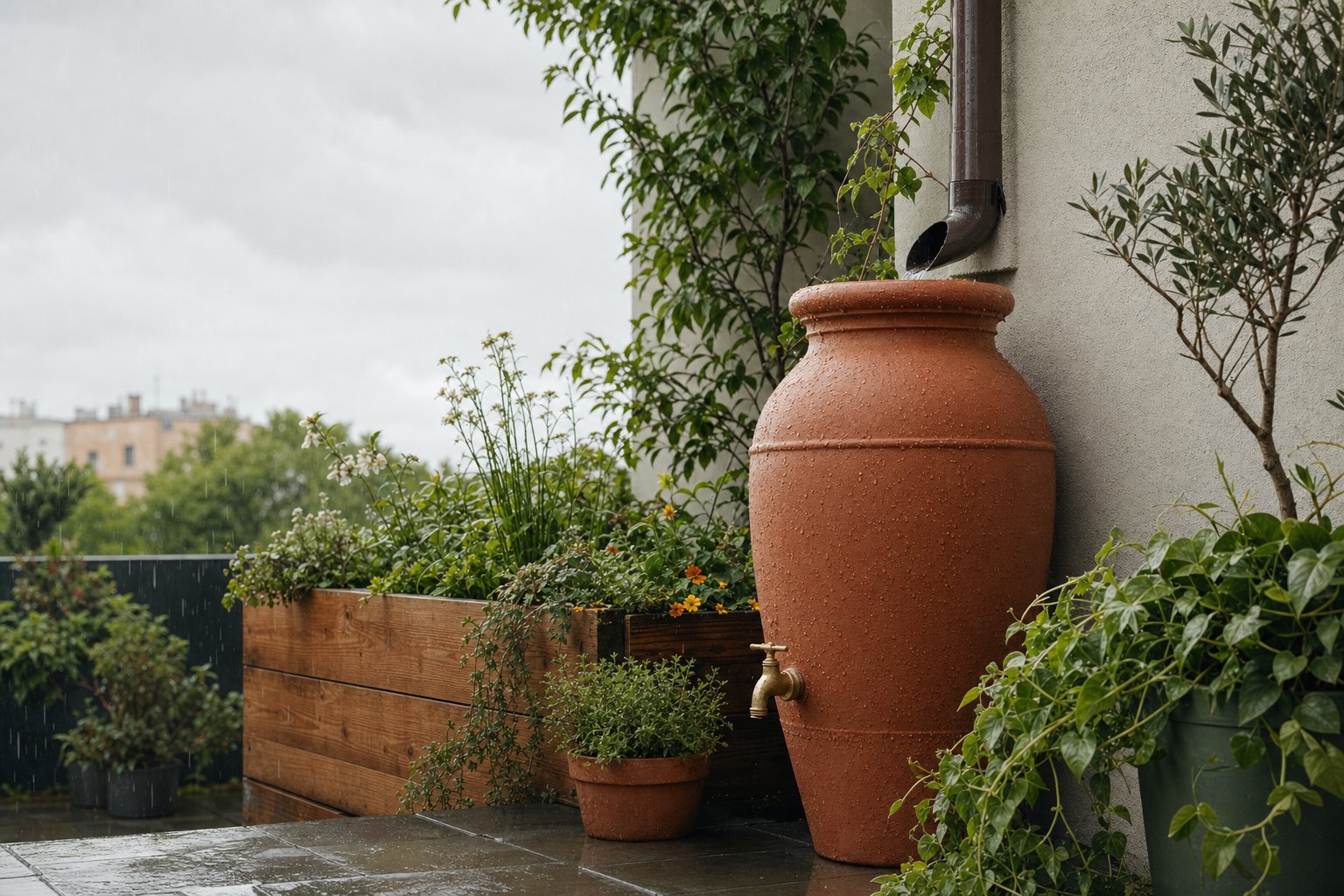
Featured Options Compared in This Guide
Full specs & notes ↓This post contains affiliate search links. If you purchase through them, we may earn a commission at no extra cost to you.
A rain barrel is most practical for a renter who has an approved ground-level location, access to roof runoff, and nearby plants that will use the water. An upper-floor balcony without an approved collection point is a much harder fit. The first decision is whether your rental can accommodate the filled barrel and its overflow—not which container looks best.
Rain barrels can replace some municipal water used for gardening and reduce runoff, but savings depend on how much water you collect and actually use. They do not come with a dependable one-season payback. University of Minnesota Extension describes lower water bills as a possible benefit, rather than a guaranteed result.
Which rental situations work?
| Your situation | Practical approach | Main condition |
|---|---|---|
| Ground-floor patio or yard with a downspout | Propose a covered barrel with a compatible diverter | Written approval for the connection, a stable base, and a planned overflow route |
| Ground-level space beneath concentrated roof runoff | Consider a screened barrel beneath the roof edge | Observe where rain falls and establish where excess water will go |
| Upper-floor balcony | Resolve structural support and drainage before considering storage | The filled system’s weight and overflow need assessment for that location |
| No approved runoff access | Keep using a watering can for your containers | A barrel filled from a tap provides storage but does not itself replace tap water |
Clemson Extension describes collection through downspouts, rain chains, or concentrated flow beneath roof corners and eaves. It also calls for a screened inlet, securely fastened lid, and emergency overflow directed away from the foundation. Collection without a downspout connection still needs those features. Source: Clemson Extension
Treat balcony weight as a decision before purchase. Clemson reports that a full 55-gallon barrel weighs more than 450 pounds. A lightweight empty container or a collapsible design does not remove the weight of the stored water. Ask the property manager to establish whether the proposed location and support are suitable; if that cannot be resolved, pursue a ground-level arrangement instead. Keep access routes clear. Sources: Clemson Extension, SFPUC installation requirements
Make the landlord request specific
Ask for written approval of a defined installation. Include:
- Location and capacity: identify the exact spot, its base, and access to nearby plants.
- Connection work: explain any drilling, cutting, or changes to the existing downspout.
- Overflow destination: show where water will travel once the barrel is full.
- Maintenance: agree who will clear screens, inspect connections, and handle winter storage.
- Move-out arrangements: state who will remove the barrel and restore altered drainage parts.
A useful request might read: “I would like to place a covered rain barrel beside the patio downspout for watering ornamental containers. The proposed diverter requires drilling. Before installation, I would like to agree on the base, overflow route, installation responsibility, and restoration when I move out.”
Removable equipment can still leave a modification behind. For example, Good Ideas says its Rain Wizard 50 Gallon Rain Barrel with Diverter Kit requires holes in both the downspout and barrel. It includes a plug for disconnecting the barrel, but that does not make installation a clip-on, no-trace procedure. Source: Good Ideas
Compare the connection, not just the barrel shape
A diverter that returns excess flow to the downspout
This is worth considering where maintaining the existing drainage route is central to approval. Good Ideas describes its Rain Wizard 50 starter kit as routing excess water down the downspout once the connected barrel fills. It includes the barrel and diverter, and permits disconnection for storage. Installation still requires drilling and following the manufacturer’s instructions. Source: Good Ideas starter kit
Before choosing this arrangement, match the installation instructions to your downspout and agree on who performs the work. Do not assume every product described as a “rain-barrel kit” includes the same connection hardware.
A barrel beneath a downspout or roof edge
Direct collection can avoid a diverter connection when the existing runoff point is suitable. However, placing a barrel under a downspout may still require shortening or repositioning that downspout. Eartheasy’s Rain Wizard listing describes positioning the downspout above the screened inlet and gives cutting guidance. Source: Eartheasy
The deciding issue is overflow. A front-facing outlet or channel changes where excess water leaves the barrel; you still need a suitable destination beyond it. University of Minnesota Extension recommends routing overflow away from buildings, such as toward an appropriate garden bed or tree. Source: University of Minnesota Extension
An urn shape or collapsible container
Choose an urn shape if its appearance and footprint suit the approved location. Good Ideas lists a flat back, screened inlet, planter top, and front overflow channel for its Rain Wizard Urn 65. Its included-parts list does not list a diverter kit. Those details distinguish it from the starter kit; appearance alone does not establish easier landlord approval. Source: Good Ideas Urn 65
For collapsible containers, weigh storage convenience against the requirements of your site and any rebate. San Francisco’s program explicitly excludes portable and collapsible devices. That is a local eligibility rule, not a nationwide ban. Source: SFPUC
For shopping, browse Amazon search results for Rain Wizard rain barrels and diverter kits. This affiliate link opens search results; compare the selected listing’s included hardware before ordering.
Check the rules that apply to your building
Landlord approval and legal eligibility are separate questions. Building type, container capacity, and intended use can matter.
Colorado: Under the residential rain-barrel provision, eligible properties include single-family residences and multifamily residences with four or fewer units. Attached homes sharing side walls are treated as single-family residences as described by the state. The allowance is up to two barrels with a combined capacity of 110 gallons, with sealable lids, collecting residential rooftop precipitation for outdoor use on the same property. No DWR permit is required under this provision. Renters in larger apartment buildings should not assume it applies to them. Source: Colorado Division of Water Resources
Utah: Registration is unnecessary for no more than two covered containers, each with a maximum capacity of 100 gallons. With registration, total storage may reach 2,500 gallons. Collection and use must remain on the same parcel. Source: Utah Division of Water Rights
San Francisco rebates: SFPUC lists rebates of up to $100 per qualifying barrel, limited to two. Applicants need an active water account or account-holder approval; when the account holder is a renter, the program requires a signed property-owner approval form. Eligible barrels must hold at least 50 gallons, and applications must follow installation and arrive within 90 days of purchase. Funding and other conditions apply, so read the terms before buying. Source: SFPUC
Elsewhere, ask your water utility or local authority about your proposed setup rather than applying another state’s allowance.
Size the barrel around usable water
Clemson provides this roof-runoff estimate:
Roof area draining to the collection point × rainfall in inches × 0.623 = estimated gallons of runoff.
For an illustrative 250-square-foot roof section and a quarter-inch rainfall, that calculation gives about 39 gallons, before collection losses. It does not guarantee a full 50-gallon barrel. Use only the roof area feeding your collection point, not the entire building’s roof. Source and calculation method: Clemson Extension
Compare that potential supply with the watering cans you actually use between rains. Extra capacity helps only when runoff reaches it and you subsequently use the stored water. SFPUC notes that small systems can run out quickly during dry months. Source: SFPUC
For a financial decision, multiply the gallons that replace billed tap water by your applicable usage rate, using matching billing units. Compare that saving with the barrel, connection hardware, base, and installation cost after any approved rebate. If water is included in your rent, reduced consumption may not reduce your personal bill.
Use and maintain it for a rental garden
Start with ornamental containers. University of Minnesota Extension recommends ornamental plants as the simplest way to minimize risks from roof-collected water. It warns that runoff can contain fecal contamination and contaminants from roofing materials, and that rain-barrel water should not touch edible plant parts. For balcony herbs and salad greens, use potable water. Its guidance allows some applications to taller food plants only when water can be kept off the edible portions. Source: University of Minnesota Extension
A first-flush device diverts the initial runoff; it is not a promise that collected water is suitable for every use. SFPUC requires one for watering edibles, while Minnesota recommends the more conservative ornamental-only approach to minimize risk. Sources: SFPUC, University of Minnesota Extension
Plan to fill a watering can before adding automation. Elevation improves gravity flow and spigot access, but also requires a stable, properly secured support. Clemson explains that each foot of elevation adds approximately 0.4 PSI. Compare any timer or irrigation system’s pressure requirements with your setup before buying it. Source: Clemson Extension
Keep the lid secure and the inlet screen clear. Inspect connections and overflow outlets, and use the water regularly. If mosquito treatment is needed, select a Bti product labeled for the intended application and follow its dosing and retreatment directions. EPA describes Bti as targeting mosquito, blackfly, and fungus-gnat larvae; its guidance does not establish a universal monthly treatment schedule. Sources: Clemson Extension, EPA
Include winter and move-out work in the arrangement. Before freezing weather, empty the barrel and follow its storage instructions. Minnesota Extension also advises restoring a downspout extension when the barrel is removed so rain and snowmelt drain away from the building and sidewalks. Source: University of Minnesota Extension
For planning the plants and containers around your available space, see the balcony container garden guide.
Sources
- Clemson Extension: Designing for Rain Barrel Success
- University of Minnesota Extension: Rain barrels in the home landscape
- Colorado Division of Water Resources: Rainwater, Storm Water & Graywater
- Utah Division of Water Rights: Rainwater Harvesting Registration
- SFPUC: Rain Barrel and Cistern Rebate
- EPA: Bti for Mosquito Control
- Good Ideas: Rain Wizard 50 Gallon Rain Barrel with Diverter Kit
- Good Ideas: Rain Wizard Urn 65
- Eartheasy: Rain Wizard Rain Barrel—40, 50 & 65 Gallons
Products Compared in This Guide
Amazon search results for Rain Wizard rain barrels and diverter kits
Compare current manufacturer specifications, materials, and package options for Amazon search results for Rain Wizard rain barrels and diverter kits.
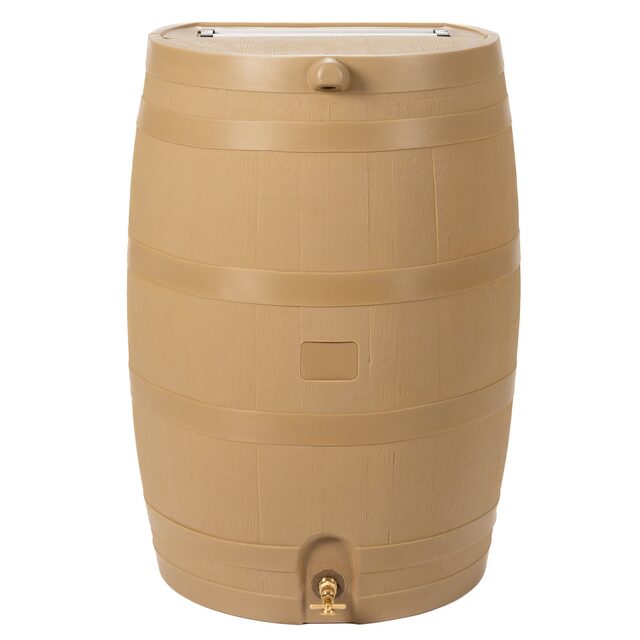
Eartheasy 50-Gallon Rain Barrel with Diverter Kit
Flat-back design for placement against a house or fence wall. Includes a diverter kit that installs on a standard round downspout — the diverter sends overflow back to the downspout automatically once the barrel is full, preventing flooding. Brass spigot at the base. UV-resistant recycled polyethylene. The flat back reduces the visual footprint against a wall significantly.
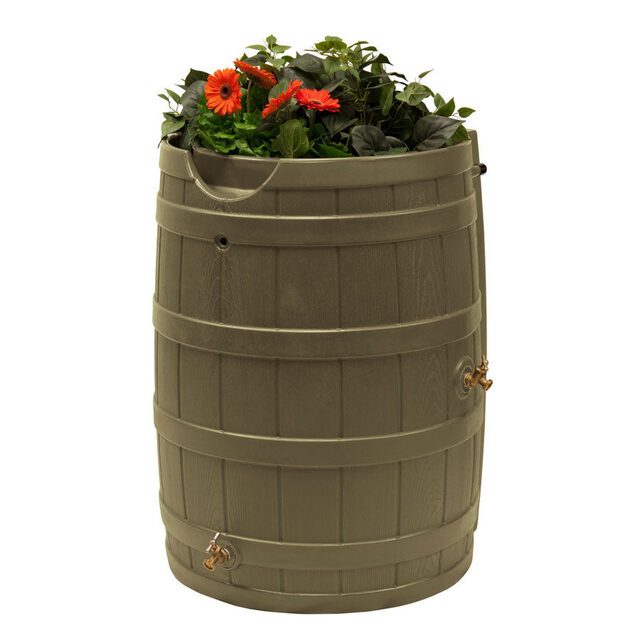
Eartheasy Rain Barrel (65-Gallon, Urn Style)
Decorative urn form factor that looks intentional rather than utilitarian — landlord approval is significantly easier when the barrel looks like outdoor décor. Same flat-back diverter-compatible design. 65 gallons is a useful volume for a balcony container garden over 3–5 dry days. Available in terracotta and granite-look finishes.
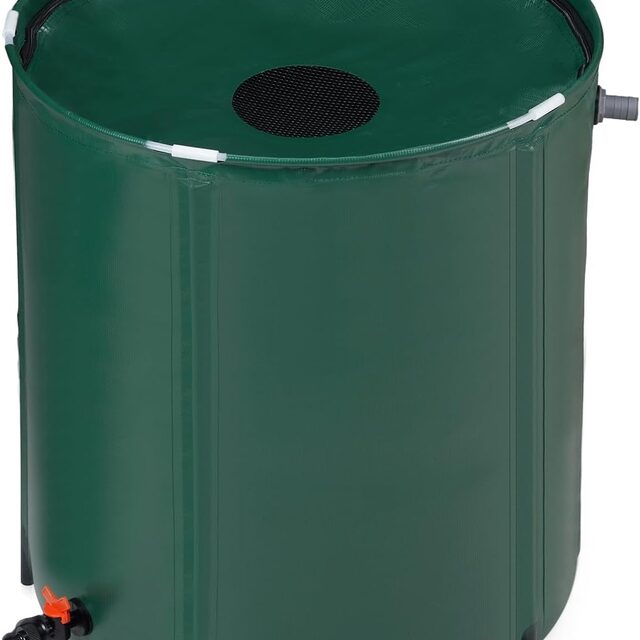
EarthHero Collapsible Rain Barrel (50-Gallon)
Folds completely flat when empty — useful for renters who store the barrel during dry months. Requires downspout diverter for connected use (diverter sold separately) or can be positioned as a standalone open-top collector under a drip edge. The collapsible design means it stores in a closet at end of season — genuinely renter-friendly.
Frequently Asked Questions
Can I install a rain barrel without changing a downspout?
Sometimes. A screened barrel can collect concentrated runoff beneath a suitable roof edge, but placement, overflow, property approval, and local rules still matter. A diverter kit may require drilling even if the barrel can later be disconnected.
Is a full-size rain barrel suitable for a balcony?
Do not assume so. Clemson Extension says a full 55-gallon barrel weighs more than 450 pounds. Have the property manager resolve whether the proposed location and support can accommodate the filled system before installing it.
Can I use rain-barrel water on herbs and vegetables?
University of Minnesota Extension recommends using it on ornamental plants to minimize contamination risk. It says collected water should not touch edible plant parts. For a renter's herb or salad garden, potable water is the simpler choice.