Organic Cotton Underwear: Fit, Blends and Buying Decisions
Choose organic cotton underwear by cut, fiber blend and care needs, with an Organic Basics example and a guide to certification claims.
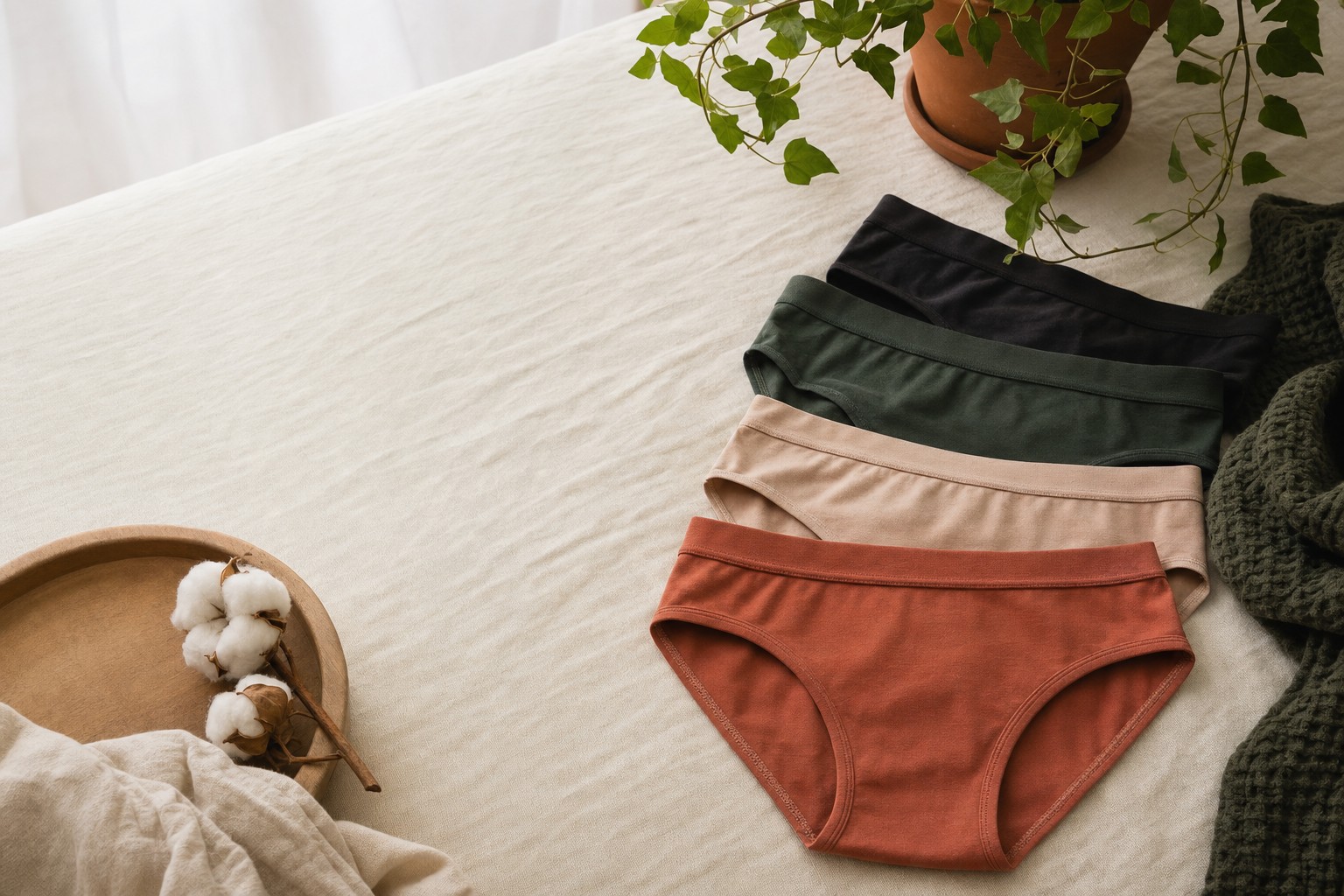
Featured Options Compared in This Guide
Full specs & notes ↓Choose the cut you want before committing to an organic-cotton multipack. Organic Basics Core Play String Bikini Briefs in Dewdrop/Light Lemon are worth considering if you want a mid-rise, high-cut, string-sided design with cheeky coverage and accept a cotton–elastane blend. The manufacturer lists 95% organic cotton and 5% elastane—not an entirely cotton garment. Organic Basics product details
That makes this a specific option for a specific preference, rather than a universal underwear recommendation. If your priority is a high waist, full rear coverage or no elastane, look for a different specification instead of choosing this pair for its organic-cotton content alone.
What the Organic Basics design offers—and when to look elsewhere
The product description identifies elastic contrast binding, string sides at the hips and a cotton gusset. Use those construction details to decide whether the shape matches what you actually want to wear. Organic Basics construction and fit
| Your priority | Buying decision |
|---|---|
| Mid-rise underwear with high-cut leg openings | This pair matches those stated design preferences. |
| String sides and cheeky rear coverage | Those are documented features of this design. |
| A high-waisted or full-coverage brief | Look for a cut explicitly described that way; this item is described as mid-rise and cheeky. |
| Organic cotton with elastane included | The listed 95% organic cotton/5% elastane blend meets that preference. |
| A garment without elastane | This pair does not meet that requirement. |
A cotton gusset and the garment’s overall fiber blend answer different questions. Here, the maker lists a cotton gusset separately from the 95%/5% composition. Do not read the gusset description as a claim that the entire pair is pure cotton. Nor does the description provide a separate fiber breakdown for every trim. Organic Basics fabric and construction
When comparing another pair, put its rise, leg opening, side construction and rear coverage beside these features. A matching cotton percentage is not enough to establish a matching cut.
Size and laundry requirements deserve their own decision
Use both waist and hip entries in the Organic Basics size chart. For example, its size S lists a waist range of 26–28.5 inches and a hip range of 35–37.5 inches. These are the brand’s chart dimensions, not garment measurements or a fit guarantee. If your waist and hip measurements point to different sizes—or you need help locating the measurement points—ask the brand for guidance before ordering. Organic Basics size guide
For this item, Organic Basics specifies machine washing at a maximum of 30°C and flat drying. If you need underwear suitable for a hotter wash or tumble drying, choose an item whose care directions permit that routine rather than assuming this one will tolerate it. Organic Basics care instructions
Separate cotton content, substance testing and factory standards
These claims address different buying priorities; one should not stand in for another.
- Organic cotton content: Organic Basics lists this pair as 95% organic cotton and identifies it as GOTS-certified. Keep that certification statement attributed to the manufacturer, and do not turn it into a claim that every component is organic. Organic Basics material and certification statements
- Textile substance testing: OEKO-TEX STANDARD 100 evaluates textiles against limits for harmful substances, with requirements tied to intended use and skin contact. Its scope can extend from yarn to a finished article. This is a different question from organic cotton content. OEKO-TEX also provides a label-check service using the label’s QR code or certificate number. OEKO-TEX STANDARD 100
- Factory requirements and worker funds: Fair Trade USA’s factory program covers social, environmental and economic requirements. It also includes premiums that fund projects selected by workers through Community Development Funds. A factory-program claim is not a cotton-percentage claim. Fair Trade USA factory program
The STANDARD 100 and Fair Trade explanations describe those programs; they are not additional certification claims for the Organic Basics pair. None of these labels should be treated as a personal comfort assessment or a wear-life rating.
Make a multipack earn its place
Before ordering several pairs, confirm that you want every included cut and color, and read the seller’s underwear return and try-on conditions. If you are unsure about the design, consider starting with one pair rather than multiplying the same fit uncertainty across a bundle.
For value, divide the delivered cost by the number of pairs you expect to use. Include shipping, and do not count unwanted pairs as useful savings. Without a known wear life, there is no sound reason to assume a higher-priced pair will be cheaper per wear.
The practical choice: consider the Organic Basics example for its documented string-bikini shape and cotton–elastane composition. Choose another specification if your coverage, material or laundry requirements differ. Organic content is one useful criterion—not a substitute for those decisions.
Sources
- Organic Basics — Core Play String Bikini Briefs, Dewdrop/Light Lemon: composition, construction, size chart, manufacturer certification statement and care instructions.
- OEKO-TEX — STANDARD 100: testing scope, intended-use classes and label checking.
- Fair Trade USA — Fair Trade Certified Factories: factory-program requirements and worker-directed Community Development Funds.
Products Compared in This Guide
Organic Cotton Underwear — Top-Spec Options
Compare current model specifications, material disclosures, and third-party certifications for organic cotton underwear for eco friendly comfort.
Certified Organic Cotton Underwear For Eco Friendly Comfort Alternatives
Check verified certification scope, replacement parts, and packaging details across ethical fashion listings.
Frequently Asked Questions
Does organic cotton underwear contain elastane?
It can. Organic Basics lists 95% organic cotton and 5% elastane for its Core Play String Bikini Briefs in Dewdrop/Light Lemon. That item is not a 100% cotton garment.
Is OEKO-TEX STANDARD 100 the same as organic certification?
No. STANDARD 100 concerns testing textiles against limits for harmful substances. It does not by itself establish organic cotton content.
How should the Organic Basics Core Play String Bikini Briefs be washed?
Organic Basics specifies machine washing at a maximum of 30°C and flat drying for this item. Do not transfer those instructions to other underwear without checking its care directions.