Energy-Efficient Ceiling Fans: Airflow, Fit and Running Cost
Choose a ceiling fan by airflow, installation fit and running cost, with a close look at Minka-Aire Light Wave specifications and their limitations.
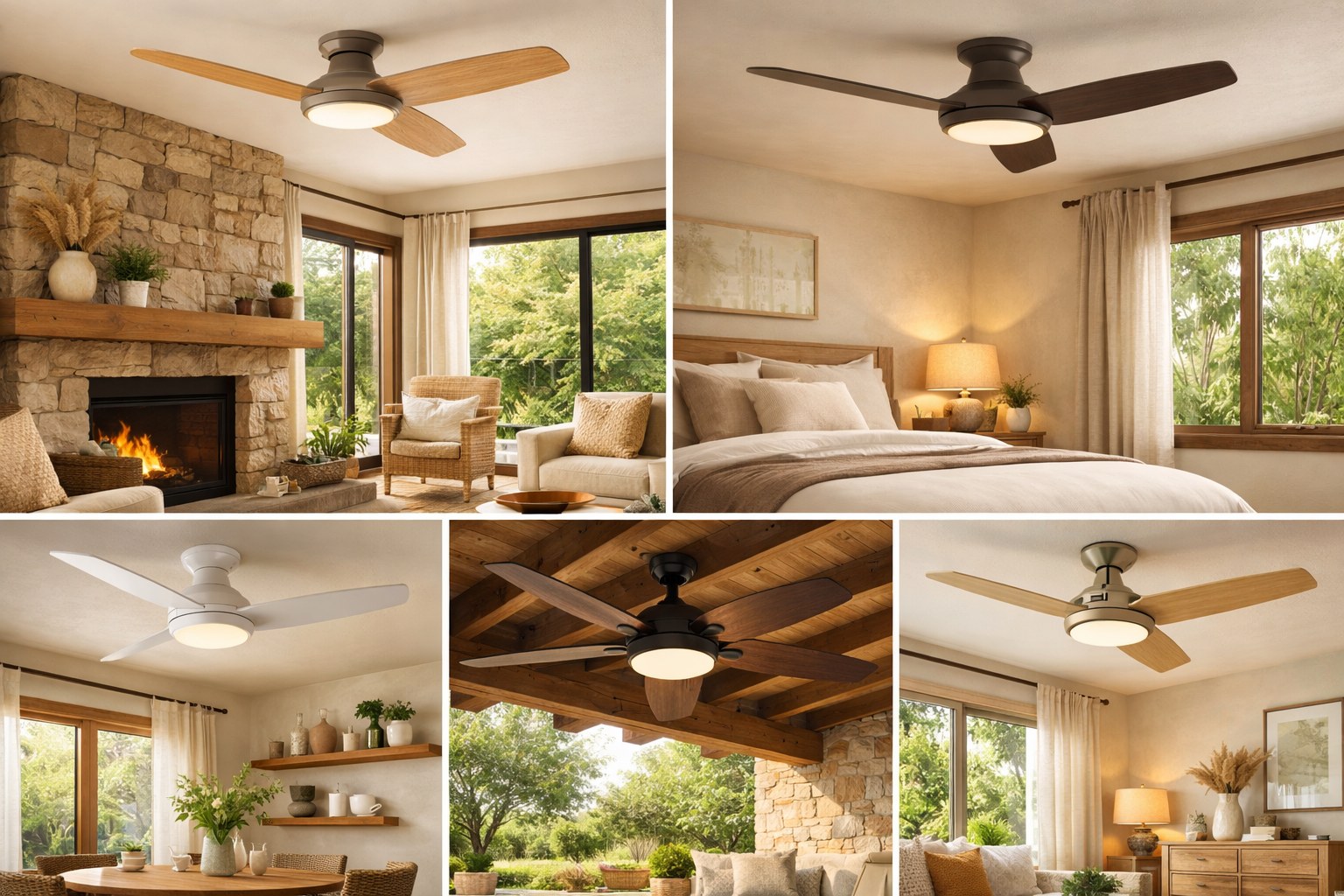
Featured Options Compared in This Guide
Full specs & notes ↓Choose a ceiling fan for useful airflow at the setting you expect to use—not simply the lowest advertised wattage. Installation fit, lighting and controls also matter: an efficient setting is little help if it does not provide a comfortable breeze where you sit or sleep.
As spring weather warms, remember what the fan does. Air movement makes occupants feel cooler; it does not lower the room temperature. ENERGY STAR recommends switching the fan off when the room is empty and adjusting the thermostat to take advantage of the breeze. Any air-conditioning savings depend on how you use the fan and thermostat together, not just the fan’s power draw. ENERGY STAR installation and usage guidance
Compare airflow and power together
Fan specifications can list airflow in cubic feet per minute, or CFM, electrical input in watts, and airflow efficiency in CFM per watt. Minka-Aire’s Light Wave page, for example, provides separate low- and high-speed entries for all three. Minka-Aire F844-DK specifications
Use those figures to answer different questions:
- Airflow: How much air does the listed setting move?
- Watts: What electrical input is reported at that setting?
- CFM/W: How much airflow is reported relative to that input?
Keep each airflow figure paired with its corresponding power figure. Do not combine low-speed watts with high-speed airflow. For comparisons between models, use the same stated rating conditions; a setting called “low” on two different fans does not, by itself, establish equivalent airflow.
For a purchase decision, compare settings that could meet your needs before comparing their running costs. The lowest-wattage option is not necessarily the useful choice if you would need to run it faster for comfort.
Certification is more informative than a motor label
ENERGY STAR says its certified ceiling fans use improved motor and blade designs and undergo independent certification against energy-efficiency requirements. Its ceiling-fan page also provides a Product Finder entry point for exploring certified models. An AC or DC motor description alone does not establish that a particular fan is certified. ENERGY STAR ceiling fans
Use certification as one comparison tool—not as a substitute for checking the airflow, installation requirements and features of the exact model.
Minka-Aire Light Wave F844-DK: a specification example
Minka-Aire lists the Light Wave F844-DK as a 52-inch, three-blade ceiling fan with an AC motor and a handheld remote. Its included light uses an integrated LED module; the page lists 20 watts for the light and identifies it as dimmable. These are manufacturer specifications, not measurements of comfort or performance in a home. Minka-Aire F844-DK
The published speed-specific figures are:
| Setting | Airflow | Electrical input | Listed airflow efficiency |
|---|---|---|---|
| Low | 1,497 CFM | 10.16 W | 141.98 CFM/W |
| High | 4,453 CFM | 67.49 W | 68.33 CFM/W |
Source: Minka-Aire F844-DK low- and high-speed fields.
The displayed airflow-efficiency values do not match airflow divided by watts. Calculating directly from the displayed entries gives:
- Low:
1,497 ÷ 10.16 ≈ 147.34 CFM/W - High:
4,453 ÷ 67.49 ≈ 65.98 CFM/W
Those results are arithmetic checks, not replacement official ratings. The manufacturer page does not explain why its listed efficiency values differ from these quotients. Ask Minka-Aire for matching airflow, power and efficiency figures—and their rating conditions—before relying on this model’s efficiency numbers for a purchase comparison. Manufacturer data
The published entries still illustrate a useful trade-off: high speed delivers more reported airflow but draws more power. Low speed draws less power but also delivers less airflow. Neither setting establishes an efficiency advantage over another fan, and the page provides no noise figures for judging bedroom use.
If you need both a fan and overhead lighting, the included remote and dimmable LED may make this configuration relevant. Before choosing it, ask about replacement LED modules and remotes, their availability and cost. Do not assume the integrated light can be maintained like a fixture with an ordinary replaceable bulb.
Choose for the room and installation
Measure the room, ceiling height and intended fan position before ordering. Then compare the complete installed dimensions and mounting requirements—not blade diameter alone. ENERGY STAR emphasizes reading the manufacturer’s instructions before installation. ENERGY STAR installation guidance
Use your room’s constraint to narrow the choice:
| Your situation | Prioritize | Resolve before buying |
|---|---|---|
| Bedroom | A comfortable breeze at a tolerable sound level | Look for model-specific noise information or an opportunity to assess operation; ask whether control lights or beeps can be disabled. |
| Low ceiling | Total installed drop and required blade clearance | Compare the mounting arrangement and installed height in the manual, rather than selecting by blade span. |
| Large or divided living space | Air movement at the seats you use | Map those positions against the proposed fan location before deciding whether one fan is an appropriate layout. |
| Replacing the only ceiling light | Lighting and fan control as separate needs | Decide whether you want an integrated LED or replaceable bulbs, and ask how independently the light and fan can be operated. |
| Sloped ceiling | A permitted mounting configuration | Confirm the allowed ceiling angle and any required adapter or downrod in the instructions. |
| Covered porch | Suitability for the actual exposure | Confirm that the model’s location rating and instructions permit the installation; a roof overhead is not enough information to choose a fan. |
The F844-DK specifications discussed above do not settle noise, ceiling-angle compatibility, required clearances or porch suitability. Do not extend those specifications into a room-specific recommendation without the relevant instructions and performance information.
Replacing a light fixture is not just a fixture swap
ENERGY STAR specifies a UL-listed metal electrical box identified for ceiling-fan use. It also notes that replacing a ceiling light will often require replacing the electrical box. Have a qualified installer assess the support, wiring and proposed controls if you are unsure whether the existing installation is suitable. ENERGY STAR electrical-box and mounting guidance
Include any necessary installation work in your budget before comparing purchase prices.
Estimate running cost without overstating savings
For a setting with a known electrical input, use this budgeting calculation:
Electricity cost = watts ÷ 1,000 × operating hours × electricity rate per kWh
As an illustration—not a prediction of annual use—1,000 hours at the F844-DK’s listed 67.49-watt high-speed input would use 67.49 kWh. The same operating time at its listed 10.16-watt low-speed input would use 10.16 kWh. Multiply either result by your electricity rate. These calculations use the manufacturer’s displayed power entries, and the two settings provide different reported airflow. Minka-Aire power and airflow data
For lighting, first establish whether the quoted fan power includes the light. Do not automatically add the F844-DK’s listed 20-watt light to the speed figures: the page does not explain that relationship. If lighting needs to be counted separately, use its own operating hours rather than assuming it always runs with the fan. Minka-Aire lighting and power fields
To judge an efficiency premium:
- Replacing a working fan: Compare annual electricity costs at settings that meet your needs, then divide the replacement’s total installed cost by the positive annual saving.
- Buying a fan anyway: Compare the additional installed cost of the more efficient option with its annual electricity-cost saving.
This is simple payback arithmetic, not a forecast. If the calculated annual saving is zero or negative, lower electricity costs do not repay the premium under those assumptions. Keep possible air-conditioning savings separate from the fan-electricity calculation.
Use the breeze deliberately through spring and beyond
For warm-weather cooling, ENERGY STAR recommends counterclockwise rotation, producing a breeze you can feel beneath the fan. When air conditioning is running, try a warmer thermostat setting that remains comfortable with the breeze; do not assume that adding a fan while leaving everything else unchanged will reduce total cooling energy. ENERGY STAR usage guidance
For cooler periods when heating is needed, ENERGY STAR recommends clockwise operation at low speed to redistribute warm air collected near the ceiling. Follow the fan’s instructions for changing direction. ENERGY STAR year-round guidance
The practical choice is the fan that fits the installation and provides useful airflow at a setting you will actually use. If your current fan already does that, calculate the likely savings before replacing it solely for efficiency. For coordinating cooling controls, see our smart thermostat guide.
Sources
- ENERGY STAR: Ceiling Fans — certification, motor and blade design, and product-search access.
- ENERGY STAR: Ceiling Fan Installation and Usage Tips — electrical support, occupancy, seasonal direction and thermostat guidance.
- Minka-Aire: Light Wave F844-DK — model features, lighting, airflow, power and listed airflow-efficiency figures.
Products Compared in This Guide
Energy-Efficient Ceiling Fans — Top-Spec Options
Compare current model specifications, material disclosures, and third-party certifications for 5 energy efficient ceiling fans comfort.
Certified 5 Energy Efficient Ceiling Fans Comfort Alternatives
Check verified certification scope, replacement parts, and packaging details across energy-efficient home listings.