Energy-Efficient LED Bulbs: Brightness, Fit and Running Costs
Compare LED brightness, light appearance and running costs using GE Relax A19 specifications and clear electricity-saving calculations.
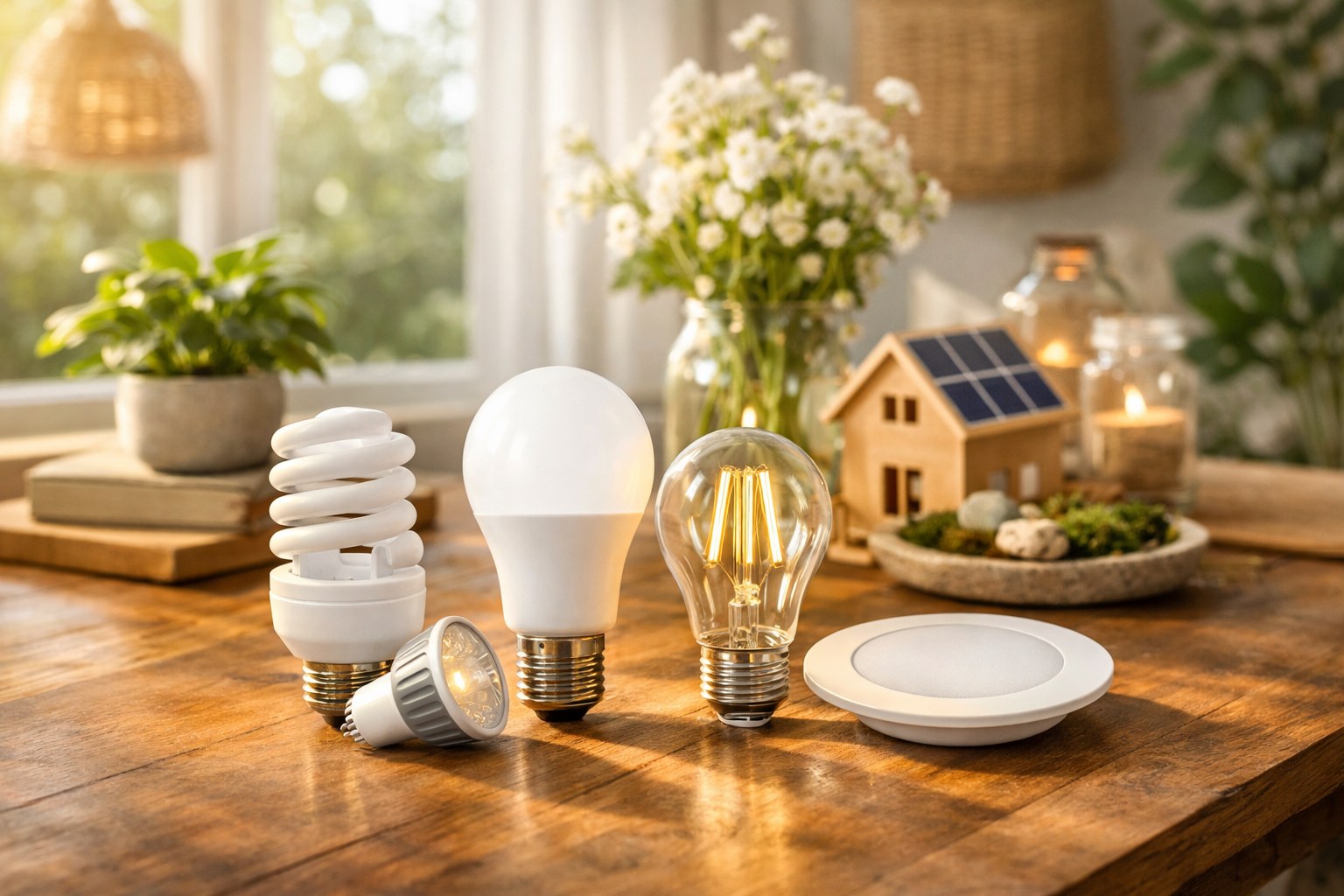
Featured Options Compared in This Guide
Full specs & notes ↓Choose the brightness you need first, then compare electricity use. Lumens describe light output; watts describe power consumption. A traditional 60-watt incandescent produces about 800 lumens, while an LED can deliver that output using about 9 watts, according to the FTC’s light-bulb shopping guide.
That distinction matters in two ways: a lower-watt bulb is not necessarily an equally bright replacement, and a “60-watt replacement” LED does not necessarily consume 60 watts. For savings calculations, use the bulb’s actual wattage.
Choose brightness and appearance separately
The Lighting Facts label separates several decisions that are easy to confuse:
| Information | What it tells you | How to use it |
|---|---|---|
| Lumens | Light output | If your current brightness works, look for similar output; choose more lumens if you want more light |
| Watts | Power consumption | Compare watts after narrowing the choices to your desired brightness |
| Light appearance | Whether the light looks warmer and more yellowish, or cooler and more bluish | Choose the appearance you prefer rather than treating “cool” as a brightness claim |
| Expected life | The stated life estimate | Treat it as an estimate, not a promise of how long a bulb will last in your home |
| Estimated yearly energy cost | A running-cost estimate | Recalculate for your own electricity rate and hours of use |
These are separate fields on the FTC’s description of the Lighting Facts label. A warm-looking bulb and a cool-looking bulb can be compared for brightness using lumens—not their appearance descriptions.
Before buying enough bulbs for a whole room, consider trying one to see whether you like its brightness and appearance alongside the lamps you already use.
GE Relax HD A19: an 800-lumen example
GE’s published specifications for the Relax HD A19 soft white two-pack, UPC 043168527873, list:
- 800 lumens of light output.
- 8.5 watts of power consumption.
- 2700K color temperature, described by GE as warm, soft white light.
- 120 volts, a medium base and an A19 shape designation.
- Indoor use and dimming with a dimmer switch.
GE presents it as a general-purpose LED replacement for a 60-watt bulb. The important comparison is therefore 800 lumens at 8.5 watts, not the replacement-wattage wording alone. GE product specifications
For dimming, GE says this bulb works with most dimmer switches—not every switch. If dimming matters in your room, confirm the intended bulb-and-dimmer combination before buying multiple packs. This is an indoor general-purpose example, not an outdoor or appliance-bulb recommendation. Use the UPC to identify the example; do not assume its specifications apply to another package. GE product description
Calculate which replacements will save the most
Use actual wattage and your expected operating hours:
annual kWh = watts ÷ 1,000 × hours used per day × 365
annual electricity cost = annual kWh × electricity rate per kWh
Here is an illustrative calculation assuming three hours of use every day and electricity costing $0.20/kWh. The incandescent output comes from the FTC’s example; the LED figures come from GE’s specifications cited above.
| Bulb | Light output | Actual wattage | Annual electricity use | Annual electricity cost |
|---|---|---|---|---|
| Traditional incandescent example | About 800 lumens | 60 W | 65.7 kWh | $13.14 |
| GE Relax example | 800 lumens | 8.5 W | 9.3 kWh | $1.86 |
Under those assumptions, the difference is approximately 56.4 kWh and $11.28 per bulb per year. That is an electricity-only saving, before the purchase cost of the replacement.
Use the same calculation to decide where to spend:
- Frequently used incandescent lamps: These offer more annual savings than identical bulbs used only occasionally. At one hour daily instead of three, the example’s saving falls to about 18.8 kWh, or $3.76 a year.
- An already efficient LED: Compare the actual wattage difference before replacing it for savings alone. Illustratively, a 9-watt LED versus an 8.5-watt LED at similar output differs by only about 0.55 kWh, or $0.11 a year, at three hours daily and $0.20/kWh.
- A bulb that does not provide enough light: Choose the required lumens first, then recalculate. Savings based on an 800-lumen replacement are not a like-for-like comparison if you actually need more light.
For a purchase decision, divide the amount you would spend by the estimated annual electricity saving to see how many years of those savings would cover that outlay. Use your actual purchase cost rather than assuming the lowest-watt option will quickly pay for itself.
If the bulb you are removing is a CFL
CFLs contain mercury. EPA recommends switching a working CFL off, allowing it to cool and handling it by the base rather than the glass tubing where possible. For fluorescent-bulb disposal, check local government requirements: some places require recycling of both intact and broken fluorescent bulbs. EPA CFL handling and disposal guidance
If a CFL breaks, EPA’s initial steps include having people and pets leave the room, ventilating to the outdoors for 5–10 minutes and shutting off central forced-air heating or cooling. Do not begin cleanup by vacuuming. Follow the complete EPA cleanup instructions, including the directions for your floor surface and disposal of debris.
Sources
Products Compared in This Guide
Energy-Efficient LED Bulbs — Top-Spec Options
Compare current model specifications, material disclosures, and third-party certifications for energy efficient light bulbs savings.
Certified Energy Efficient Light Bulbs Savings Alternatives
Check verified certification scope, replacement parts, and packaging details across energy-efficient home listings.