Portable Power Stations for Emergencies: Choose by Loads and Runtime
Plan outage loads, estimate battery runtime, compare two EcoFlow stations, and prepare for refrigeration, medical equipment, and recharging.
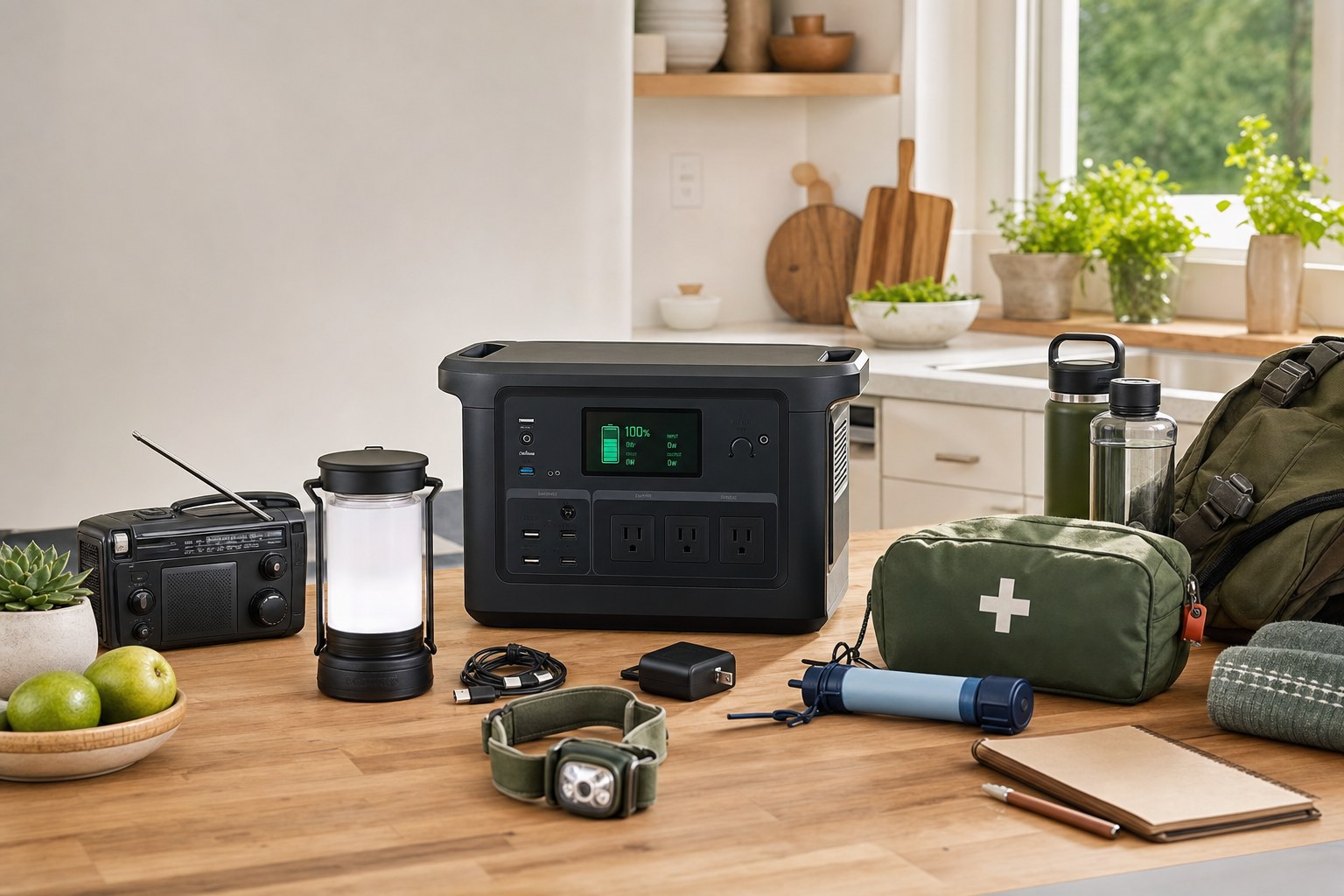
Featured Options Compared in This Guide
Full specs & notes ↓Choose an emergency power station by what must run, how much energy it needs, and how long you need to bridge before recharging or relocating. Start with a household outage budget, then compare battery capacity and output separately: watt-hours describe stored energy; watts describe power output.
For a useful plan, set a target duration and identify what you will do if the outage lasts longer. Treat recharging, food storage, and medical needs as parts of that decision before spending money on extra batteries.
Build a load list you can actually use
Separate the equipment you want to support into three groups:
- Communications and lighting: Phones, a radio, lights, and internet equipment if service remains available. Decide which need continuous power and which can be charged occasionally.
- Appliances with a larger energy budget: A refrigerator, freezer, fan, or pump. Record the exact appliance, its operating power, any stated starting requirement, and the hours you intend to use it.
- Medical equipment: Make a separate continuity plan based on the device instructions and advice from its manufacturer or distributor. The FDA recommends checking whether a medical device can use batteries or a generator.
For refrigeration, consider recording a full day’s energy use rather than estimating consumption from a single power reading. For a pump, ask its manufacturer about starting demand and estimate several possible operating schedules instead of assuming one fixed daily energy figure. These are planning steps, not promised outage runtimes.
Keep two checks separate: whether the station can operate the planned combination of appliances, and whether its battery can supply enough energy for the required duration.
Calculate hours with an explicit allowance
Suppose a hypothetical station has 1,000Wh of nominal storage and you budget 80% for delivery to the loads after a reserve and conversion losses:
Budgeted energy = 1,000Wh × 0.80 = 800Wh.
Estimated runtime = budgeted watt-hours ÷ average combined watts.
| Assumed average combined load | Illustrative runtime |
|---|---|
| 40W | 20 hours |
| 100W | 8 hours |
| 200W | 4 hours |
| 500W | 1.6 hours |
The 80% factor is a chosen planning assumption, not a measured efficiency for either station below. Use these figures to compare scenarios, then allow additional contingency if your household energy estimate is uncertain.
For another hypothetical household, refrigeration requiring 1,200Wh/day plus 300Wh/day for other essentials totals 1,500Wh/day. Under the same assumption:
- One day requires 1,500Wh ÷ 0.80 = 1,875Wh nominal storage.
- Two days require 3,000Wh ÷ 0.80 = 3,750Wh nominal storage.
Those results address energy only. They do not establish whether an inverter can start the refrigerator or operate it alongside your other appliances.
Two EcoFlow stations for different outage budgets
The figures below are manufacturer specifications. They provide a basis for sizing, but do not establish household runtime or comparative reliability.
| Station | Nominal storage | Rated AC output | Manufacturer-listed weight | Practical fit |
|---|---|---|---|---|
| EcoFlow DELTA 3 | 1,024Wh | 1,800W total | Approximately 12.5kg / 27.6lb | Consider for a smaller energy budget or when moving the station is a priority. |
| EcoFlow DELTA 2 Max | 2,048Wh | 2,400W | 23kg | Consider when the energy budget exceeds a 1kWh station and the additional weight is manageable. |
The DELTA 2 Max has twice the nominal base storage of the DELTA 3, while its rated AC output is one-third higher. That distinction matters: a household with modest power demand but a long outage target may need more watt-hours without needing a much larger inverter.
For the hypothetical 1,500Wh daily budget above, the DELTA 3’s base capacity falls below the calculated 1,875Wh requirement. The DELTA 2 Max exceeds it, but only modestly; this calculation alone would not justify promising a full day of backup.
Expansion changes the energy budget. EcoFlow lists the DELTA 3 as expandable to approximately 5kWh with specified compatible extra batteries. For the DELTA 2 Max, it lists 4,096Wh with one extra battery and 6,144Wh with two. Compare the complete configuration you intend to buy, including compatible batteries and cables. See the DELTA 3 specifications and DELTA 2 Max configurations.
For sizing, use the rated AC outputs in the table. Do not substitute the larger X-Boost marketing figures for a device-specific compatibility check.
Medical equipment needs its own continuity plan
The FDA’s disaster guidance advises reading the medical device’s instructions or contacting its manufacturer or distributor to establish whether battery or generator operation is possible. It also recommends notifying the electric company and fire department about medical equipment that requires power.
Prepare specific questions: Which backup source and connection are suitable? How much operating time is needed? What happens when power switches sources? What should you do if backup power runs out? Consider discussing the duration and relocation plan with your medical provider.
EcoFlow lists UPS switching of less than 10 milliseconds for the DELTA 3 and less than 20 milliseconds for the DELTA 2 Max. Those specifications alone do not establish compatibility with a particular medical device.
For people who depend on a device to stay alive, the FDA advises seeking emergency services immediately and, where possible, contacting the local public health authority about evacuation before adverse weather. After power returns, check the device settings: the FDA notes that an interruption can reset some devices to their defaults. FDA medical-device guidance.
Plan recharging as an energy budget
A hypothetical 200W panel receiving four equivalent full-sun hours, with an assumed 0.75 charging allowance, would add:
200W × 4 hours × 0.75 = 600Wh per day.
A continuous 200W load would consume 4,800Wh over 24 hours. In that scenario, the panel replaces only a fraction of the daily consumption. Neither the sunshine assumption nor the charging allowance is a forecast or a measured result.
Compare a low-solar scenario and a no-solar scenario before relying on panels through an outage. Identify another charging location or a place to relocate if the battery reserve becomes insufficient.
EcoFlow lists maximum solar input of 500W for the DELTA 3 and 1,000W for the DELTA 2 Max. These are input limits, not daily energy yields. The higher limit matters only if your compatible panel setup and available sunlight can use it. Match the panel arrangement to the station’s electrical input requirements before purchasing. DELTA 3 charging specifications; DELTA 2 Max charging information.
For vehicle charging, identify the actual charging equipment in your plan. EcoFlow’s advertised 800W alternator-charging option uses an alternator charger; do not budget that rate for an ordinary vehicle accessory socket. EcoFlow DELTA 2 Max charging comparison.
Protect food even if battery power runs out
The FDA recommends appliance thermometers, with the refrigerator at or below 40°F and freezer at or below 0°F. During an outage, keep doors closed as much as possible. An unopened refrigerator generally keeps food cold for about four hours; a full freezer holds its temperature for approximately 48 hours, or 24 hours when half full, with the door closed.
Prepare coolers and ice for an outage lasting beyond the refrigerator’s short reserve. This gives the food plan another option if battery capacity must be reserved for other needs.
After power returns, use temperatures and elapsed time to assess food. The FDA says to discard refrigerated perishables that have been above 40°F for four hours or more. Appearance and smell are insufficient checks. Follow its separate guidance for frozen food and food exposed to flooding. A station’s remaining charge percentage does not establish food safety. FDA food-safety guidance.
Choose the connection plan before the outage
For plug-in backup, plan around appliances that can connect directly within the station’s ratings. Treat support for house circuits as a separate installation decision.
EcoFlow describes transfer-switch use for partial home backup on its DELTA 2 Max page. Its Home Backup Kit transfer-switch instructions require installation by a qualified electrician following the installation instructions and applicable electrical codes. Ask the installer and EcoFlow to identify the exact compatible switch, station, and cable combination; the brand name alone is insufficient to select the kit.
If a portable fuel-burning generator is part of the recharge plan, follow the FDA’s carbon-monoxide precautions: operate it outside, away from open doors or windows where exhaust could enter. An open garage door does not make a garage an appropriate operating location for a portable generator.
Make the kit easy to use
Keep a written load list, charging plan, device instructions, and contact numbers accessible offline. For station storage and charging, use the exact model’s instructions to set your preparation schedule.
Before an expected outage, consider a rehearsal with the nonmedical appliances you intend to run. Record their energy use over your target period and decide which optional loads to remove if the reserve falls faster than planned. Keep separate lights and phone backup available so that using the main station for refrigeration does not consume your only communications reserve.
Shopping option: search Amazon for the EcoFlow DELTA 2 Max. This is an affiliate link; GreenChoice may earn a commission from qualifying purchases. Compare the station and included extra batteries against your planned configuration.
Sources
Products Compared in This Guide
The EcoFlow DELTA 2 Max
Compare current manufacturer specifications, materials, and package options for The EcoFlow DELTA 2 Max.
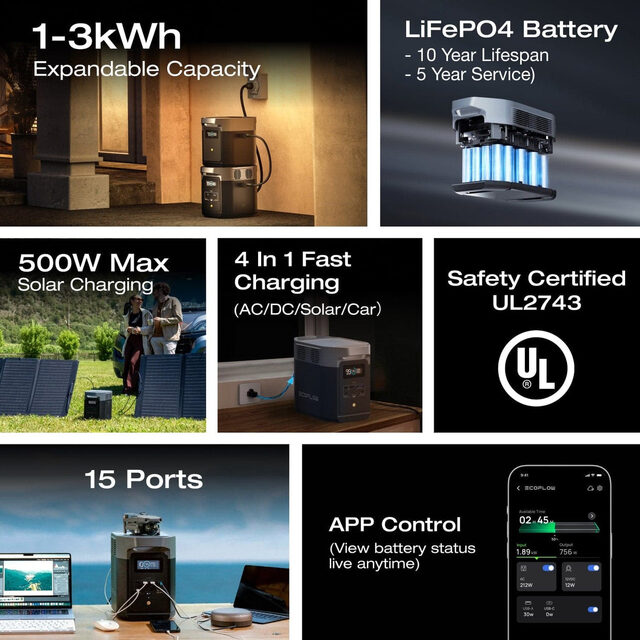
EcoFlow Delta 2
The best emergency prep station for most households. 1,024Wh LiFePO4, 1,800W output, 50-min charge via X-Stream. Can top up from your car's 12V outlet in the hours before a storm. Handles refrigerator, CPAP, phone charging, and LED lights through a 12-hour outage easily.
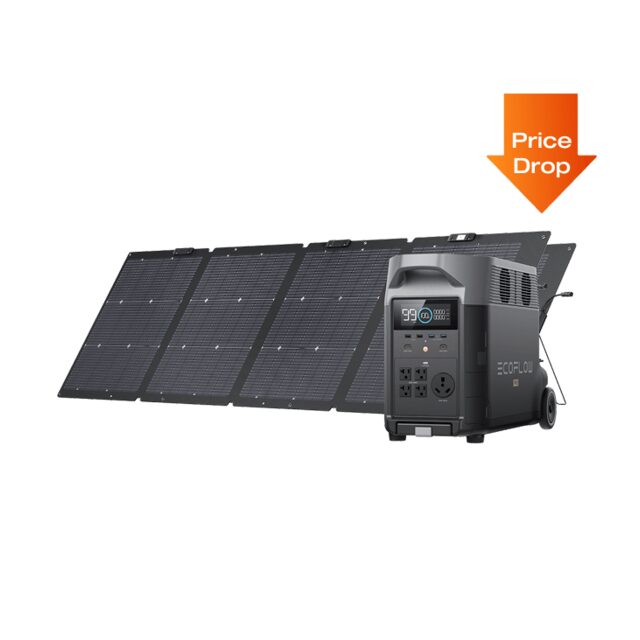
EcoFlow DELTA Pro
For serious whole-home backup: 3,600Wh, 3,600W output, expandable to 25kWh, 240V split-phase support. Connects to your electrical panel via the EcoFlow Smart Home Panel. Replaces a whole-home generator for most outage scenarios.
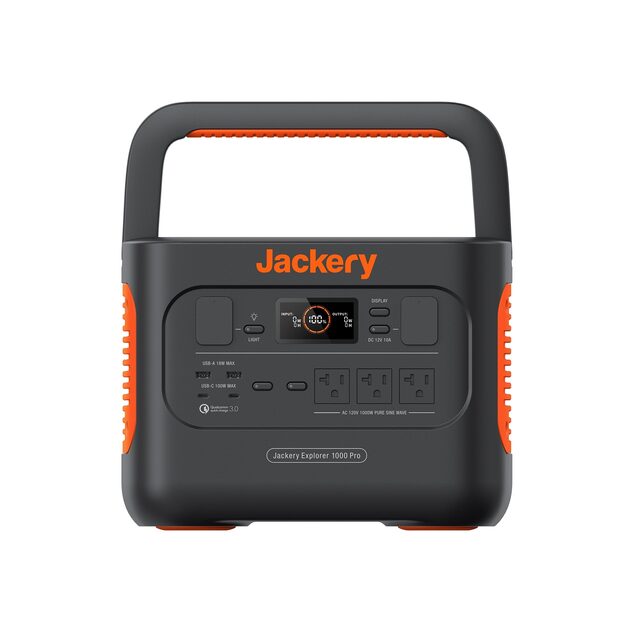
Jackery Explorer 1000 Pro
The best value for an apartment or condo prep station. 1,002Wh LiFePO4, 1,000W output, 1.8 hours to 80% via AC. Lighter than the Delta 2 (25 lbs). Handles all device charging, LED lights, CPAP, and small fans. Can't run a refrigerator continuously but handles short-duration critical loads.