EcoFlow DELTA 2 Review: Capacity, Expansion and Practical Limits
Compare the EcoFlow DELTA 2's battery capacity, AC output, charging options and compatible extra batteries to decide whether it fits your backup needs.
Featured Options Compared in This Guide
Full specs & notes ↓The EcoFlow DELTA 2 is worth considering when you need 1,800W output but can work within a 1,024Wh starting battery capacity. Its appeal is the combination of fast wall charging and an expansion path. Whether that is enough depends on the energy your devices need between recharges, plus the replenishment you can realistically arrange—not simply your daily consumption. EcoFlow DELTA 2 overview; capacity and expansion specifications.
For occasional short appliance use alongside electronics, the base unit may fit. For a longer interval without charging, compare an extra battery. If your needs include higher AC output or more solar input, compare the DELTA 2 Max as a separate power station.
What the core specifications mean
| Item | EcoFlow’s published figure | Buying implication |
|---|---|---|
| Base battery capacity | 1,024Wh | Size the energy budget around the interval before the next recharge |
| Standard output | 1,800W | Check the combined demand of devices you intend to run together |
| X-Boost | Appliances up to 2,200W, according to EcoFlow | A separate operating-mode claim, not the standard output rating |
| Solar input | Up to 500W | An input ceiling, not a prediction of daily solar harvest |
| AC charging | 0–80% in 50 minutes under laboratory conditions; 0–100% in 80 minutes | Useful where a wall-charging stop is available |
| Battery chemistry and endurance | LFP; EcoFlow advertises 3,000+ full cycles before reaching about 80% capacity | A manufacturer cycle-life claim, not a guaranteed service life in years |
Sources: DELTA 2 overview and Smart Extra Batteries comparison.
Build a runtime budget around your actual trip or outage
Power and energy answer different questions. Watts describe demand at a moment; watt-hours describe consumption over time. Virginia Cooperative Extension explains energy estimation as wattage multiplied by operating hours. The Department of Energy also distinguishes power capacity from stored energy and explains that storing and retrieving energy involves losses. Consequently, 1,024Wh of nominal capacity should not be treated as 1,024Wh guaranteed at your appliances. Virginia Cooperative Extension; DOE storage basics.
These are hypothetical load calculations, not measured DELTA 2 runtimes:
| Planned use | Energy consumed by the load |
|---|---|
| A steady 100W load for four hours | 400Wh |
| A steady 200W load for four hours | 800Wh |
| A 1,500W appliance for ten minutes | 250Wh |
The second and third examples together require 1,050Wh at the appliances, already exceeding the base battery’s nominal capacity before losses. Running the 1,500W appliance briefly therefore makes a meaningful difference to an otherwise modest electronics budget.
Use the longest planned gap between charging opportunities as your starting point. A daily energy total near 1,024Wh does not automatically require a larger battery if replenishment arrives when needed. The same demand with no charging available for two days is a different purchase decision. Leave room for losses and a reserve rather than planning to consume the full nominal capacity.
Refrigerators and other appliance loads
Refrigerators cycle on and off, so multiplying their running wattage by every hour they remain plugged in can misrepresent consumption. Virginia Cooperative Extension describes this cycling behavior. Separately, GE explains that compressor startup can create a higher power demand and that defrost equipment affects how refrigerator ratings should be interpreted. For refrigerator backup, establish both energy use over the intended interval and the exact appliance’s power requirements. Avoid applying a universal startup multiplier. Virginia Cooperative Extension; GE appliance power guidance.
GE also identifies voltage, frequency and sufficient power as requirements when matching appliances to an auxiliary source. EcoFlow’s broad appliance-coverage advertising does not establish compatibility with your particular refrigerator, microwave or air conditioner. GE guidance.
Keep X-Boost separate from the standard rating
EcoFlow publishes 1,800W output and advertises operation with appliances up to 2,200W using X-Boost. These figures describe different conditions. Use the standard rating for initial load planning; treat any purchase that depends on X-Boost as requiring appliance-specific compatibility information. The higher marketing figure alone is insufficient to decide whether your equipment will operate as intended. DELTA 2 overview.
Charging: wall access changes the buying decision
EcoFlow’s 50-minute claim for charging from empty to 80% applies to AC charging under laboratory conditions. That can make the base battery more practical on a trip with regular wall access, but it does not predict charging from a vehicle accessory socket or solar panel. DELTA 2 overview.
The same page promotes charging 1kWh in about 1.3 hours using EcoFlow’s separate 800W Alternator Charger. That is an accessory-based charging arrangement, not the performance of a standard vehicle outlet. Consider it only as part of a vehicle installation plan, rather than assuming ordinary car charging will match wall charging.
Solar harvest and the cable to buy
DELTA 2 accepts up to 500W of solar input, and EcoFlow advertises charging in as little as three hours. Actual harvest depends on conditions: DOE identifies heat, dirt and shading as sources of reduced solar yield. A shaded campsite can therefore make replenishment the limiting factor even when the battery is large enough for one evening. EcoFlow overview; DOE photovoltaic energy yield.
For illustration, an assumed average input of 150W over four hours supplies 600Wh before storage losses. This is arithmetic, not a predicted DELTA 2 charging result. If consumption repeatedly exceeds replenishment, an extra battery extends the available reserve but does not close that ongoing energy deficit. DOE storage basics.
For the cable, EcoFlow identifies Solar to XT60i as a preferred match for DELTA 2. Its cable page also describes Solar to XT60 as compatible across DELTA and RIVER models. Those statements concern cable compatibility; they do not establish that every panel or panel array meets DELTA 2’s electrical input requirements. EcoFlow solar cable page.
Budget for the cable when buying a standalone station: EcoFlow’s DELTA 2 overview says the solar-to-XT60 cable is included only with purchases of EcoFlow portable solar panels. Confirm which cable the selected bundle contains. Box contents.
Expansion: three compatible batteries, one connection allowance
EcoFlow lists three compatible extra-battery models and limits DELTA 2 to one extra battery. The total capacities below are calculated by adding the accessory capacity to the station’s 1,024Wh. They are nominal storage totals, not delivered-energy promises. Smart Extra Batteries specifications and FAQ.
| Compatible accessory | Added capacity | Combined nominal capacity | Listed chemistry | Added weight |
|---|---|---|---|---|
| DELTA 2 Extra Battery | 1,024Wh | 2,048Wh | LFP | 21lb |
| DELTA Max Extra Battery | 2,016Wh | 3,040Wh | NCM | 40lb |
| DELTA 2 Max Extra Battery | 2,048Wh | 3,072Wh | LFP | 42lb |
These are Extra Battery accessories, distinct from standalone stations named DELTA Max or DELTA 2 Max. The distinction matters when shopping: buying another similarly named power station is not the expansion configuration listed in this table.
The DELTA 2 Extra Battery adds the least weight of these three options. The two larger accessories provide similar storage, but differ in chemistry and published endurance: EcoFlow lists 800 cycles to 80% capacity for the NCM DELTA Max Extra Battery and 3,000 cycles to 80%+ for the LFP DELTA 2 Max Extra Battery. Compare the exact accessory rather than treating all compatible batteries as equivalent. EcoFlow comparison.
When DELTA 2 Max is the more relevant comparison
The standalone DELTA 2 Max has 2,048Wh capacity, 2,400W total AC output and two solar inputs supporting up to 1,000W combined. EcoFlow lists its weight as 50lb. These are DELTA 2 Max specifications. DELTA 2 Max specifications.
DELTA 2 with its 1,024Wh Extra Battery reaches the same nominal storage capacity as the standalone Max. Choose between those arrangements based on the capability you need: expansion addresses a storage shortfall, while the Max also offers higher published AC output and solar input. More storage alone should not be treated as an upgrade to the base station’s output rating.
For other capacity classes, see the portable power station guide.
Automatic backup needs its own compatibility decision
EcoFlow advertises an emergency power supply mode that automatically switches to battery when grid power fails. That description alone does not establish uninterrupted operation for every connected device. If avoiding a restart is essential, obtain the equipment’s transfer requirements and a specified transfer time before choosing this setup. DELTA 2 overview.
For medical equipment, FDA advises consulting the device instructions, distributor or manufacturer to determine whether battery or generator power is supported. It also advises notifying the electric company and fire department about medical devices that require electricity and checking device settings after power returns. Make the device’s backup requirements part of the purchase decision. FDA medical-device outage guidance.
Where to browse
Prices and availability change. These search listings are a place to check the current product.
Sources
- EcoFlow DELTA 2 overview
- EcoFlow Smart Extra Batteries: capacities, compatibility and connection limits
- EcoFlow Solar to XT60/XT60i Charging Cable
- EcoFlow DELTA 2 Max specifications
- Virginia Cooperative Extension: estimating appliance energy use
- GE Appliances: running an appliance on a generator
- DOE: photovoltaic system design and energy yield
- DOE: solar energy and storage basics
- FDA: medical devices and natural disasters
Products Compared in This Guide
EcoFlow Delta 2
Compare current manufacturer specifications, materials, and package options for EcoFlow Delta 2.
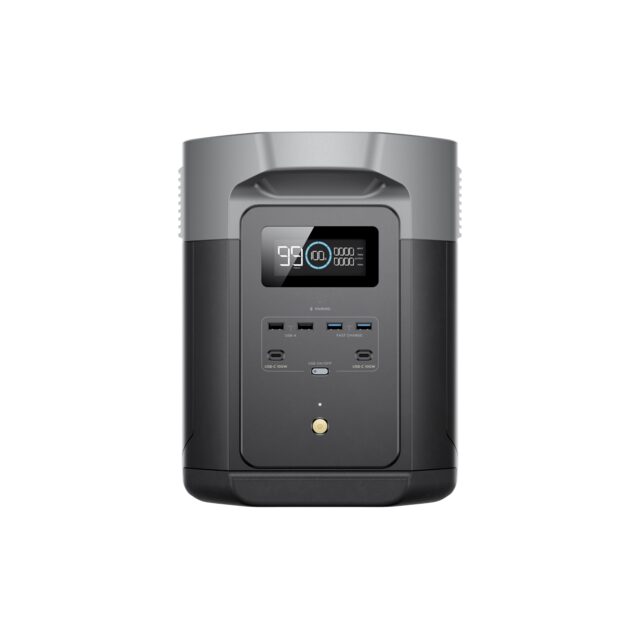
EcoFlow Delta 2 Max
Double the capacity (2,048Wh) for $500 more. The right upgrade if you're running a 12V cooler 24/7 or need two-day self-sufficiency without solar input. Same fast charging, same LiFePO4.
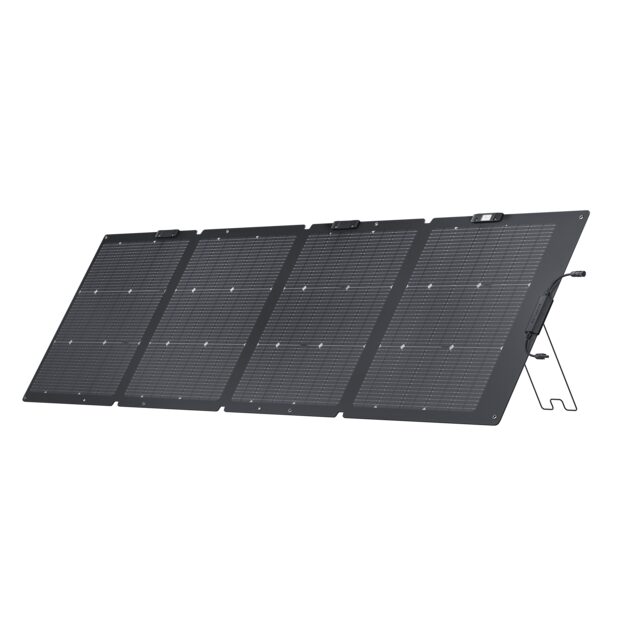
EcoFlow 220W Bifacial Solar Panel
The panel to pair with the Delta 2. Bifacial design adds 5–10% real-world output. Folds to backpack size. The kickstand is adjustable and genuinely sturdy.
Frequently Asked Questions
Which extra batteries work with the EcoFlow DELTA 2?
EcoFlow lists the DELTA 2 Extra Battery (1,024Wh), DELTA Max Extra Battery (2,016Wh) and DELTA 2 Max Extra Battery (2,048Wh) as compatible. DELTA 2 accepts one extra battery. These accessories are distinct from the similarly named standalone power stations.
Does a 1,024Wh battery deliver 1,024Wh to appliances?
Do not budget on receiving the full nominal capacity. Energy storage involves conversion and retrieval losses; the capacity figure alone does not establish delivered appliance energy or runtime.
Does X-Boost make DELTA 2 a 2,200W power station?
EcoFlow lists 1,800W output and separately advertises appliances up to 2,200W with X-Boost. Treat the higher figure as a mode-specific claim, not a replacement for the standard output rating or confirmation that a particular appliance will work.
Which solar cable should I choose for DELTA 2?
EcoFlow identifies Solar to XT60i as a preferred match for DELTA 2, while also describing Solar to XT60 as compatible across DELTA and RIVER models. The DELTA 2 overview says the solar cable is included only with purchases of EcoFlow portable solar panels. Cable compatibility alone does not establish compatibility of a complete panel setup.