Featured Options Compared in This Guide
Full specs & notes ↓An off-grid solar system needs to meet three separate requirements: enough stored energy between charges, enough output for simultaneous loads, and enough generation to replenish what you use. A large battery cannot compensate indefinitely for inadequate solar collection, and a high output rating does not establish runtime.
Start with the appliances and the time you need them to operate. Then choose whether the job calls for movable plug-in power, integration with an RV battery system, or a permanent cabin installation.
Choose the arrangement that fits the job
| Arrangement | When to consider it | Decision to resolve first |
|---|---|---|
| Portable power station with compatible panels | Camping, remote work, or selected plug-in backup loads | Can its storage cover the interval between charging opportunities? |
| Panels and a controller connected to an RV house battery | Supplying built-in vehicle loads | How will solar charging fit the existing battery and other charging equipment? |
| Separate batteries, solar controller, and inverter | A cabin or other permanent installation | What seasonal energy budget and electrical design will support the intended loads? |
| An inverter/charger within a component system | A system that also uses shore power or another external AC source | How many AC inputs are needed, and which loads should receive battery power? |
Package names do not tell you which of these arrangements you are buying. For example, EcoFlow offers the DELTA 3 alone, with an extra battery, and in several panel bundles. Victron’s SmartSolar installation diagram instead shows a separate controller, battery, panels, and DC loads. Those are different purchasing scopes. EcoFlow package options; Victron installation diagram.
For AC appliances, an inverter converts battery DC power to AC. Victron describes its inverter/chargers as combining that function with battery charging and automatic transfer from an external AC supply. Its selection guide distinguishes the MultiPlus range’s single AC input from the Quattro range’s two inputs. That distinction matters when planning for both shore power and a generator; the final model and installation still need system-specific sizing. Victron inverter/charger guide.
Calculate daily energy and battery reserve
For a steady load:
Energy in Wh = watts × operating hours.
For an appliance that cycles on and off, use a daily energy figure covering its intended use instead of multiplying its running wattage by 24 hours. Include overnight and standby consumption in your budget.
Here is a hypothetical camping or small-backup example. None of these figures represents a tested product or a promised consumption level.
| Load | Illustrative assumption | Daily energy |
|---|---|---|
| Cooler | Assumed daily total | 600Wh |
| Laptop | 50W for 4 hours | 200Wh |
| Lights, combined | 10W for 5 hours | 50Wh |
| Phones, combined | Daily allowance | 40Wh |
| Fan | 20W for 6 hours | 120Wh |
| Total | 1,010Wh |
Add cooking, heating, tools, or air conditioning if they belong in your actual plan. Alternatively, explicitly leave them outside the battery-powered load list.
Suppose you want two days without charging and choose an illustrative assumption that 80% of nominal battery capacity reaches the loads after reserve and losses:
Required nominal storage = 1,010Wh × 2 ÷ 0.80 = 2,525Wh.
The 80% factor is a planning assumption, not a measured efficiency or a universal battery discharge limit. Replace it with appropriate operating limits and loss estimates for the chosen system.
EcoFlow lists 1,024Wh for the DELTA 3 and 2,048Wh for the DELTA 3 plus DELTA 3 Extra Battery package. Under the same hypothetical 80% assumption, those capacities would provide about 819Wh and 1,638Wh to loads. The base unit falls short of this example’s full day, and the extra-battery package still falls short of two days. Both packages list 1,800W output: adding this battery increases storage without increasing that listed output. EcoFlow specifications and package options.
This makes the practical choice clearer: reduce the daily load, recharge sooner, or select more storage. A higher output number alone does not solve the energy shortfall.
Check simultaneous power separately
Make a second list showing which appliances will run together. A hypothetical 1,200W cooking appliance and 600W appliance already total 1,800W before any other AC loads are added.
Victron’s sizing guidance calls for considering combined continuous demand as well as starting peaks from equipment such as pumps and compressors. It also says the battery system, wiring, protection, and battery management system must support the inverter’s DC demand. A battery’s energy capacity alone does not establish that capability. Victron output-power guidance.
For the DELTA 3, EcoFlow’s specification table lists 1,800W total across its six AC outlets and separately lists 3,600W surge. Use the normal output rating for the running-load budget; the surge entry does not establish how long a particular appliance can operate above that rating. Obtain appliance-specific compatibility information before relying on X-Boost for a load exceeding normal output. EcoFlow specifications.
For an RV or cabin, give the installer appliance model numbers, expected combinations, and available startup requirements. Include required AC voltage and frequency. Victron’s guide explains that these vary by model and that systems supplying both 120V and 240V require an appropriate configuration and professional design. Victron voltage and sizing guidance.
Estimate solar collection for your season
A simple planning calculation is:
Panel watts × equivalent full-sun hours × assumed delivery factor = daily energy.
Using an illustrative 400W array and a 0.75 delivery factor:
| Assumed equivalent full-sun hours | Calculated daily energy | Balance against the 1,010Wh load |
|---|---|---|
| 4 hours | 1,200Wh | 190Wh surplus |
| 2 hours | 600Wh | 410Wh deficit |
These are arithmetic scenarios, not a production forecast. Equivalent full-sun hours are an input to this simplified model, not simply the number of daylight hours. The delivery factor is also an assumption, not a specification for a named panel or controller.
The four-hour scenario only narrowly exceeds daily consumption. At a 190Wh daily surplus, replacing an additional 1,010Wh used during a day without charging would take more than five such days while continuing to supply the normal load. The two-hour scenario steadily consumes battery reserve.
That is why a weekend setup and a continuously occupied cabin need different planning. For a trip, you may be able to start charged and return before reserve runs out. For continuous operation, budget both ordinary consumption and recovery after poor production.
PVWatts estimates grid-connected PV energy production. It can inform generation planning, but its stated scope does not establish off-grid battery reserve or uninterrupted service. Ask a cabin designer to evaluate the intended season, load schedule, and periods of low production together.
Portable station or separate controller: a concrete comparison
The EcoFlow DELTA 3 and Victron SmartSolar controllers serve different roles. Their specifications help identify the work each can do; they are not interchangeable alternatives.
Choose the portable route when the listed outputs and storage fit your plug-in loads. EcoFlow lists a DELTA 3 weight of approximately 12.5kg / 27.6lb and solar charging input of 11–60V, up to 500W. Consider whether that weight fits your transport plan and whether the intended panel arrangement meets the input requirements. A panel’s wattage alone does not settle compatibility. EcoFlow specifications.
Consider a separate controller when designing around a house battery. Victron lists these differences between its SmartSolar models:
| Specification | SmartSolar MPPT 100/30 | SmartSolar MPPT 100/50 |
|---|---|---|
| Battery voltage | 12V or 24V | 12V or 24V |
| Rated battery charge current | 30A | 50A |
| Nominal PV power at 12V | 440W | 700W |
| Nominal PV power at 24V | 880W | 1,400W |
| Maximum PV open-circuit voltage | 100V | 100V |
| Maximum PV short-circuit current | 35A | 60A |
Source: Victron technical specifications.
For a hypothetical 400W array charging a 12V battery, both controllers’ listed nominal PV power figures exceed the array wattage. That makes the 100/30 worth evaluating before paying for additional charge-current capacity. It does not establish compatibility: array voltage, short-circuit current, and battery requirements still matter.
For a hypothetical 600W array at 12V, the 100/50’s listed nominal PV power accommodates that wattage, while 600W exceeds the 100/30’s 440W nominal figure. Victron says the controller limits input power when additional PV power is connected. This does not permit exceeding its voltage or current limits. Neither model lists 48V battery operation. Victron technical specifications.
The controller is only one part of the purchase. Victron’s installation diagram shows separate battery storage and panels; its installation requirements also call for battery fusing and guarded connections. Include those needs when comparing a component system with a portable station. Victron installation manual.
Make installation requirements part of the buying decision
For a permanent system, commission the electrical design before ordering components. Victron recommends confirming final system design and sizing with an authorised dealer or installer. Victron system-selection guide.
The SmartSolar manual illustrates several requirements that affect an RV or cabin layout:
- Cold-weather array voltage: Victron requires considering panel open-circuit voltage and its temperature coefficient because open-circuit voltage rises below 25°C. An arrangement near the controller’s 100V ceiling needs more analysis than adding panel wattages.
- Mounting space: These controllers require vertical mounting on a nonflammable surface, terminals downward, with at least 10cm clearance above and below for cooling.
- Protection: The manual requires a battery fuse and protection against accidental contact with battery and PV connections. It identifies the PV, battery, and control circuits as hazardous.
- Connection procedure: For automatic battery-voltage detection, the specified sequence connects the battery before PV and checks the detected voltage. Follow the complete manual rather than treating this overview as wiring instructions.
These requirements apply to the documented SmartSolar models. Victron installation instructions.
For building backup, have an installer specify the equipment, transfer arrangement, and circuit connections for the intended system. Victron distinguishes AC-input and energy-storage-system requirements in its inverter/charger guide; a solar controller specification is not a building-backup design. Victron inverter/charger selection.
Turn the numbers into a purchase plan
Camping: Compare the whole trip’s energy requirement with starting battery capacity and realistic charging opportunities. If the charged battery covers the trip, panels may be optional. Continue with the camping power setup guide.
RV: Decide whether you need movable plug-in power or integration with the house battery. Before changing battery voltage or adding a controller, inventory the existing DC loads and charging equipment. Use the RV solar setup guide for the next planning stage.
Cabin: Prepare a seasonal load schedule, identify loads that can be deferred, and specify how much time without charging you want to cover. Take that brief to the designer alongside the off-grid cabin guide.
Medical-device backup: Follow the device instructions or contact its manufacturer or distributor to establish whether battery or generator operation is allowed. FDA also advises checking device settings after power returns. A station’s general backup marketing does not answer those device-specific questions. FDA medical-device guidance.
Ask for a total cost covering storage, panels, charging equipment, AC equipment where needed, mounting, wiring, protection, installation, and any monitoring accessories. Compare that proposal with your actual usage: an occasional trip and a year-round cabin justify different purchases.
Environmental value also depends on what the system replaces. EIA describes solar’s lack of operating air-pollution and greenhouse-gas emissions while acknowledging impacts from material production, manufacturing, and disposal. That supports considering solar without treating every equipment purchase as impact-free. EIA solar environmental overview.
For additional portable shopping options, search Amazon for the Jackery Explorer 2000 Plus. This is an affiliate search link; GreenChoice may earn a commission from qualifying purchases. Compare the exact model and included equipment against your load budget before purchasing.
Sources
- PVWatts API: model scope
- EcoFlow DELTA 3: specifications and package options
- Victron: choosing an inverter/charger
- Victron SmartSolar MPPT 100/30 and 100/50: technical specifications
- Victron SmartSolar MPPT 100/30 and 100/50: installation
- FDA: medical devices and natural disasters
- EIA: solar energy and the environment
Products Compared in This Guide
The Jackery Explorer 2000 Plus
Compare current manufacturer specifications, materials, and package options for The Jackery Explorer 2000 Plus.
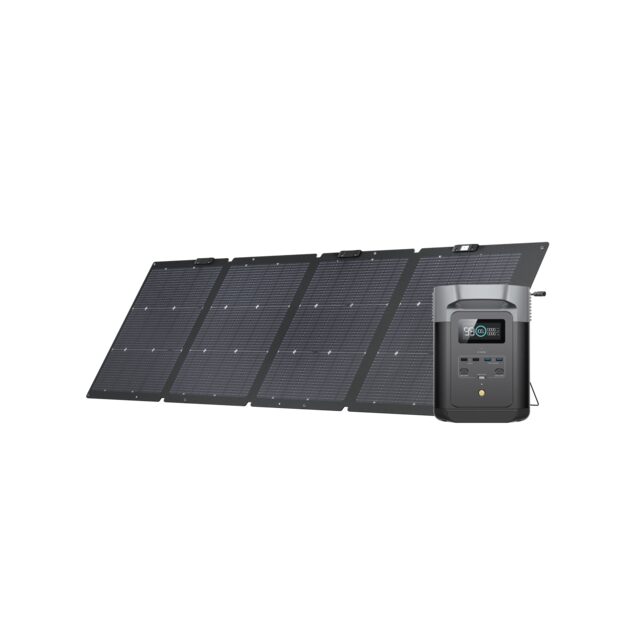
EcoFlow Delta 2
The best all-around portable power station for most people. 1,024Wh LiFePO4 battery, 1,800W AC output, charges from 0–80% in 50 minutes via X-Stream. Handles refrigerators, CPAP machines, and power tools without complaint. The 3,000 charge-cycle rating means it outlasts lithium-ion competitors by years.
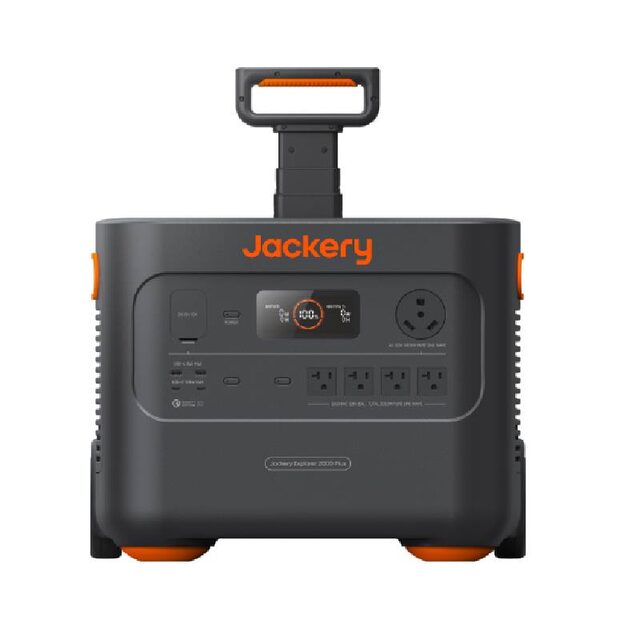
Jackery Explorer 2000 Plus
The expandable option if you anticipate growing your setup. Native 2,042Wh with add-on battery packs that scale to 12kWh. 3,000W AC output handles most home appliances. LiFePO4 chemistry, 4,000-cycle rating. Heavier and pricier than the Delta 2, but the expandability is unique.
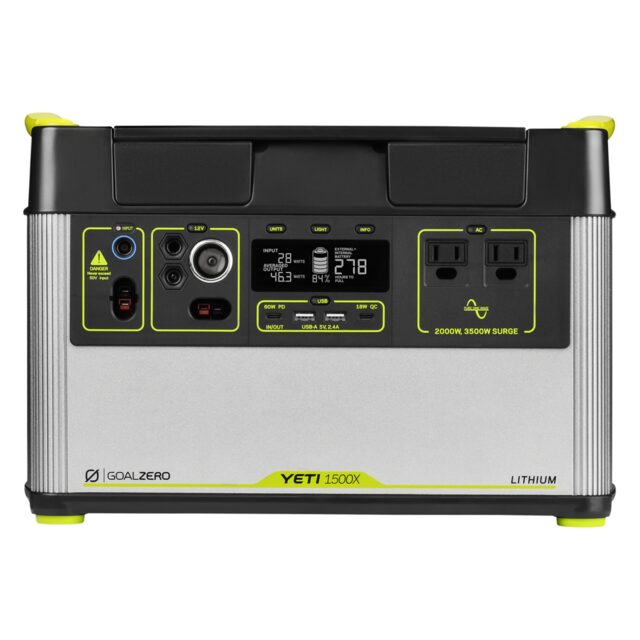
Goal Zero Yeti 1500X
The benchmark for reliability and ecosystem depth. 1,516Wh lithium NMC battery, 2,000W AC output, connects to Goal Zero's tank expansion packs and Nomad solar panels. App integration is the best in class. The NMC chemistry trades cycle count for energy density—solid for occasional use, not the best for daily cycling.