Balcony Solar for Renters: Portable Panels, Permissions and Bill Savings
Compare small-device balcony solar, battery storage and community solar, with practical space checks, permission questions and conditional savings math.
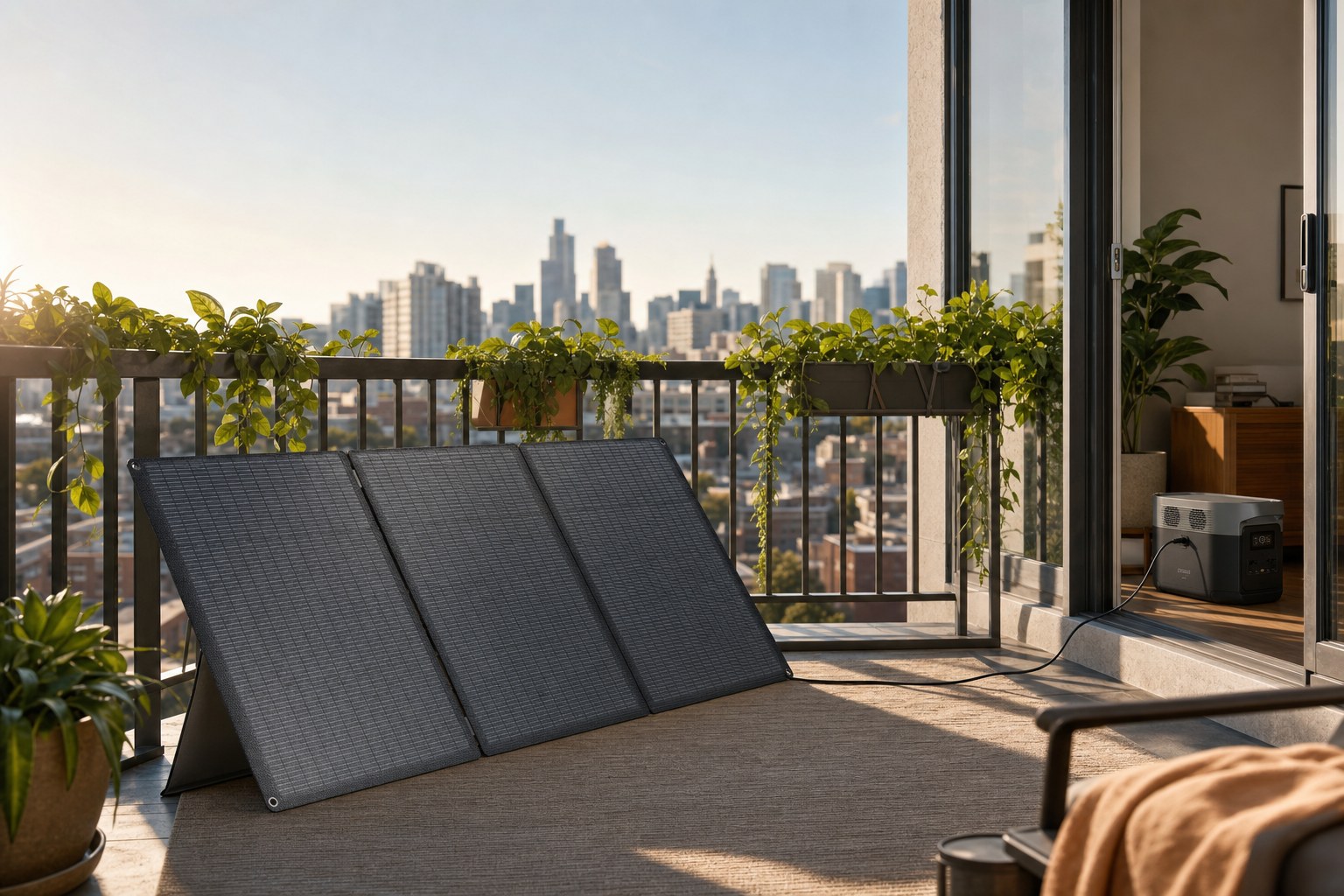
Featured Options Compared in This Guide
Full specs & notes ↓Balcony solar is most straightforward to assess as a small-device charging project. Start with the devices you want to charge, the space you can use and the sunlight that reaches it. Supplying building electricity is a separate installation decision; reducing your bill may be better served by an available community solar subscription.
A concrete small-device example is the Goal Zero Nomad 10, which the manufacturer describes as a charger for phones, power banks and other small USB devices. For renters whose priority is electricity costs, DOE explains that community solar typically offers credits from a shared array without requiring panels on their own roof.
Choose the route that matches your goal
| Your goal | Route to consider | What determines whether it fits |
|---|---|---|
| Charge a phone or other small USB device | Portable USB solar charger, with a compatible power bank if needed | Supported devices, usable sunlight and space for the open panel |
| Save solar energy for later use | Panel-and-battery system designed to work together | The particular system’s charging requirements, storage capacity and supported loads |
| Supply electricity through building wiring | A solar installation planned with the owner, utility and local authority | Applicable installation and connection requirements |
| Reduce electricity costs without balcony equipment | Community solar subscription | Eligibility, subscription charges, bill credits and moving terms |
DOE’s PV design overview explains that batteries store solar energy for later use and that panels are only one part of a complete system. That general capability does not establish which appliances a particular portable battery can run. If your goal extends beyond small USB devices, choose around documented support for those exact loads.
Settle placement and permission together
Before shopping, sketch the proposed setup: where the open panel will sit, whether anything attaches to the building, where a battery would be stored and where cables would run. Give that plan to the property manager and ask about balcony-use requirements. Request written answers you can keep with your lease.
Measure the usable footprint with furniture and normal access accounted for. A panel that fits only when folded is not a useful match. If the plan depends on railing attachments, ask specifically whether those attachments are permitted and how mounting requirements will be addressed. DOE’s design guidance emphasizes stable supports capable of withstanding environmental loads; a balcony location deserves more consideration than simply finding somewhere sunny.
For any proposed connection to building electricity, ask the utility and local electrical authority which process applies to that exact system. DOE’s rooftop permitting guide describes permitting, inspection and utility connection, with local variation. It is guidance for rooftop installations, not permission for a particular balcony connection method.
Assess the actual panel position
Observe the intended position at several times during a clear day. Note when the balcony above, railing, neighboring buildings or trees shade it. Record the location and time rather than describing the whole balcony as simply “sunny.” If winter use matters, revisit the assessment in that season.
DOE’s design guidance identifies orientation and tilt as factors in annual output. For an apartment, use that as a reason to compare the positions available to you—not to assign a fixed production estimate from compass direction alone.
An indoor window position needs its own assessment. Solar manufacturer PowerFilm explains that panels can generate through glass, but output falls relative to direct outdoor exposure and varies with glass, coatings, tint, sunlight angle and panel technology. Its examples do not establish a loss percentage for your window or charger. If indoor placement is your only option, treat it as a possible modest charging setup rather than budgeting on the panel’s rated output.
What a small charger actually offers
According to Goal Zero’s Nomad 10 specifications, the panel has a 10W rating, while its USB port is specified at 5V, up to 1.5A, or 7.5W maximum. These are manufacturer specifications, not demonstrated balcony output. The panel rating and USB maximum describe different parts of the product; neither promises continuous charging at that level.
Goal Zero lists unfolded dimensions of 9.5 × 14.5 × 0.75 inches. Use that footprint to check whether a compact charger fits your intended position. The manufacturer lists phones, headlamps, fitness trackers and power banks among its intended charging uses, and says charging times vary with conditions including season and sun angle.
For daytime use, direct charging may match your routine. For charging a device later, consider a manufacturer-supported power bank pairing. Goal Zero also says the Nomad 10 cannot be chained with other panels, so buying another is not a supported way to combine their output into one charging connection. Its care guidance says equipment being charged needs protection from dust, rain and snow. These details apply to the named charger and its guidance, not every portable solar system.
If your requirement is laptop or appliance backup, make a separate list of the devices and how long you need each one. Require documented load support and panel pairing before selecting a larger system. The Nomad 10’s small-device specifications do not answer that purchasing question.
Calculate savings from electricity you would otherwise buy
For a simple energy-charge estimate, use:
Grid electricity purchases avoided in kWh × the applicable avoidable charge per kWh.
For illustration only, suppose solar charging replaces 0.3kWh of grid purchases on 150 days each year, at an avoidable rate of $0.20/kWh:
0.3 × 150 × $0.20 = $9 per year.
These inputs are hypothetical. They are not a balcony production estimate, measured performance or a current tariff. Do not substitute a panel’s wattage or a battery’s nominal capacity for avoided annual grid purchases.
Read the energy-charge components of your bill rather than dividing the whole bill by consumption. DOE’s utility-rate guidance distinguishes consumption charges from demand charges and fixed charges. It also explains that energy prices can vary by time and season. If a monthly charge remains unchanged when you buy less electricity, exclude it from the savings calculation. For time-varying rates, use the rate applicable to the grid consumption you actually replace.
Compare the resulting annual estimate with the equipment cost. Keep any value you place on portable charging or backup separate from bill savings; those benefits do not increase the electricity savings arithmetic.
When community solar is the better next inquiry
If permitted panel positions receive little useful sun, or your main aim is lower bills, ask your utility about community solar availability. Compare expected credits against subscription payments and fees, then review cancellation and address-transfer terms before committing. DOE recommends reviewing contracts and state consumer protections; do not assume every subscription offers the same savings or flexibility.
A bill-credit subscription by itself does not supply backup power to your apartment. That does not mean every community solar project lacks outage benefits: DOE describes a microgrid combining community solar and battery storage. Ask whether a program offers any backup service to your particular building, separately from its billing benefits.
For a renter with permitted sunny space and small USB charging needs, a compact panel is a focused option to assess. For someone seeking building-circuit power, start with the owner and connection requirements. For bill savings without balcony equipment, start with subscription terms.
Sources
- DOE: Community Solar Basics
- DOE: Permitting and Inspection for Rooftop Solar
- DOE: Solar Photovoltaic System Design Basics
- Goal Zero: Nomad 10 product specifications and guidance
- PowerFilm: Will a Solar Panel Work Behind a Window?
- DOE: Evaluating Your Utility Rate Options
- DOE: The Road to Resilience with Rooftop Solar
Products Compared in This Guide
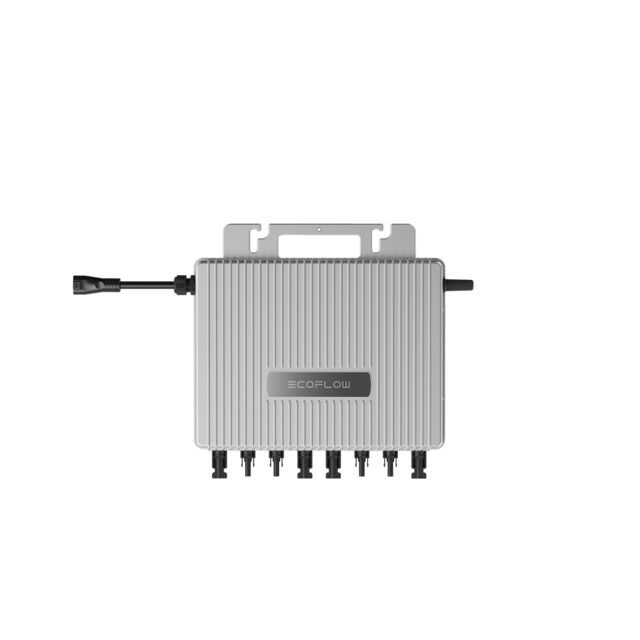
EcoFlow PowerStream Balcony Solar Kit (800W)
The most complete plug-in balcony solar system available. Includes 2× 400W bifacial panels, PowerStream microinverter, and EcoFlow app integration. Plugs into a standard outlet via a Schuko (EU) or NEMA 5-15 (US) plug and feeds solar power into your home circuit. With a Delta Pro battery, stores excess for overnight use.
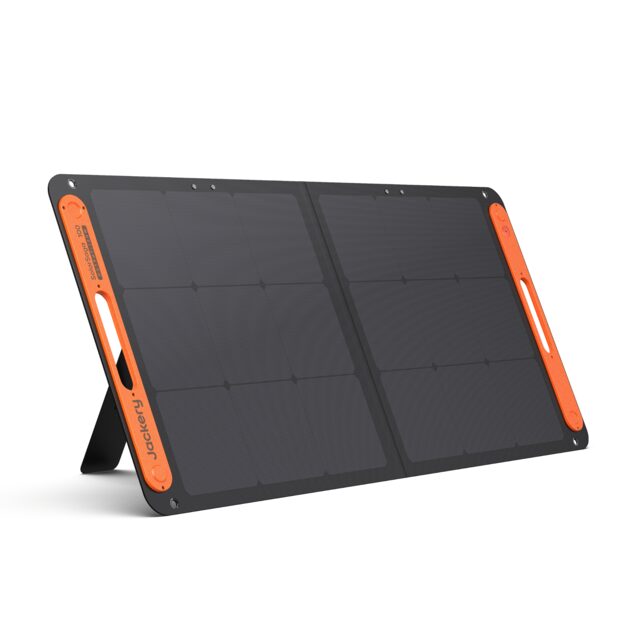
Jackery SolarSaga 100W
The simplest balcony panel—lean against the railing, connect to a Jackery station, charge devices. No grid connection, no permits, no installation. Produces roughly 300–500Wh on a sunny day depending on angle and orientation.
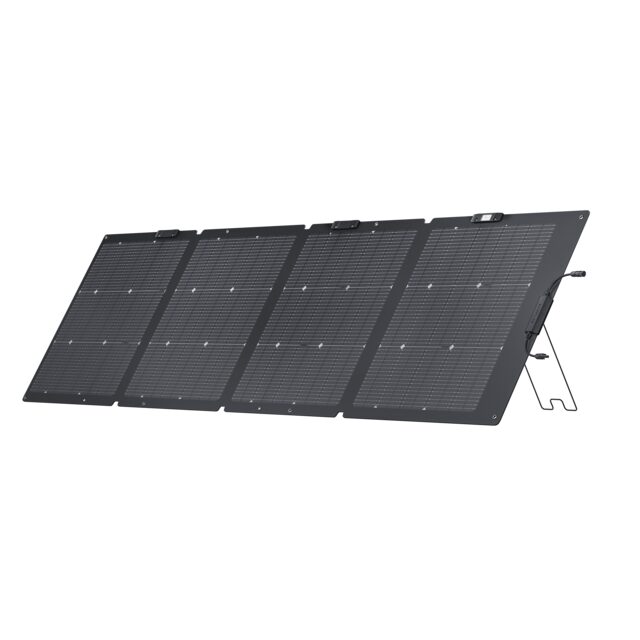
EcoFlow Delta 2 + 220W Bifacial Panel Bundle
The practical renter solution: the panel charges the Delta 2 during the day; the Delta 2 powers devices. No grid tie, no permits, full flexibility. The bifacial design helps on balconies where the panel faces a white building wall—reflected light adds 5–10% output.
Frequently Asked Questions
Can renters charge small devices with balcony solar?
A USB solar charger can charge supported small devices or a compatible power bank. Goal Zero describes this use for its Nomad 10, but charging depends on sunlight and placement. Check building permission before choosing a setup. Source: https://goalzero.com/products/nomad-10-solar-panel
Does a portable panel automatically need no landlord permission?
Do not assume that portability settles permission. Ask the property manager about the proposed panel position, mounting, battery storage and cable route before buying. Requirements for a connection to building electricity need a separate local inquiry.
Will community solar keep my apartment powered during an outage?
A bill-credit subscription by itself does not provide apartment backup power. Some community solar projects support resilience through additional infrastructure; DOE describes a microgrid using community solar and batteries. Ask what backup service, if any, reaches your building. Source: https://www.energy.gov/cmei/systems/articles/road-resilience-rooftop-solar