Jackery Explorer 2000 Plus Review: Capacity, Charging, and Fit
A specification-based review of the Jackery Explorer 2000 Plus: output limits, runtime planning, solar connections, battery expansion, and buying tradeoffs.
Featured Options Compared in This Guide
Full specs & notes ↓The Jackery Explorer 2000 Plus is worth considering for car-based camping and household backup when you need substantial AC output and room to add batteries. Its main drawback is handling: Jackery lists the base station at approximately 27.9kg, or 61.5 lb, before panels or expansion packs. For phones and lights alone, that is a substantial carrying burden. Jackery specifications
This review assesses the manufacturer’s specifications for the US Explorer 2000 Plus, model JE-2000C. Runtime examples below are calculations, not hands-on test results.
What its output rating means for your appliances
Jackery’s support table provides these base-station specifications:
| Specification | Published figure | Practical implication |
|---|---|---|
| Nominal battery capacity | 2,042.8Wh | Delivered energy depends on losses, operating settings, and load |
| Total AC output | 3,000W at 120V | All five AC outlets share this total |
| Instantaneous peak output | 6,000W | Check motor startup requirements; this is not sustained output |
| Battery chemistry and cycle rating | LiFePO4; 4,000 cycles to at least 70% capacity | The endpoint permits substantial capacity decline |
| Weight | Approximately 27.9kg / 61.5 lb | Plan vehicle loading and stairs before buying |
| Dimensions | 47.3 × 35.9 × 37.3cm | Allow room for the unit and cable connections |
| Charging temperature | 0–45°C / 32–113°F | Charging below freezing is outside the specified range |
The station includes a TT30 outlet, but its socket rating does not increase the shared 3,000W output. A single station supplies 120V; adding battery packs does not change that voltage. Outlet specifications
Simultaneous charging and discharging has a different output limit. Jackery specifies a maximum AC output current of 12A in that mode. It separately lists AC input at 120V with a 15A maximum. These are different limits, so a load that fits the battery-powered 3,000W rating should not automatically be treated as suitable while the station is charging. Output and charging specifications
For a campsite, add together the appliances you expect to operate at once. Running a cooking appliance and another high-power load together can be the deciding constraint even when each fits individually. For backup, separate the power needed to start an appliance from the energy needed to keep it running.
Runtime: budget energy before buying extra batteries
As an illustrative planning assumption, allowing 80% of nominal capacity for appliance use leaves approximately 1,634Wh. Divide that allowance by average load:
| Average appliance load | Calculated runtime without charging |
|---|---|
| 100W | 16.3 hours |
| 300W | 5.4 hours |
| 1,000W | 1.6 hours |
The 80% allowance is an assumption, not a measured Jackery efficiency figure. Actual runtime varies with temperature, appliance cycling, battery condition, settings, and the station’s own consumption. This simplified allowance does not model those effects individually. The starting capacity comes from Jackery’s support table.
For a refrigerator, measure energy use over a complete day under representative conditions rather than multiplying its running wattage by 24. For electric cooking or heating, multiply watts by operating hours: a hypothetical 1,500W load running for one hour consumes 1,500Wh, which uses most of this example’s energy allowance.
That distinction helps choose an upgrade. If your appliances fit the output limit but run out of energy too soon, battery expansion addresses the problem. If their combined demand exceeds the output limit, more stored energy alone does not solve it.
Solar charging: choose the arrangement with the panels
Jackery estimates about two hours for AC charging and about 25 hours from a car charging port. For SolarSaga 200W panels, its estimates are roughly seven hours with two panels, 3.8 hours with four, and two hours with six. Treat these as manufacturer estimates; weather and panel placement affect the charging you get. Charging support table
The two DC8020 solar inputs are connected in parallel. Jackery specifies a working voltage range of 17.5–60V, a maximum of 12A and 700W per port, and up to 1,400W combined. Six 200W panels total 1,200W of nameplate capacity; the higher input ceiling does not establish compatibility with an arbitrary array. Solar input specifications
Jackery documents these SolarSaga arrangements:
| Panel count | Connection arrangement | Adapter requirement |
|---|---|---|
| One or two | Direct connections; one panel per port when using two | Included cable; no additional series adapter required |
| Three | Combine three panels into DC Input 1 | One SolarSaga Adapter for Pro/Plus/New Series |
| Four | Two panels into each input | Two SolarSaga Adapters for Pro/Plus/New Series |
| Six | Three panels into each input | Two SolarSaga Adapters for Pro/Plus/New Series |
When both inputs are used, each must have the same panel count, with no more than six panels overall. Jackery calls for matching models and explicitly rejects putting a 100W panel on one input and a 200W panel on the other. Its mixed-model exception requires identical maximum wattage, open-circuit voltage, and operating voltage; it gives SolarSaga 200C and 200D as an example. Panels grouped on an adapter must follow its matching requirements, and the panel’s front conversion adapter may need removal or direct connection depending on the model. Panel and adapter instructions
For buying decisions, compare complete two-, four-, and six-panel setups, including the required adapters and space to deploy the panels. A two-panel setup involves fewer components, but Jackery’s charging estimate is much longer. Adding batteries without increasing available charging energy also increases the time needed to replenish an empty system.
Expansion: storage packs and station pairing are different
The Battery Pack 2000 Plus adds 2,042.8Wh and weighs approximately 19kg / 41.9 lb. Its listed box contents include an expansion cable. Jackery explicitly excludes compatibility with HomePower 2000 Plus v2, so the exact model name matters.
Using the published capacities, one base station plus one pack provides 4,085.6Wh nominal storage; with two packs, it provides 6,128.4Wh. Jackery supports up to five packs per station, giving approximately 12.26kWh including the base battery. That increases stored energy; the single station’s AC output remains the constraint for simultaneous loads. Station specifications · Battery pack specifications
Pairing two compatible stations is a different arrangement. Jackery says this increases both capacity and rated output, and the Explorer 2000 Plus requires a Jackery Connector for that operation. The battery pack’s expansion cable connects additional storage; it does not replace the required station-pairing connector. Before purchase, confirm whether the selected offer includes the Jackery Connector and what equipment your intended home connection requires. Parallel-operation guidance
How it compares with the EcoFlow DELTA 2 Max
The DELTA 2 Max is a useful comparison when shopping around 2kWh. These are manufacturer specifications, not comparative test results. Jackery specifications · EcoFlow specifications
| Buying consideration | Explorer 2000 Plus | DELTA 2 Max |
|---|---|---|
| Base capacity | 2,042.8Wh | 2,048Wh |
| AC output | 3,000W | 2,400W standard output |
| Base weight | Approximately 27.9kg | 23kg |
| Expansion with one base station | Up to five packs; approximately 12.26kWh total | Up to two extra batteries; 6,144Wh total |
| Solar inputs | Parallel inputs; matching panel arrangements required | Two inputs with independent MPPT tracking |
| Published cycle endpoint | 4,000 cycles to at least 70% capacity | 3,000 cycles to 80% capacity |
The base capacities are effectively alike for planning purposes. Jackery’s stronger reasons to choose it are its higher standard AC output and larger single-station expansion range. EcoFlow merits attention when your loads fit 2,400W and carrying weight matters: its published weight is 4.9kg lower.
Independent solar tracking is another architectural difference worth considering, though it does not establish a charging winner without the actual panels and conditions. Likewise, the cycle figures use different remaining-capacity endpoints and cannot support a simple claim that one battery lasts longer.
Compare complete configurations at purchase time. Include the batteries, panels, and connection hardware you actually need rather than comparing a bare station with an expanded bundle.
Backup limitations and ownership terms
Jackery’s EPS feature switches to battery power within 20 milliseconds after a mains failure. It does not provide zero-interruption switching, and Jackery excludes devices such as servers and workstations that require uninterrupted UPS operation. Choose around the connected equipment’s interruption tolerance. The support table also lists no waterproof or dustproof protection, which matters when planning campsite placement. EPS and environmental limitations
For the base station, Jackery documents a three-year standard warranty with an available two-year extension, for a maximum of five years. Confirm the extension terms applicable to the purchase. Station warranty specification
Condition and seller can change the ownership calculation. Jackery’s service policy lists six months of warranty for renewed products and limits warranty coverage to the original consumer purchaser. It also states a battery-cell coverage condition requiring a full charge within seven days of purchase and at least every six months. Its 30-day return period runs from receipt for purchases through Jackery’s website or Jackery’s Amazon Store; purchases elsewhere follow the respective retailer’s return policy. Jackery service policy
Choose the Explorer 2000 Plus when your load budget justifies its output, you can handle its weight, and its expansion path matches your expected needs. For the next planning step, use the emergency power guide or camping power setup guide.
Shopping option: search Amazon for the Jackery Explorer 2000 Plus. This is an affiliate search link, and GreenChoice may earn a commission from qualifying purchases. Confirm the model, included equipment, condition, and seller of any result before buying; this search link does not identify a specific offer.
Sources
Products Compared in This Guide
The Jackery Explorer 2000 Plus
Compare current manufacturer specifications, materials, and package options for The Jackery Explorer 2000 Plus.
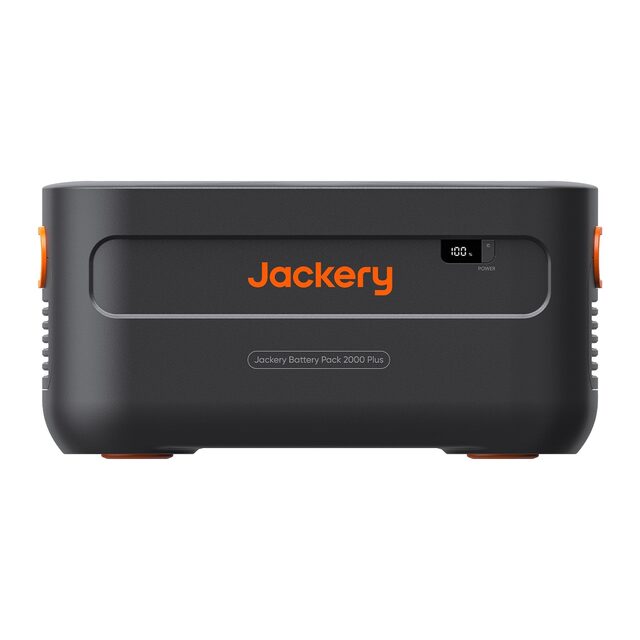
Jackery Explorer 2000 Plus
The expandable power station for buyers planning to grow their system. Ships at 2,042Wh but accepts Jackery battery packs to reach 12kWh total. LiFePO4, 4,000-cycle rating, 3,000W output. Expensive for the base unit; the value comes from the expandability.
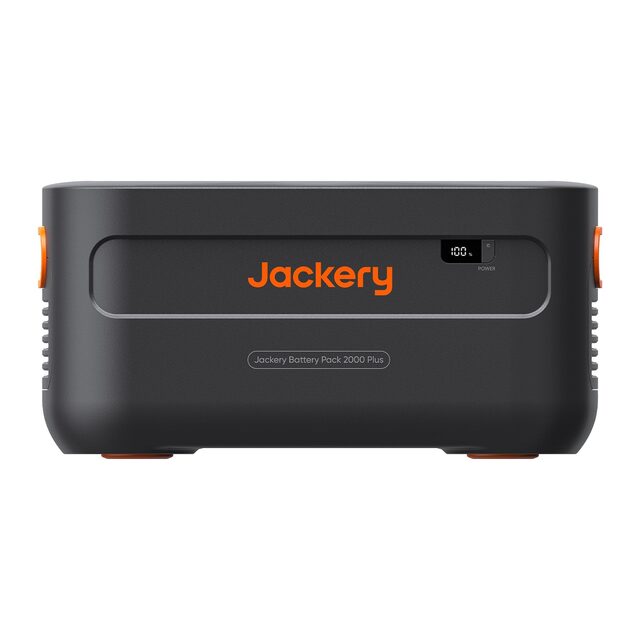
Jackery Battery Pack 2000 Plus
Each expansion pack adds 2,042Wh. Chain up to five packs to the Explorer 2000 Plus base for 12.24kWh total. The packs connect via a proprietary cable and integrate fully with the base unit's display and app.
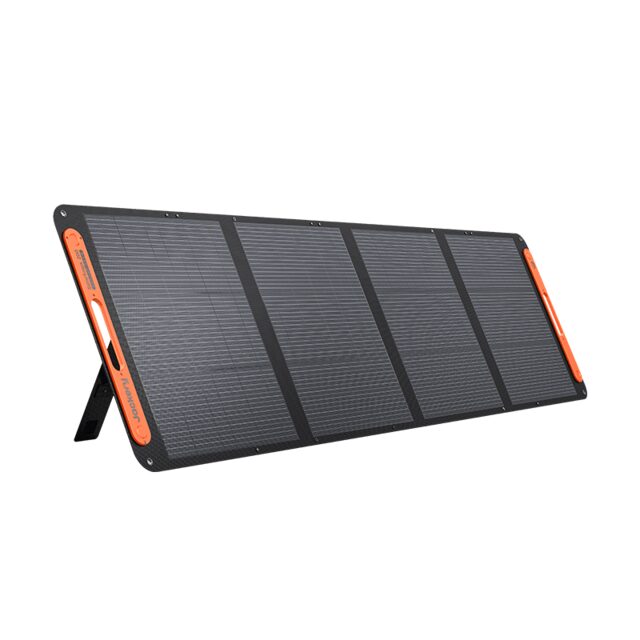
Jackery SolarSaga 200W
Jackery's best portable panel. IP67 waterproof, USB-A ports for direct device charging, folds to backpack size. The Explorer 2000 Plus accepts up to 1,200W solar input—pair three SolarSaga 200W panels to approach full charge in 3–4 hours on a clear day.