RV Solar Setup Guide: Panels, House Batteries, and Dry-Camping Loads
Size RV solar from daily loads and overnight reserve, compare roof and portable panels, and match controllers and batteries to your RV’s charging system.

Featured Options Compared in This Guide
Full specs & notes ↓An RV solar setup recharges the house battery for camping away from hookups. The useful starting point is how much energy you use each day and how long the battery must support you between charges. Panels, storage, and charging equipment answer different parts of that problem. Victron’s RV conversion guide describes how solar, shore power, and alternator charging fit together.
For an existing RV, first decide whether you need to replenish modest overnight use or support several days without another charging source. Include electric cooking and air conditioning explicitly if you intend to use them; the example below does not include either.
Audit the RV before buying panels
Record the house battery’s nominal voltage, chemistry, capacity, and charging limits. Identify the shore-power converter/charger, solar controller, alternator charging equipment, and any inverter. These determine which additions can work with the existing system.
A solar-ready sticker needs a vehicle-specific follow-up. For example, Zamp’s support page describes roof and sidewall ports and says the extent of factory wiring varies by RV manufacturer. For your RV, ask where the port connects, whether a controller is installed, and what current the wiring and connectors support. Confirm connector polarity and the intended regulated or unregulated panel arrangement before choosing an accessory.
As practical planning checks, measure roof space around vents, skylights, and the air conditioner. Ask the RV manufacturer or installer to specify attachment methods, sealing, service clearances, and allowable added weight. Include panels, batteries, and mounting hardware in the payload calculation.
Build a daily load sheet
For a load with reasonably steady power, watts × operating hours = watt-hours. Virginia Cooperative Extension’s energy-use guidance explains this calculation, notes that refrigerator compressors cycle, and identifies standby consumption as another load to count.
The following figures are hypothetical planning inputs, not measurements or typical consumption claims:
| Load | Example assumption | Daily energy at the appliance |
|---|---|---|
| Compressor refrigerator | Assumed daily total, including cycling | 600Wh |
| Lights, all fixtures combined | 12W × 5h | 60Wh |
| Roof fan | 20W × 6h | 120Wh |
| Laptop | 50W × 4h | 200Wh |
| Two phones combined | Assumed daily allowance | 40Wh |
| Water pump | 60W × 0.5h | 30Wh |
| Total | 1,050Wh |
Replace each input with your appliance documentation or suitable energy measurements. For the refrigerator, seek a daily energy total rather than multiplying compressor running watts by 24 hours. Add the electrical consumption of any heating equipment you plan to operate, plus controls and other continuously powered devices. Record inverter idle consumption separately when an inverter will remain on.
Keep measurement boundaries consistent: an appliance’s energy use and its battery-side supply draw are different quantities. If you measure consumption at the battery, do not add conversion losses already included in that reading.
Turn the load sheet into a battery reserve
For illustration, assume an 80% usable storage window and 90% efficiency from stored battery energy to appliance input, including discharge, wiring, and conversion losses. Neither percentage is a specification for a particular battery or inverter.
- A 500Wh overnight load needs approximately 694Wh nominal storage: 500 ÷ (0.80 × 0.90).
- Two complete days at 1,050Wh/day, with no recharging, need approximately 2,917Wh nominal storage: 2,100 ÷ (0.80 × 0.90).
These calculations cover only the stated loads. Add omitted equipment and a deliberate reserve before selecting a battery. Compare nominal storage using voltage × amp-hours, then apply the chosen battery’s permitted usable capacity.
Also check current capability. A battery with enough watt-hours may still have an insufficient discharge limit for the intended simultaneous loads. Victron’s Lithium Smart installation manual requires system current, battery limits, cable sizing, and fuse selection to be coordinated.
What would a 400W array cover?
Use the following as a sensitivity calculation, not a campsite production forecast. Assume a 400W array and a 0.75 factor that represents energy successfully stored in the battery after collection, controller, charging-cable, and battery-charging losses. Then apply the separate 0.90 battery-to-appliance delivery factor above.
| Hypothetical solar input | Energy stored in battery | Appliance energy after 90% delivery efficiency | Balance against the listed 1,050Wh load |
|---|---|---|---|
| Four equivalent full-sun hours | 400 × 4 × 0.75 = 1,200Wh | 1,080Wh | 30Wh surplus |
| Two equivalent full-sun hours | 400 × 2 × 0.75 = 600Wh | 540Wh | 510Wh deficit |
Equivalent full-sun hours express an energy input, not simply hours between sunrise and sunset. Both sun-hour values and both efficiency factors here are assumptions.
The first case barely covers the listed appliances; it leaves little room to replenish an earlier shortfall. The second consumes battery reserve each day. These balances include the assumed delivery losses, but exclude unlisted loads, separate equipment idle consumption, and storage losses during extended idle periods. They also assume the battery can accept the calculated charge.
Use this distinction when spending your budget: more storage extends the time before you need a recharge; more usable solar production helps replace daily consumption. A larger controller alone does neither if the existing array is already operating within its limits.
Roof panels or portable panels?
Choose the arrangement around your parking and handling needs. Treat these as planning tradeoffs, not measured performance rankings:
| Approach | Reason to consider it | Resolve before buying |
|---|---|---|
| Permanent roof panels | You want panels mounted without placing and packing them at every stop | Roof layout, attachment approval, payload, access, and the exposure available where you park |
| Portable panels | You want to choose a panel position separately from the RV’s position | Storage space, carrying weight, setup effort, cable routing, and a plan for wind and unattended equipment |
| Both | You want permanent panels plus another placement option | How both arrays connect, controller limits, and whether the extra equipment solves a recurring charging shortfall |
If you commonly park under cover or trees, evaluate the available panel positions before committing to a roof layout. Do not assume portable panels will deliver more energy: your load plan still needs a realistic input estimate for the position you can actually use.
Ask for explicit mounting and travel instructions for the selected panel. For a portable connection, establish whether its output should reach the battery through an onboard controller or through one supplied with the portable equipment. Zamp’s support resources list separate guides for regulated and unregulated portable arrangements; the appropriate connection depends on your RV’s wiring and equipment.
Compare the Victron 100/30 and 100/50 against that load plan
Victron documents the following specifications for its SmartSolar controllers. These are manufacturer specifications, not daily energy guarantees. Source: Victron technical specifications.
| Specification | SmartSolar MPPT 100/30 | SmartSolar MPPT 100/50 |
|---|---|---|
| Supported battery voltage | 12V or 24V | 12V or 24V |
| Rated battery charging output | 30A | 50A |
| Nominal PV power at 12V | 440W | 700W |
| Nominal PV power at 24V | 880W | 1,400W |
| Maximum PV open-circuit voltage | 100V | 100V |
| Maximum PV short-circuit current | 35A | 60A |
For the example 400W array on a 12V battery system, the 100/30 is within its documented nominal PV power figure. The 100/50’s higher charging capability does not establish a daily-energy advantage for that same array.
If you plan a 600W array at 12V, the 100/50 accommodates that wattage within its 700W nominal figure. That makes it the more direct candidate of these two for that expansion, subject to battery, voltage, current, and wiring compatibility. A 600W array exceeds the 100/30’s 440W nominal figure.
Victron states that the controllers limit input power when more PV power is connected. Nominal PV wattage therefore describes a power-limited operating envelope; it does not replace the voltage and current checks. On the 100/50, 60A is the PV short-circuit-current ceiling, while 50A is the battery charging output rating. They apply to different sides of the controller. Victron specifications.
Have the installer calculate the proposed array’s open-circuit voltage in cold conditions and its short-circuit current. Victron’s installation manual requires accounting for the panel’s voltage temperature coefficient; open-circuit voltage rises below the stated reference temperature. The controller also needs PV voltage above battery voltage to start charging. Panel wattage alone cannot establish compatibility.
Keep a lithium upgrade compatible with every charging source
Before replacing a lead-acid battery, establish whether the shore-power charger and solar controller support the new battery’s required charging settings. Have the alternator charging path assessed too: Victron’s RV conversion guidance describes DC-to-DC charging, alternator compatibility, and associated cable and protection checks.
For cold-weather camping, specify how charging will be prevented below the battery manufacturer’s permitted temperature, and whether heating is needed. Victron’s RV guide identifies low-temperature charging protection as a lithium-conversion requirement to address. Its Lithium Smart manual, specifically, sets a default minimum charging temperature of 5°C and warns against lowering it below that value. Use the limit for the battery you choose; freezing point is not a universal charging threshold.
For modest trips, compare the complete lithium conversion cost with retaining a serviceable, compatible battery system. Include charging equipment, monitoring, wiring, and protection in that comparison, not just battery capacity.
Specify AC needs and commission the whole system
List which appliances need AC and which can use a compatible DC supply. For AC loads, give the installer running input power, starting demand, and intended runtime. Motor starting and sustained energy use are separate sizing questions; Virginia Cooperative Extension’s energy-use guidance explains why motor starting demand can exceed running demand.
For air conditioning, request a separate calculation using the actual unit’s requirements. Do not count it as covered by the 1,050Wh example.
Have a qualified RV electrical installer design permanent AC integration, shore-power transfer, grounding, neutral bonding, and ground-fault protection for each operating mode. Victron’s electrical-safety guidance explains why the grounding arrangement must account for switching between shore power and inverter operation.
The installation quote should also specify DC cable sizes using current and the complete cable path, suitable overcurrent protection, disconnects, and cable support for vehicle vibration. For lithium systems, fuse interrupt capacity needs attention as well as the fuse’s amp rating. These considerations are covered in Victron’s DC wiring guidance.
Before a remote trip, ask the installer to confirm operation from every intended charging source and the battery-management system’s protective functions. Victron’s Lithium Smart commissioning instructions include charging-setting and BMS checks. Then observe an overnight cycle with your usual loads and compare consumption with the load sheet. Use that result to adjust your reserve or appliance plan.
For rental trips or separate plug-in appliances, see the camping power guide. For a permanent RV installation, request complete installed quotes against the same load sheet and charging assumptions.
Shopping option: search Amazon for 400W RV solar panel kits. This is an affiliate search link, and GreenChoice may earn a commission from qualifying purchases. Results vary; match the selected configuration to your installer’s component list.
Sources
- Virginia Cooperative Extension: Estimating Appliance and Home Electronic Energy Use
- Victron: Upgrading Your RV Battery Bank from Lead-Acid to Lithium
- Victron Lithium Smart Battery: Installation
- Victron SmartSolar MPPT 100/30 and 100/50: Technical Specifications
- Victron SmartSolar MPPT 100/30 and 100/50: Installation
- Victron Wiring Unlimited: DC Wiring
- Victron Wiring Unlimited: Ground, Earth and Electrical Safety
- Zamp Solar: Support and Documents
Products Compared in This Guide
400W RV solar panel kits
Compare current manufacturer specifications, materials, and package options for 400W RV solar panel kits.

Renogy 200W 12V Monocrystalline Solar Panel (2-Pack)
The best value in rigid RV rooftop panels. Pre-drilled for Z-brackets or tilting mounts, MC4 connectors, 25-year power output warranty. A 2-pack gives you 400W—enough to sustain a full RV build with a 100Ah LiFePO4 battery.
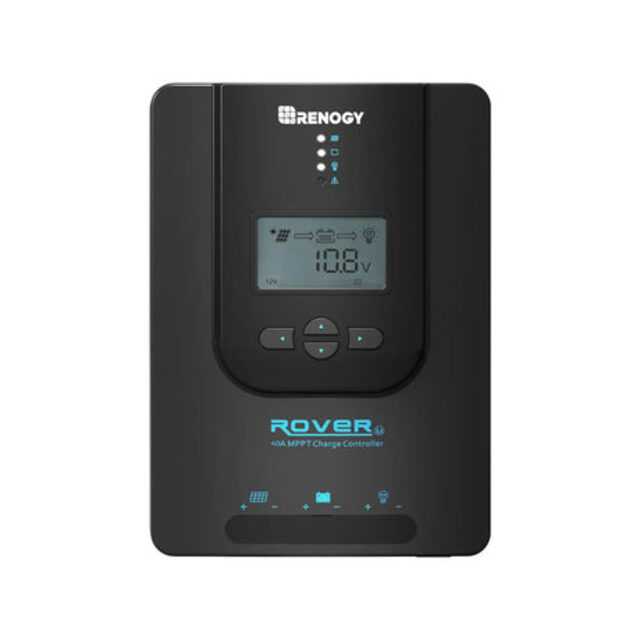
Renogy Rover 40A MPPT Solar Charge Controller
The standard MPPT controller for 12V/24V RV systems up to 400W. Bluetooth-connected via Renogy BT-1 module, displays real-time charge data. 40A handles 400–500W of panels on a 12V system. Reliable, well-supported, widely used in DIY RV builds.
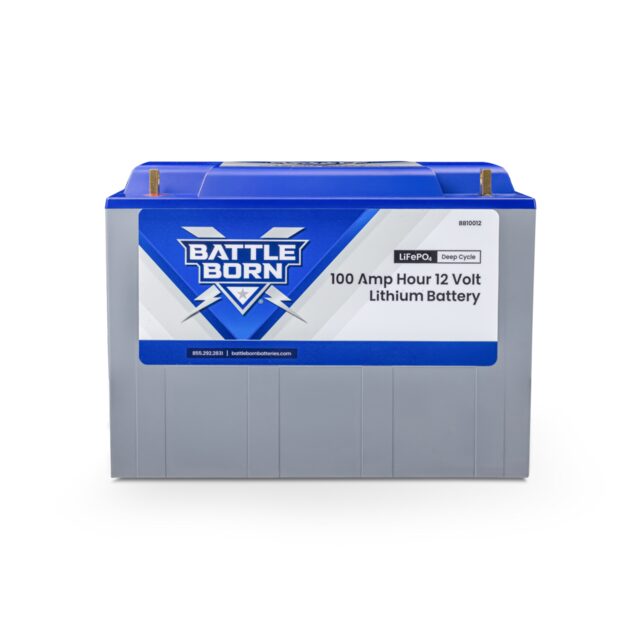
Battle Born 100Ah 12V LiFePO4 Battery
The benchmark for RV LiFePO4 batteries. 100Ah usable capacity (vs. 50Ah usable from equivalent lead-acid), 3,000–5,000 cycle rating, built-in BMS, heated for cold-weather charging down to 25°F. More expensive than off-brand LiFePO4 but the warranty and support justify it for permanent RV installs.