Sustainable Garden Tools: Materials, Repairs and Warranties (2026)
Compare DeWit hand tools, the Haws Rowley Ripple and FELCO 2 for small gardens, with practical guidance on fit, replacement parts, warranties and care.
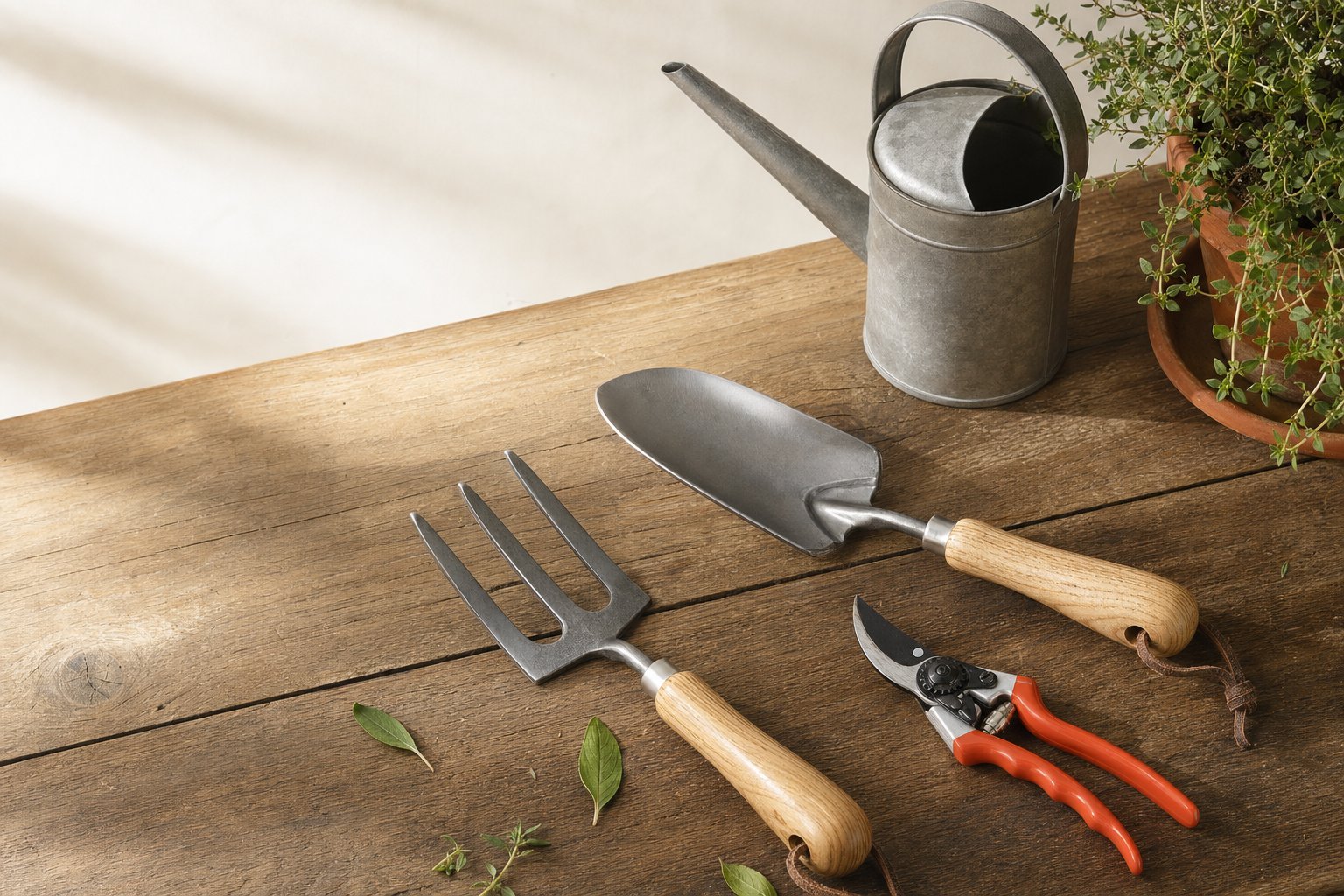
Featured Options Compared in This Guide
Full specs & notes ↓This post contains affiliate search links. If you purchase through them, we may earn a commission at no extra cost to you. Search results can include different models and sellers.
For a small garden, start with the jobs you actually do: moving potting mix, watering, harvesting and, if you grow woody plants, pruning. A useful tool purchase combines suitable dimensions with maintenance and repair support. Wood handles, metal construction and a long warranty each tell you something, but none alone establishes a tool’s overall environmental impact.
DeWit, Haws and FELCO offer different reasons to consider their tools. DeWit describes its materials and a steel warranty; Haws specifies a compact watering can with two pouring modes; FELCO lists replacement components for its pruner. These are useful buying distinctions, rather than a basis for an environmental ranking.
Choose the tool before choosing the brand
| Your regular task | Tool to consider | Practical decision |
|---|---|---|
| Filling pots and making transplant holes | Hand trowel | Choose a blade that fits the space between the pot wall and the planting hole. |
| Loosening mix between crops | Hand fork or cultivator | Add one if you regularly refresh planters; it need not be part of every starter kit. |
| Watering small pots or seed trays | Watering can with direct stream and removable rose | Match the pouring mode to the plants and the capacity to your refill routine. |
| Thinning seedlings and harvesting tender growth | Garden snips | Start here if your cutting work is mostly soft growth. |
| Cutting young woody branches | Bypass pruner | Hand size, handedness and rated cutting diameter matter. |
| Occasional larger woody pruning | Pruning saw suited to the task | Consider borrowing before buying a tool you rarely use. |
University of Maryland Extension recommends snips for thinning seedlings without pulling on neighboring roots, and a hand cultivator for loosening salad-table mix before replanting. It also emphasizes airy potting mix and adequate drainage. A stronger fork does not replace those growing conditions. Source: Maryland Extension
DeWit: distinguish the steel warranty from the whole tool
DeWit’s range page describes Dutch manufacture, forged boron steel and wooden handles made from FSC-certified ash. It also advertises lifetime coverage for the steel. These are manufacturer statements about its range; the certification statement concerns the wood, and the warranty wording identifies the steel. Neither establishes lifetime coverage for every component. Source: DeWit
The range includes several trowel designs, a hand fork and cultivators. For container work, make the trowel your first consideration if you mainly transplant and move mix. Add a fork or cultivator when loosening mix between plantings is a recurring job. Buying both simply to complete a matching set is unnecessary.
Handle length and blade shape deserve separate attention. A longer handle may help you reach across a planter, but you still need clearance around nearby pots and shelving. Compare the actual head width with the opening you work through; a handle-length specification does not tell you the tool’s total length or blade width.
Before choosing a wooden-handled model, ask how a damaged handle is replaced and whether a compatible replacement is sold. DeWit’s range page does not explain that repair route or provide detailed warranty exclusions. Boron steel is a material description, not evidence that these tools resist corrosion better than every alternative.
Affiliate searches: DeWit hand trowels and DeWit hand forks.
Haws Rowley Ripple: precise pot watering versus refill frequency
The green Rowley Ripple is an indoor watering can listed with galvanized-steel construction and a one-liter capacity. Haws specifies dimensions of 36 × 12 × 16 cm and a minimum clearance of 16 cm beneath the tap for filling. Those dimensions matter if you have a shallow sink or limited cupboard space. Source: Haws Rowley Ripple
Haws describes two ways to use it:
- Without the rose: a direct stream for watering individual pots.
- With the supplied Baby Oval Rose: a fine spray intended for seeds and seedlings.
The product page identifies that supplied rose as the compatible attachment. Do not assume another Haws rose will fit simply because it is from the same brand. Source: Haws Rowley Ripple
This makes the Rowley Ripple worth considering for small pots where positioning the spout is useful. For a balcony full of large vegetable containers, weigh that control against repeated trips to the tap. Maryland Extension notes that a large container may need several gallons at a watering, so a one-liter can can mean many refills. You could keep a small can for seedlings and use an existing larger watering vessel for bigger pots. Source: Maryland Extension
A fine rose helps deliver water gently; it does not prevent root rot. Drainage, moisture levels and watering decisions still matter. Maryland advises checking moisture below the surface and thoroughly rewetting the container when watering is needed.
Haws lists a five-year guarantee for this model. The product description does not detail exclusions or establish that every kind of finish damage or corrosion is covered. Source: Haws Rowley Ripple
Affiliate search: Haws Rowley Ripple two-pint watering cans.
FELCO 2: repair support is useful only if the pruner fits
The FELCO 2 is a Swiss-made bypass pruner with forged aluminum handles and a hardened-steel blade. FELCO specifies right-handed use, large hands and a cutting diameter of 0.98 inches. Its listed length is 8.46 inches and weight is 0.55 pounds. Treat these as manufacturer specifications, not a promise of comfortable use or easy cutting at the maximum diameter. Source: FELCO 2
For a gardener regularly pruning young woody branches, the repair options are a concrete advantage: the product page lists a replacement blade, springs, an adjustment key and a thumb-catch assembly. Those identifiable components provide a clearer repair route than a general durability claim. FELCO explicitly states lifetime warranty coverage for forged aluminum parts; that should not be read as lifetime coverage for blade wear or every component. Source: FELCO 2
If you have smaller hands, use your left hand or mainly thin seedlings, consider a tool designed for that fit and task before choosing the FELCO 2. For an herb-and-salad garden, snips may be the more relevant first cutting tool. For recurring woody pruning, prioritize comfortable reach across the handles and access to replacement parts.
Affiliate search: FELCO 2 pruners.
A pruning saw is an optional addition
A saw belongs on the shopping list when your plants create a specific woody-pruning job. It need not be part of an herb-garden starter set.
Grow Organic sells several brands of pruning saws. Its collection includes the Opinel Folding Pruning Saw No. 18 and a separately listed replacement blade for that model. That pairing is useful when comparing repair options, but the collection does not establish blade compatibility, cutting behavior or warranty terms for every saw it sells. Choose by the exact model rather than treating the retailer’s name as a saw brand. Source: Grow Organic
Care that supports continued use
Cleaning and disinfecting serve different purposes. University of Minnesota Extension explains that soil and plant debris can carry pathogens and interfere with disinfection. Remove visible debris first, using a brush and soap and water as appropriate. Disinfection is especially relevant after working on an infected plant and before moving to another, or after using tools at a different garden site. Source: Minnesota Extension
For small cutting tools, Minnesota discusses isopropyl alcohol at 70% concentration or higher, while warning that it is flammable and may be ineffective for pruning tools exposed to fire blight on apple trees. It cautions against bleach on sharp pruning tools because corrosion can pit the metal. Choose a disinfectant appropriate to the disease and tool materials, follow its directions and never mix disinfectants.
Let tools dry completely before storage. Minnesota recommends a small amount of linseed, tung or mineral oil on metal after its cleaning treatment, and advises against motor oil because it may transfer to plants. Follow model-specific directions for joints, finishes, sharpening and wooden handles. A fixed annual oiling schedule is less useful than responding to how the tool is used and stored. Source: Minnesota Extension
For your next purchase, address the limitation you encounter most often: an awkward trowel, too many watering refills, an uncomfortable pruner or a worn part that cannot be replaced. Keep serviceable tools in use and add equipment as the garden’s tasks change.
For planning where those tools will be used, see the balcony container garden setup guide and complete apartment garden guide.
Sources
- DeWit: tool range, materials and steel warranty
- Haws: Rowley Ripple Green Two Pint specifications and guarantee statement
- FELCO: FELCO 2 specifications, replacement parts and warranty scope
- Grow Organic: pruning saw collection
- University of Maryland Extension: growing vegetables in containers and salad tables
- University of Minnesota Extension: cleaning and disinfecting gardening tools and containers
Products Compared in This Guide
DeWit hand trowels
Compare current manufacturer specifications, materials, and package options for DeWit hand trowels.
DeWit hand forks
Compare current manufacturer specifications, materials, and package options for DeWit hand forks.
Haws Rowley Ripple two-pint watering cans
Compare current manufacturer specifications, materials, and package options for Haws Rowley Ripple two-pint watering cans.
FELCO 2 pruners
Compare current manufacturer specifications, materials, and package options for FELCO 2 pruners.