Plastic-Free Pillow Fills: Comfort, Care and Material Caveats (2026)
Compare buckwheat, wool, kapok and millet, plus latex and hemp construction caveats and why water-based pillows stay outside the plastic-free shortlist.
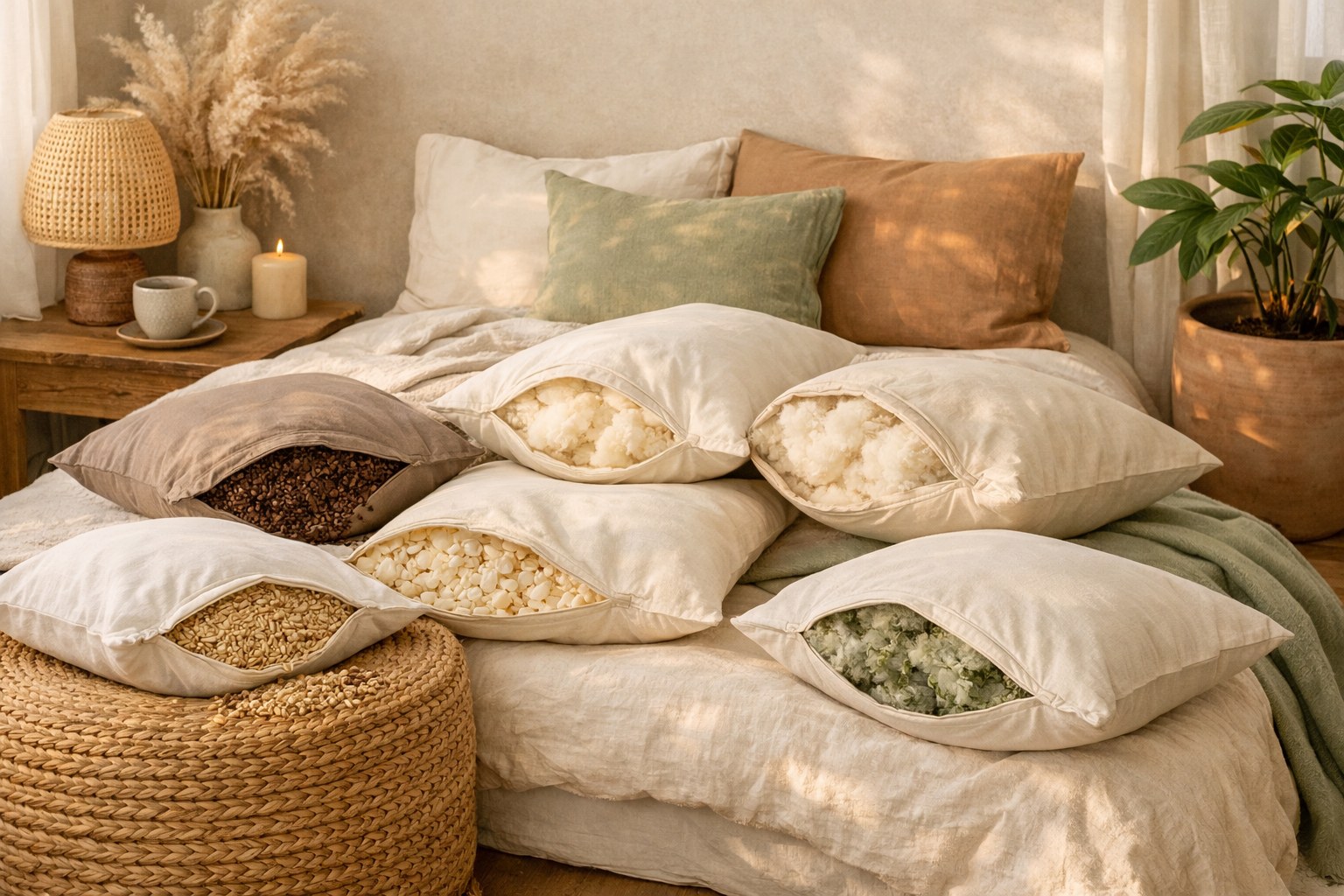
Featured Options Compared in This Guide
Full specs & notes ↓For a pillow without synthetic stuffing, the useful starting point is the feel and maintenance you can live with. Buckwheat offers firm, shapeable hulls; millet offers a smoother hull alternative; kapok supplies plush plant fiber; and wool comes in layered constructions that settle with use. The examples below also differ in whether you can remove filling or must choose the thickness at purchase.
Those four fills form the main comparison. Separate latex and hemp sections explain specific blended constructions and the remaining limits around certification, adjustment and availability. Water-based construction stays outside the plastic-free shortlist because essential component materials remain unspecified. Natural stuffing alone does not establish the composition of every zipper, lining or accessory.
Four fills: the practical differences
| Fill | Manufacturer-described feel | Loft adjustment in the example | Main ownership trade-off |
|---|---|---|---|
| Buckwheat | Firm and shapeable, with rustling when moved | Hullo allows adding or removing hulls | Empty the shell before washing; hulls gradually flatten |
| Wool | Soft, supportive layered batting | Holy Lamb offers thickness choices at purchase | Filling settles; the pillow needs spot cleaning |
| Kapok | Light and plush | Sachi provides zipper access and two initial fill levels | Daily fluffing; avoid machine washing the filling |
| Millet | Smoother, quieter and slightly softer than buckwheat in Sachi’s comparison | Sachi allows adding or removing hulls | The example is a compact support pillow; millet-specific care is not explained |
Sources: Hullo, Holy Lamb organic wool pillow, Sachi kapok pillow and Sachi hull options. These are manufacturer descriptions, not measured comfort or cooling rankings.
Buckwheat: shapeable support, audible movement
Hullo lists buckwheat hulls inside a certified organic cotton twill shell. That organic designation describes the shell; it should not automatically be applied to the filling. The manufacturer describes a firm feel and acknowledges rustling as the hulls shift. Source: Hullo
Choose this style if you want to reshape the pillow and control its thickness. Hullo ships fully stuffed and lets you scoop hulls out through the zipper. Removing some filling lowers the profile and changes how readily the remaining hulls move. It does not make hulls feel like plush fiber. If movement noise is a deciding factor, consider the millet comparison below.
For cleaning, Hullo directs owners to transfer the hulls to a dry container, wash the empty shell in cool water and air-dry it completely before refilling. It also says hulls gradually flatten and lose spring, and offers replacement filling. This makes refill access useful for maintaining loft without replacing the shell. The page advertises a 60-night return trial, relevant when firmness or rustling is unfamiliar. Source: adjustment, care and trial
Wool: choose thickness with settling and returns in mind
Holy Lamb’s All-Natural Wool-Filled Bed Pillow uses its Premium Eco Wool inside organic cotton sateen. Its Certified Organic Wool Bed Pillow separately lists GOTS-certified wool batting and a GOTS-certified organic cotton sateen case. These are different material specifications despite sharing the same brand. Sources: natural wool pillow, organic wool pillow
For the standard organic pillow, Holy Lamb describes Light as its stomach-sleeper option, Perfect for side and back sleepers, and Extra Thick for a fuller feel. Treat these as starting suggestions for fit. Both wool pages warn that the layered filling settles during early use. They present thickness as a purchase choice, without describing the removable-fill adjustment offered by Hullo and Sachi.
That makes the return terms consequential. The pillow pages describe a refund for unused, unwashed items in original packaging within 30 days of shipment. For used items, they describe a one-time exchange for an item of equal or lesser value within that window, and require returns to be shipped in the original packaging. Source: organic wool pillow return terms
However, Holy Lamb’s separate return policy says used items receive store credit only, expiring after one year. It requires a return request within 30 days of shipment, use of the prepaid label within five days, and repacking in the original box. Refunds depend on inspection; odors or foreign fibers can result in store credit. Because the pages describe different remedies for used bedding, confirm which applies before relying on an exchange to solve a loft mismatch. Keep the original packaging. Source: Holy Lamb return policy
The wool pillow itself is spot-clean only. Separate cases can be machine washed cold and line-dried or tumble-dried low. Choose layered wool when you accept that care routine and prefer selecting an initial thickness over handling loose filling. Source: wool pillow care
Kapok: plush plant fiber with removable loft
Sachi identifies kapok as fiber from tree seed pods and describes its pillow as light, soft and plush. It lists kapok filling inside sateen made from organic cotton fibers, with Regular and Extra Thick options and a zipper for adjusting loft. Source: Sachi kapok pillow
This is a useful starting point when you want soft plant stuffing and find firm hull support unappealing. The zipper gives you more control over height than the preset layered wool examples. Sachi nevertheless acknowledges compression over time and recommends daily fluffing, so adjustability does not eliminate maintenance.
Sachi permits washing the removable cover according to its care label and advises against machine washing the kapok filling. It also recommends occasional airing in indirect sunlight. If washing the entire pillow is essential, this construction does not match that requirement. Source: kapok care
You can browse kapok pillows on Amazon. This is an affiliate search link; GreenChoice may earn a commission from qualifying purchases. Results can include different fill blends and are not endorsements of individual listings.
Millet: a smoother hull feel in a compact example
Sachi offers buckwheat and millet in its Medium Support Pillow. Within that design, the manufacturer describes millet hulls as smaller, smoother and quieter, with a slightly softer feel than buckwheat. Both options provide zipper access for adding or removing filling. This supports considering millet when shapeable hull support appeals but buckwheat’s texture and rustling do not; it does not establish silence or a noise ranking across brands. Source: Sachi Medium Support Pillow
The example measures 12 by 16 inches and is marketed for targeted support and travel. Hullo’s standard bed pillow measures 20 by 26 inches. Decide whether you want a compact support cushion or a larger sleeping surface before treating them as interchangeable purchases. Sources: Sachi dimensions, Hullo dimensions
Sachi’s care section specifically discusses buckwheat, including keeping those hulls out of the wash. It does not supply equivalent millet-specific directions. Obtain those instructions for the millet version before choosing it for a particular cleaning routine.
Latex: a disclosed blend, with option-specific certification
Naturepedic’s Adjustable Organic Latex Pillow supplies a concrete latex example. Its specifications list shredded latex with 10% GOTS-certified organic cotton batting and an organic cotton fabric enclosure. The manufacturer describes the feel as springy and buoyant, offers Soft and Medium choices, and includes extra shredded latex for loft adjustment. Source: Naturepedic adjustable latex pillow
Consider this construction when you want adjustable height with responsive pushback. Kapok’s manufacturer emphasizes plush softness, while Hullo emphasizes firm, moldable hull support. Those descriptions provide a useful feel distinction without establishing which will be more comfortable for you.
Naturepedic specifies GOLS- or FSC-certified latex depending on the option. The page does not clearly map that distinction to each listed comfort choice, so do not assume every version has GOLS-certified latex. Its certification wording also does not resolve every small component’s material.
The removable outer encasement can be machine washed and dried; the inner encasement and latex fill require spot cleaning and complete drying before use. Naturepedic recommends fluffing and adjusting as needed. This is an adjustable pillow with a washable exterior, not a fully machine-washable filling. Source: specifications and care
Do not confuse that construction with Nest Easy Breather. Nest lists a memory-foam/high-response-foam blend plus polyester fiber, making it unsuitable for a shortlist that excludes synthetic stuffing. Source: Nest materials
Hemp: layered hemp–cotton filling, with access limits
Naumann’s hemp neck pillow identifies its filling as 70% certified organic hemp and 30% certified organic cotton, arranged in thin fleece layers and rolled into a wrap. It lists a quilted cotton outer cover and a separate cotton inner cover, both with zippers. This is hemp-containing stuffing, rather than merely a hemp fabric cover. Source: Naumann hemp pillow
Naumann describes a soft, lightweight feel and warns that nightly use reduces filling height and loft. It recommends fluffing fleece fillings by hand and airing regularly. Although the covers have zippers, the page does not explain an add-or-remove loft system comparable to the loose hull and shredded latex examples.
The covers are washable, with the manufacturer recommending a gentler wash at 40°C and prohibiting tumble drying, ironing and bleaching. The filling is not washable. Choose this layered blend only if hand fluffing and separate cover care suit your routine. Source: construction and care
The listed sizes are compact—20 by 40 or 30 by 50 centimeters—and the page emphasizes business customers and custom production. It does not establish straightforward U.S. consumer availability. That makes it a useful construction example, with purchasing and adjustment questions still unresolved.
Water-based pillows: outside the plastic-free shortlist
Mediflow Original Fiber combines a fiber comfort layer, a water support layer and a cotton cover. The manufacturer says adding or removing water changes firmness and height. Its materials description does not identify the fiber composition or the water chamber material. Source: Mediflow Original Fiber
Those omissions concern major components. Water adjustment can be a useful comfort feature, but neither the water nor the cotton cover establishes a plastic-free pillow. This construction therefore stays outside the shortlist for that requirement.
Which trade-off fits your routine?
Start with buckwheat for firm support you can reshape, millet for Sachi’s smoother hull alternative, kapok for plush plant fiber, or wool for layered batting with thickness selected at purchase. Latex adds a manufacturer-described springy feel with removable filling; the hemp example offers a layered plant blend but leaves adjustment and U.S. purchasing less clear.
If loft uncertainty is your main concern, prioritize a clearly explained adjustment system and return terms you can use after sleeping on the pillow. If cleaning is the deciding factor, remember that a washable cover does not make the stuffing washable. The care instructions above place substantial limits on laundering the filled pillow.
For coordinating cases and other bedding, see the organic bedding guide.
Sources
- Hullo buckwheat pillow: materials, adjustment, dimensions, care and trial
- Holy Lamb All-Natural Wool-Filled Bed Pillow
- Holy Lamb Certified Organic Wool Bed Pillow
- Holy Lamb return policy
- Sachi kapok pillow: materials, adjustment and care
- Sachi Medium Support Pillow: buckwheat and millet options
- Naturepedic Adjustable Organic Latex Pillow: composition, options and care
- Nest Easy Breather: foam and polyester filling
- Naumann hemp neck pillow: blended filling, construction and care
- Mediflow Original Fiber: layered construction and water adjustment
Products Compared in This Guide
Kapok pillows
Compare current manufacturer specifications, materials, and package options for Kapok pillows.
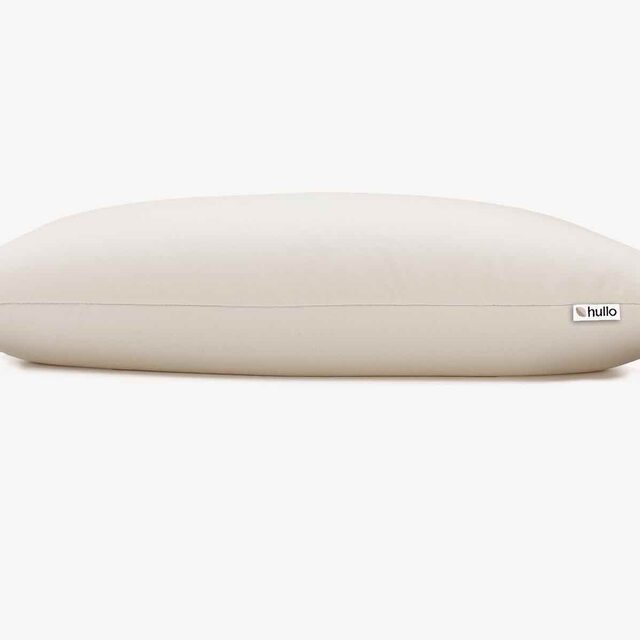
Hullo Buckwheat Pillow (Standard)
Organic buckwheat hull fill, organic cotton canvas shell. Adjustable: unzip and remove hulls to lower loft. Stays cool — hulls don't trap heat like foam. The noise level when you move is real — rustling that quiets after 2–3 weeks as hulls compress. Best pillow for side sleepers who need firm support.
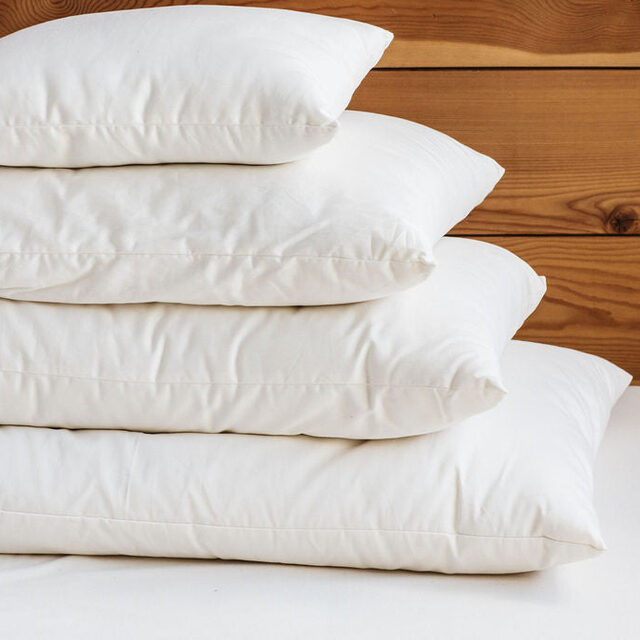
Holy Lamb Organics Natural Wool Pillow (Standard)
GOTS-certified organic wool fill, organic cotton cover. Temperature-regulating — genuinely warms in cold, dissipates heat in warmth. Doesn't flatten as fast as kapok or down. Medium-firm support. Wool's natural lanolin has mild antimicrobial properties. Hand-wash only — the main inconvenience.
Nest Bedding Organic Shredded Latex Pillow (Standard)
GOLS-certified natural latex fill, GOTS-certified organic cotton shell. Adjustable loft (unzip and remove fill). Doesn't clump. Slightly heavier than down-alternative pillows — the weight is noticeable when moving it. Latex off-gassing smell resolves in 2–3 days of airing out. Most durable fill in the test.