Organic Baby Clothes: Compare Labels, Fit and Everyday Basics
Learn what GOTS and OEKO-TEX mean, compare two organic cotton bodysuit options, and build a small baby wardrobe around fit and laundry.
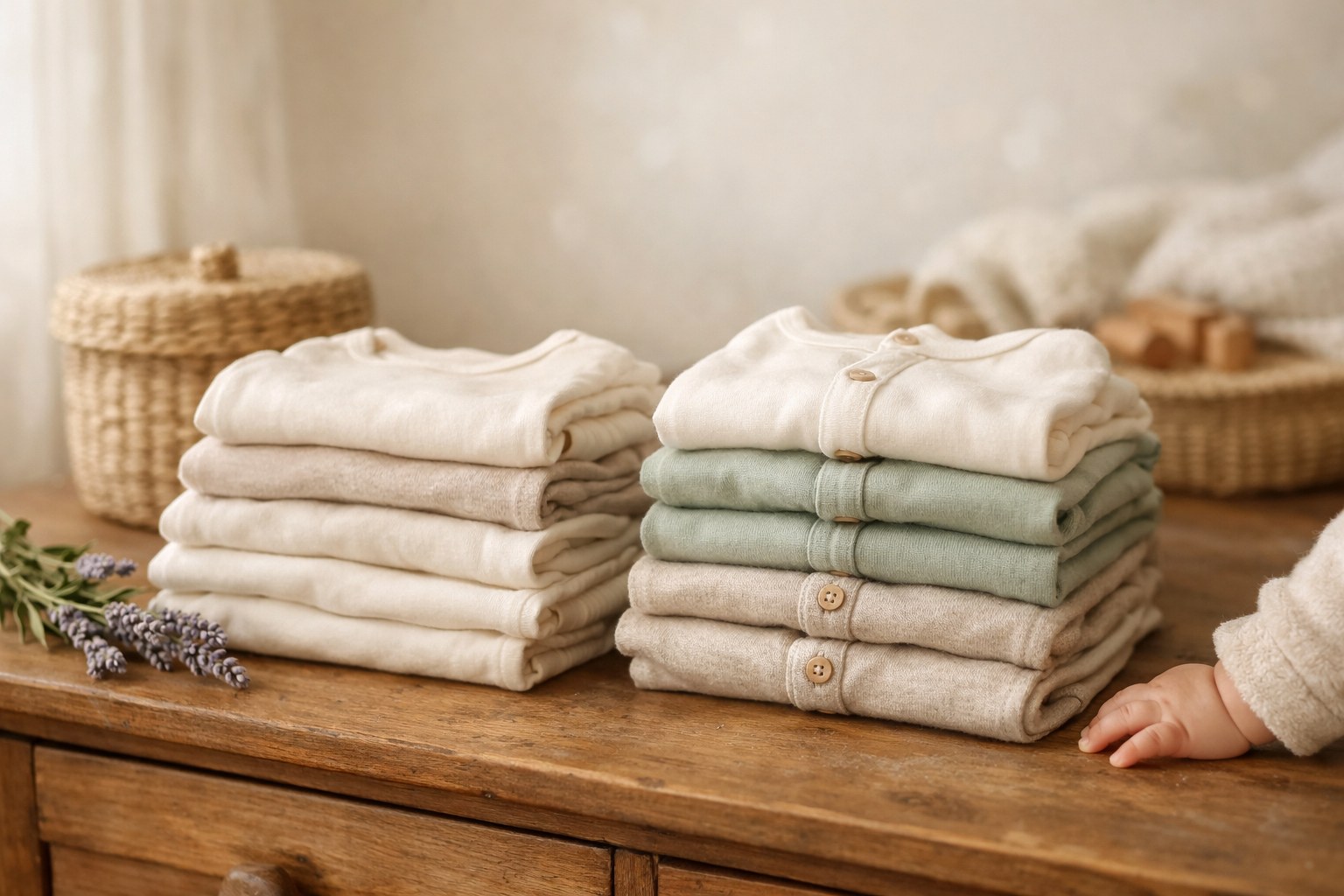
Featured Options Compared in This Guide
Full specs & notes ↓Choose organic baby clothes by the exact garment’s fiber label, certification and fit. For everyday bodysuits, a multipack of the same cut can simplify dressing and laundry. For gifts, a single printed piece may be enough. Neither a premium brand nor an organic label establishes that clothes will survive two children.
Start with clothing you can use soon. An unworn bargain in the wrong size does not reduce waste, and a sound hand-me-down can be useful even if it was not made from organic cotton.
Organic fiber and finished-product testing answer different questions
GOTS sets requirements for organic textile processing, traceability, chemical inputs and social conditions within the certified supply chain. Its labeling guidance distinguishes the “organic” grade, with at least 95% certified organic fibers, from “made with” organic material, with at least 70%. A proper label identifies the certifier and certification number. GOTS label guidance.
OEKO-TEX STANDARD 100 tests textiles and components against its harmful-substance criteria. Its Product Class 1 applies to babies and children up to three years and has the strictest limits in that standard. It is not an organic-farming certificate. The organization provides a label check using the certificate number or QR code. OEKO-TEX STANDARD 100.
Neither standard guarantees stain removal, a particular fabric thickness, a fixed wash lifespan or that a child will never react to a garment. Likewise, lack of a certification is not proof that snaps will fail or dyes are unsafe.
Two concrete bodysuit options
| Option | Manufacturer’s garment description | Useful fit details | Best reason to choose it |
|---|---|---|---|
| Burt’s Bees Baby Solid Organic Cotton Short Sleeve Bodysuits, 5 Pack, Ash, style LY31856-ASH | 100% organic cotton; lap shoulders; reinforced diaper-line snaps | Product page includes both weight and height measurements by size | Several matching everyday basics with the same closures |
| Finn + Emma “My First Easter” graphic bodysuit | 100% organic cotton; snap fasteners | Brand size chart lists weight and height ranges | One occasion or gift piece without buying a whole set |
The Burt’s Bees Baby product page specifies cold gentle washing and low tumble drying. The Finn + Emma product page specifies gentle machine washing and low tumble drying. These are documented care instructions, not comparative softness or durability results.
Both pages describe organic cotton. To make a purchase specifically dependent on GOTS certification, obtain the garment’s actual certification label and number; a brand-wide claim or a customer’s review is not the same as a product-level certificate. Do not assume every collection from either brand has identical documentation.
The plain multipack supplies five basics; the graphic option supplies one occasion design. Either can be worn whenever it fits and suits your family. Compare the delivered price per piece you will actually use; quantity alone does not make a pack better value.
Choose fit without relying on age alone
Measure the baby’s length and use their recent weight alongside the brand’s chart. Age labels are starting points. Two brands’ “3–6 months” sizes can cover different measurements.
A bodysuit needs room for the diaper without pulling tightly at the shoulders or crotch. If you use a bulky cloth diaper, evaluate the fit over that actual diaper. Check leg openings and sleeve cuffs, and make sure fasteners are secure.
For sleepwear, follow the garment’s designated use and fit instructions. Do not turn a larger size into a money-saving rule for pajamas or sleep sacks. Our sleep sack guide explains why secure upper-body fit matters.
Work out how many clothes you need
Use your laundry interval instead of a universal 25-piece checklist. For example, if you expect two daytime outfits per day and wash every two days, four outfits cover that interval; add enough spares for drying and unexpected changes. This is planning arithmetic, not a promise about how often your baby will need changing.
Keep newborn purchases modest until you know what fits. Save hand-me-downs in clearly labeled sizes so they are found before the baby outgrows them. Ask gift-givers for later sizes only after considering the season in which those clothes will be worn.
Preserve clothing by following its care label
Check stain-treatment instructions before applying a product, fasten closures when the label advises it, and avoid more heat than the garment allows. Line drying may suit some pieces; it is not necessary to disregard a manufacturer’s permission to tumble dry on low.
Before passing clothing on, inspect snaps, buttons, zippers, seams and worn knees. Repair an ordinary seam when appropriate, but retire pieces with unresolved hazards or compromised fasteners. Store only clean, fully dry garments.
There is no need to replace a workable wardrobe all at once. Add well-fitting pieces as sizes change, and use certification to inform those purchases rather than to judge every item already in the drawer.
For shopping, Amazon search for Burt’s Bees Baby organic bodysuits opens search results, not a verified exact offer. Match the style and pack contents before ordering. Purchases through this link may earn a commission. Affiliate disclosure.
Sources
Products Compared in This Guide
Amazon search for Burt's Bees Baby organic bodysuits
Compare current manufacturer specifications, materials, and package options for Amazon search for Burt's Bees Baby organic bodysuits.