Open Farm Dog Food Review: Recipes, Sourcing and Cost per Day
Compare Open Farm Turkey & Chicken Grain-Free with Turkey & Ancient Grains, including nutrition, large-breed puppy limits, sourcing and feeding costs.
Featured Options Compared in This Guide
Full specs & notes ↓Open Farm is worth considering for its recipe-level sourcing disclosures, provided the particular food fits your dog. It does not follow that the most expensive format is nutritionally best, or that a welfare certification makes the finished diet superior to every conventional kibble.
For a grain-inclusive comparison, start with Homestead Turkey & Ancient Grains. The similarly named Homestead Turkey & Chicken is a separate, grain-free recipe. Neither of the two US labels examined below includes large-breed puppy growth. This review evaluates published labels and buying considerations; it is not a feeding trial.
Two recipes that should not be confused
The following figures come from Open Farm’s US product pages, accessed September 5, 2026. Amounts in the guaranteed analysis are as fed. Read the delivered bag for your exact recipe and market.
| Label detail | Homestead Turkey & Chicken Grain-Free | Homestead Turkey & Ancient Grains |
|---|---|---|
| Listed protein sources include | Turkey, chicken and fish meals | Turkey and fish meals |
| Grain/carbohydrate distinction | Potatoes, chickpeas, lentils and peas appear in the ingredients | Oats, sorghum and quinoa appear; the brand describes it as free of peas, potatoes and legumes |
| Crude protein, minimum | 30% | 26% |
| Crude fat, minimum | 14% | 15% |
| Energy | 3,600 kcal/kg; 436 kcal/cup | 3,750 kcal/kg; 425 kcal/cup |
| Adequacy statement | Formulated to meet AAFCO profiles for all life stages, excluding growth of dogs 70 lb or more as adults | Same life-stage exclusion |
| Listed one-time 22 lb price | $93.99 | $82.99 |
Neither recipe is a single-animal-protein diet. A turkey name on the front is insufficient for choosing a food during an allergy investigation. The table also shows why “higher protein” is not a complete purchasing rule: fat, calories, life stage and the whole formulation still matter.
FDA explains that a complete-and-balanced claim can be supported by meeting AAFCO nutrient profiles or by a feeding trial using AAFCO procedures. A statement that a food is formulated to meet a profile is not a claim that it passed such a trial. Match the species and life stage before comparing extras. FDA nutritional adequacy guidance.
What the sourcing information actually tells you
The Turkey & Chicken page’s ingredient-origin section identifies G.A.P. Step 1 turkey and Step 2 chicken; the Ancient Grains turkey page identifies Step 1 turkey. These are the manufacturer’s current sample disclosures, not a guarantee that every ingredient or future lot carries the same welfare level. They do not support calling all of the brand’s poultry Step 2 or pasture-raised. Turkey & Chicken sourcing, Turkey & Ancient Grains sourcing.
The pages offer a lot-code tool for geographic origin and other information. Enter the code from your own bag and distinguish that result from a sample lot. Geographic traceability is useful, but a country or state of origin is not necessarily a named farm, and a sourcing record is not a clinical study.
For a meaningful comparison with another food, ask about nutritional expertise, quality controls, finished-food analysis and evidence behind the formulation. WSAVA cautions that ingredient lists alone can mislead owners about overall food quality. WSAVA nutrition resources.
What would it cost to feed?
There is no universal monthly cost. Use the current bag price, its net weight and energy density, and the daily calorie allowance agreed with your veterinarian.
Daily food cost = bag price × daily calories ÷ total calories in the bag.
For illustration only, assume 1,000 kcal per day from this kibble. That is an arithmetic example, not a recommendation for a particular dog. A 22 lb bag weighs about 9.98 kg:
| Using the prices and energy above | Approximate days per bag | Approximate cost per day | Approximate 30-day cost |
|---|---|---|---|
| Turkey & Chicken Grain-Free | 35.9 | $2.62 | $78.49 |
| Turkey & Ancient Grains | 37.4 | $2.22 | $66.53 |
These calculations exclude tax, shipping, discounts, treats and food waste. At a different daily calorie allowance the cost changes proportionally. Compare other brands using the same calorie allowance instead of assuming that every pound of kibble contains four cups.
A large bag can lower unit cost while creating a storage problem for a small dog. Both product pages recommend using opened dry food within two months for freshness and storing it in its original bag. Choose a bag you can use within that guidance, and retain the lot code and feeding information.
Grain-free and raw are separate decisions
FDA describes non-hereditary dilated cardiomyopathy as complex, with potential interactions involving diet, genetics and other conditions. Grain-free is not a necessary upgrade for every dog; adding grains is not a promise that a diet prevents heart disease either. Discuss the exact formula with your veterinarian, especially if your dog has cardiac concerns. FDA’s DCM questions and answers.
Also distinguish ordinary cooked kibble from products containing freeze-dried raw material. Freeze-drying does not eliminate all germs. CDC includes freeze-dried raw food and toppers in its raw-food precautions and does not recommend raw foods or treats for dogs or cats. “Raw” is not evidence of better nutritional balance. CDC pet food safety.
For a pet with kidney disease, food allergies or another condition needing dietary treatment, choose with the veterinarian managing that condition. Moisture content, a short ingredient list or a premium brand name cannot establish therapeutic suitability.
Buying decision
Open Farm makes sense to shortlist if you value the sourcing detail and can comfortably fund an appropriate recipe long term. Keep a suitable existing diet if switching would strain the budget or disrupt a veterinary plan. Buy a manageable first bag, follow a gradual transition recommended for your dog, and record the exact recipe if problems arise.
See the sustainable pet care guide for other ways to reduce waste without changing a successful diet, and our pet household cleaning guide for bowl and food-area hygiene.
Shopping links: Search Amazon for Turkey & Chicken Grain-Free or Turkey & Ancient Grains. These are affiliate searches, not offers at the manufacturer prices above; check the recipe, bag size and seller. We may earn a commission from qualifying purchases.
Sources
Products Compared in This Guide
Turkey & Chicken Grain-Free
Compare current manufacturer specifications, materials, and package options for Turkey & Chicken Grain-Free.
Turkey & Ancient Grains
Compare current manufacturer specifications, materials, and package options for Turkey & Ancient Grains.
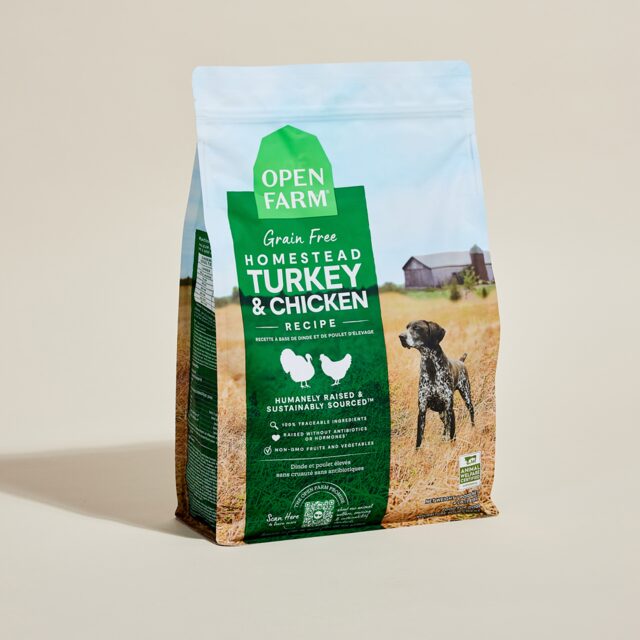
Open Farm Homestead Turkey & Chicken Dry Dog Food (22 lb)
The flagship dry food. GAP-certified poultry, non-GMO vegetables, no synthetic preservatives. Ingredient list reads cleanly. 22 lb bag lasts a 55-lb dog about 6 weeks — roughly $1.70/day. The sourcing transparency alone puts it in a different category from most premium kibble.
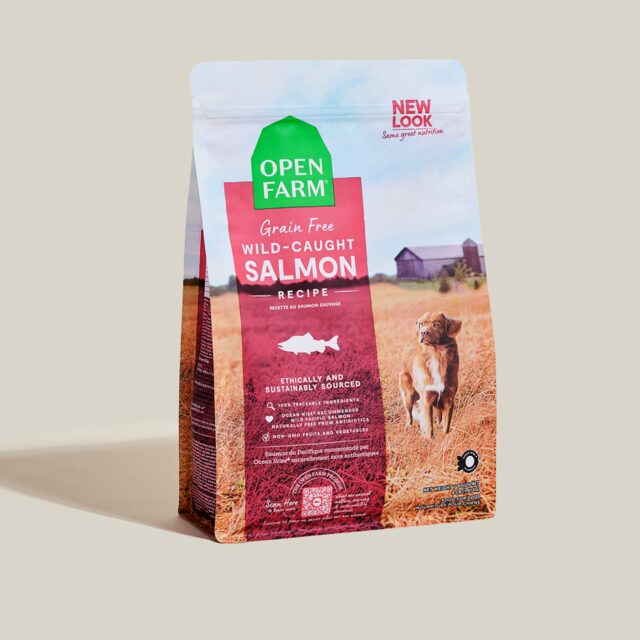
Open Farm Wild-Caught Salmon Dry Dog Food (22 lb)
Wild-caught Pacific salmon as the first ingredient, MSC certified. For dogs that do better on fish protein, this is the sustainable option. Slightly higher price than the poultry formulas reflects the fish sourcing premium. Omega-3 content is genuinely high for a kibble.
Frequently Asked Questions
Is Open Farm worth the premium?
It may be worth considering if its recipe-specific sourcing information matters to you and the food suits your dog's needs and budget. An ingredient list or welfare claim does not prove better health outcomes than another nutritionally appropriate food.
Are these Open Farm recipes suitable for large-breed puppies?
The US Turkey & Chicken Grain-Free and Turkey & Ancient Grains pages reviewed here exclude growth of dogs expected to weigh 70 pounds or more as adults from their nutritional adequacy statements. Choose an appropriate growth formula with your veterinarian.
Does freeze-drying make raw dog food free of bacteria?
No. CDC says freeze-drying does not kill all germs in raw animal protein and does not recommend raw pet foods or treats for dogs and cats.