Duvet Inserts: Compare Wool, Cotton, Down and Recycled Fill
Compare duvet insert materials, warmth information, construction and care, with specific wool, cotton and recycled-fill examples.
Featured Options Compared in This Guide
Full specs & notes ↓Choose a duvet insert by how you want it to feel, what fills it and how you can clean it. A preference for wool is only useful if you can accommodate its care restrictions. A machine-washable insert is only convenient if your washer can handle it and you have a suitable way to dry it.
For the examples below, the most useful distinction is straightforward: Holy Lamb Organics’ wool comforter calls for spot care and restricted laundering; Soaring Heart’s cotton comforter permits cool machine washing; Buffy’s all-season Cloud permits cold machine washing, while its Winter Weight version requires dry cleaning. Those instructions belong to these particular products, not every insert made with the same fiber.
Wool: choose the weight and accept the care commitment
Holy Lamb Organics describes its Certified Organic Wool Comforter as wool batting inside a cotton sateen shell, with both materials identified as GOTS-certified. Adult sizes have hand tufting, perimeter stitching and corner ties. The maker offers Light, Perfect and Extra weights, positioning them respectively for warmer sleepers or climates, general use, and colder sleepers or climates. These are the maker’s categories; they do not establish equivalence to another brand’s warmth labels. Source: Holy Lamb wool comforter.
If you already find thick bedding too warm, Light is the logical starting point within this range. If you prefer adding a separate blanket when the weather changes, the maker explicitly suggests that approach with Perfect. Neither choice promises a particular sleeping temperature.
The care restrictions are the deciding tradeoff. Holy Lamb recommends a washable duvet cover and spot cleaning. Its detailed care guide treats full machine laundering as a last resort because of shrinkage and felting risks. The permitted method uses cold soaking and manually selected spinning, with no agitating wash cycle—even a delicate cycle. It requires air drying, prohibits machine drying and dry cleaning, and does not guarantee the bedding’s integrity after machine washing. Source: Holy Lamb care guide.
This makes the wool model a reasonable candidate when wool is a priority and you can manage occasional spot care. For a household expecting frequent full washes after spills or pet accidents, the cotton and all-season synthetic examples offer more practical care instructions.
Cotton: a washable option for people who prefer more weight
Soaring Heart’s Organic Quilted Cotton Comforter uses cotton filling and a cotton sateen shell, both described by the manufacturer as certified organic. The maker recommends it for people who sleep cold or prefer a heavier-feeling comforter. It permits machine washing with cool water and mild detergent, followed by line drying or low heat to limit shrinkage. Source: Soaring Heart cotton comforter.
Consider this construction if you want cotton in both the shell and filling and need ordinary machine-wash instructions. If your main goal is a barely-there covering, the manufacturer’s emphasis on weight is a reason to consider a different construction. Its recommendation for cold sleepers is not a measured warmth comparison with wool or down.
The quilting is intended to keep filling distributed. That design description does not establish how the insert will perform after repeated laundering or guarantee that it will never compress.
Recycled polyester: distinguish the Buffy Cloud versions
Buffy lists a lyocell shell, recycled PET filling, a fill-retaining stitching pattern and corner loops for the all-season Cooling Cloud Comforter. Its care instructions allow cold machine washing and drying on low heat or air fluff. This is a candidate for someone seeking a washable alternative to wool or down who accepts synthetic filling. The lyocell shell does not change the filling into a plant fiber. Source: Buffy Cloud.
Winter Weight is a separate care decision. On the same page, Buffy describes that version with polyester filling, baffle-box construction and side vents, and specifies dry cleaning only. Its Winter Weight details do not repeat the all-season version’s recycled-fill disclosure. Do not carry either the recycled-content claim or the washing instructions across versions.
Buffy’s cooling language and descriptions of its shell do not establish that the complete insert will keep every sleeper cooler than the wool or cotton examples. Choose the version for its stated construction and maintenance requirements without treating the product name as a temperature guarantee.
Down: separate loft, quantity and sourcing
When considering a down insert, request both fill power and net fill weight. IDFL defines fill power as the volume occupied by a specified mass of filling under test conditions; net fill weight measures how much filling is present. A fill-power number alone therefore does not tell you how much down is in the duvet. Compare the same bed size and consider the shell and internal construction alongside those figures. Source: IDFL fill testing.
For animal-welfare sourcing, the Responsible Down Standard addresses ducks and geese and tracks certified material through the supply chain. Its requirements prohibit live plucking and force-feeding, with third-party audits beginning at the farm. It does not provide a duvet warmth grade or washing instructions. Source: Textile Exchange RDS.
Down remains an animal-derived choice. If avoiding animal fill is your priority, the cotton or polyester constructions above better match that preference. If down is acceptable, assess sourcing and performance separately: an RDS claim answers a different question from fill weight or laundering requirements.
What construction and certification can tell you
Tufting, quilting and baffle boxes describe how an insert is assembled. Corner ties and loops help secure the whole insert inside a cover. These serve different purposes: attachment points do not control filling inside the shell.
Likewise, shell thread count does not establish resistance to fill leakage. IDFL lists thread-count measurement and fill-proofness as separate tests; the latter examines filling escaping through fabric under agitation. A high thread count alone is not a substitute for that performance information. Source: IDFL fill testing.
For organic claims, distinguish a component description from a finished-product label. GOTS requires product labels to show the logo, label grade, certification body and certified entity’s certification number. Its organic grade requires at least 95% certified organic fibers, along with compliance with applicable GOTS requirements. A statement about a cotton shell should not be expanded to cover an unspecified filling. Source: GOTS labelling requirements.
These disclosures help you choose materials and sourcing standards. They do not establish that an insert is suitable for every allergy or will last a fixed number of years.
Make the insert work with your cover and laundry setup
Compare dimensions before buying. Soaring Heart lists its full/queen cotton comforter at 92 × 88 inches; Buffy lists its full/queen Cloud at 90 × 90 inches. The shared size label does not mean the same shape. Compare your cover’s dimensions and attachment points with the insert you intend to buy. Sources: Soaring Heart sizing, Buffy sizing. The duvet cover guide covers the other half of that pairing.
A bulky cycle does not override the insert’s care instructions. Whirlpool’s guidance for its top-load HE washers recommends a bulky cycle for suitable large items and says loads must move freely. It also directs owners to follow the textile’s care label. That advice does not authorize an agitating cycle for the Holy Lamb wool comforter. Check your washer’s manual alongside the insert’s instructions; machine capacity alone cannot resolve incompatible cycles. Sources: Whirlpool laundry guidance, Holy Lamb care.
Treat returns as part of the comfort decision. Holy Lamb’s general policy requires unused, unwashed bedding in original packaging for a refund and describes store credit for used items, subject to exclusions. Its wool product page instead describes a one-time exchange after use. Ask which terms apply to your order before treating it as a sleep trial, and retain the packaging. Sources: Holy Lamb returns, wool product terms.
If an insert starts feeling uneven, remove the cover first and inspect it flat. An insert that has slipped into one end of the cover needs a different response from filling that has gathered inside its stitched sections. For internal lumps, leakage or broken stitching, contact the maker before trying another wash or extra dryer heat. The care differences above make a universal de-clumping routine a poor choice.
Sources
- Holy Lamb Organics: Certified Organic Wool Comforter
- Holy Lamb Organics: Product Care
- Soaring Heart: Organic Quilted Cotton Comforter
- Buffy: Cloud Comforter materials, versions, sizing and care
- IDFL: Natural and Synthetic Fill Testing Options
- Textile Exchange: Responsible Down Standard
- Global Standards: GOTS Labelling
- Whirlpool: Preventing Damaged Clothing in a Top Load HE Washer
- Holy Lamb Organics: Return Policy
Products Compared in This Guide
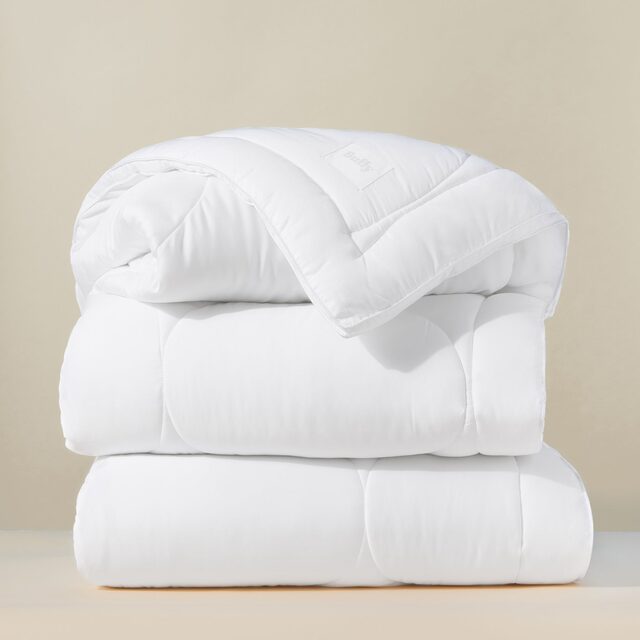
Buffy Cloud Comforter (Full/Queen)
GOTS organic cotton shell, recycled polyester fill (rPET from bottles). Lofty and lightweight. The eco case is mixed — the fill is recycled synthetic, not natural — but it diverts plastic waste. Machine-washable in standard machines. Fill retained 90% of original loft after 12 months of monthly washing. Best for buyers transitioning from synthetic who want an organic shell.
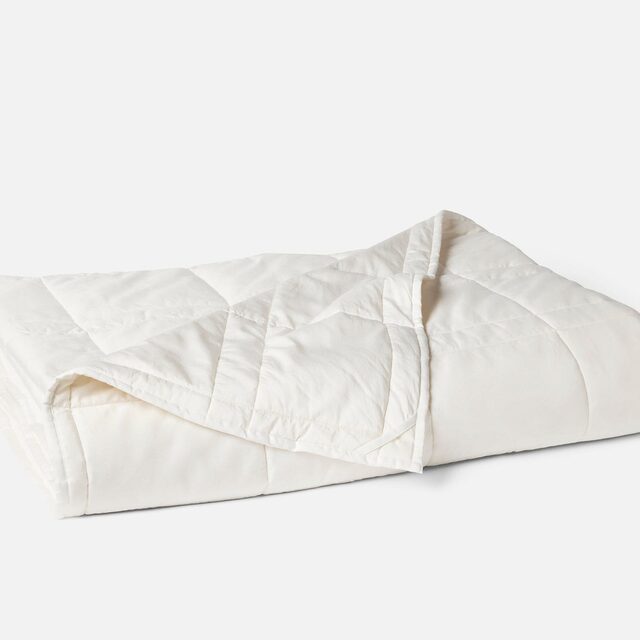
Coyuchi All-Season Organic Duvet (Full/Queen)
GOTS-certified organic cotton shell, organic cotton fill. No animal products, no synthetic fill. Heavy — 4 lbs for full/queen — and warmer than down alternatives. The fill maintained even distribution after 12 months of monthly washing with no clumping. Appropriate for cold climates or winter-weight bedding.
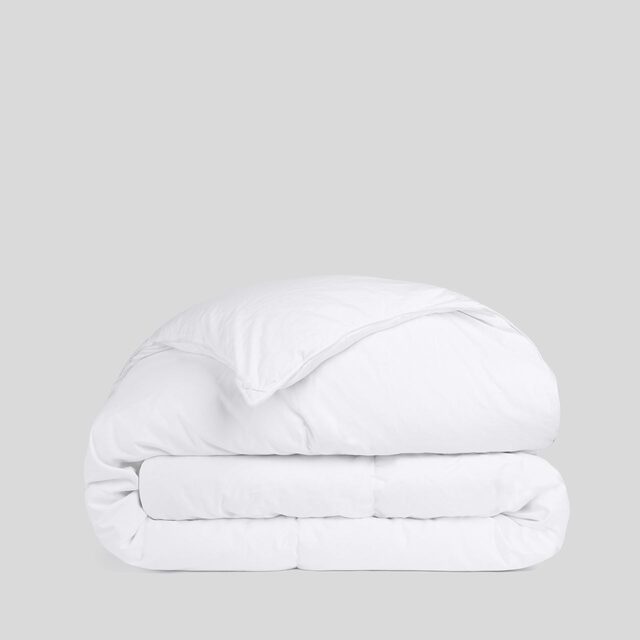
Parachute Down Alternative Comforter (Full/Queen)
OEKO-TEX certified, synthetic microfiber fill. Not a natural fill, but listed for comparison — OEKO-TEX verified free of harmful substances, and the fill retained 85% of loft after 12 months. For buyers who need easy machine-washing and lower price, this is the comparison baseline.
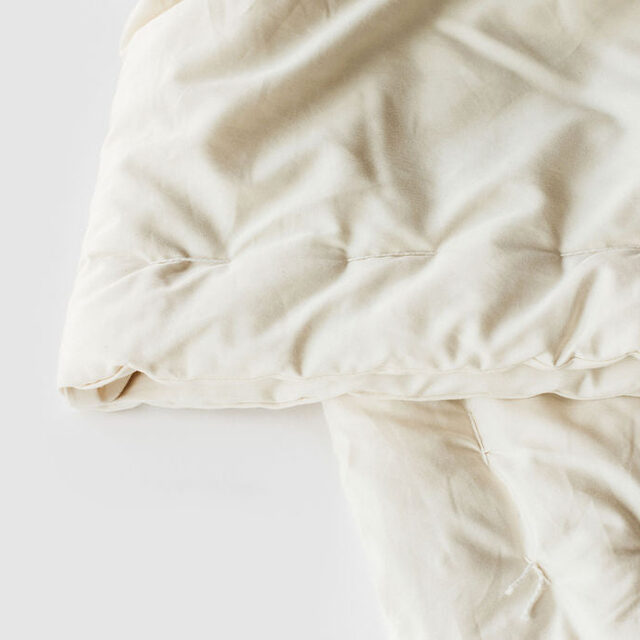
Holy Lamb Organics Organic Wool Duvet (Full/Queen)
GOTS-certified wool fill, organic cotton cover. Temperature-regulating — the best duvet in the test for households where one person sleeps hot and one sleeps cold. Spot-clean only for the wool fill; the cover is removable and machine-washable. The fill showed no clumping after 12 months of proper spot-cleaning.
Frequently Asked Questions
Which duvet fill never clumps?
No fill name establishes a clump-free guarantee. Look at the insert's stitching and care requirements, and distinguish an insert slipping inside its cover from uneven filling within the insert.
Does an organic shell make the whole duvet organic?
No. Shell and fill are separate material disclosures. A finished product's GOTS label must include its label grade, certification body and certification number; a shell-only claim does not establish whole-product certification.
Can I wash every Buffy Cloud comforter the same way?
No. Buffy specifies cold machine washing for the all-season Cloud and dry cleaning for Winter Weight. Follow the instructions for the version you own.