Wooden Montessori-Style Toys: Choose by Age, Play and Materials
Compare a wooden infant rattle and open-ended rainbow, understand age labels and toy-safety documentation, and choose fewer toys with clear uses.
Featured Options Compared in This Guide
Full specs & notes ↓Buy a wooden toy for the activity your child is ready to explore: grasping, stacking, sorting or pretend play. Then check its age recommendation, part sizes, construction and care directions. The words “wooden” and “Montessori” do not establish safety or make an entire brand suitable for every toddler.
For a baby learning to grasp, Manhattan Toy’s Skwish Classic is a documented infant option. For an older child building imaginative structures, Grimm’s Large Rainbow offers a different kind of play. They serve different developmental stages rather than competing for one universal best-toy title.
This article includes Amazon search links that may earn a commission. Affiliate disclosure.
Two examples, two very different uses
Manhattan Toy Skwish Classic: an infant grasping toy
The manufacturer lists Skwish Classic, item 200970, for ages 0+. It uses rubberwood rods and elastic cords, with beads that move along the rods. Its open structure gives a baby places to grasp, and it is marketed as a rattle and teether. Skwish Classic specifications.
This is a useful choice when the goal is a small object for supervised sensory play. It is not an all-wood product: the elastic cords are essential to its construction. Inspect those cords and all connections for damage. Remove it from use if parts loosen or the structure deteriorates; do not improvise repairs to an infant mouthing toy.
Cleaning is another important distinction. The maker instructs surface cleaning with a damp soapy cloth, followed by a clean damp cloth to remove residue. Do not submerge it, put it in a sanitizer or steamer, or microwave it. A toy being suitable for mouthing does not mean it tolerates bottle-sanitizing methods.
Grimm’s Large Rainbow: open-ended building for older children
The manufacturer describes the Large Rainbow, SKU 10670, as 12 lime-wood pieces with a water-based color glaze. Arches can become bridges, tunnels, landscape pieces or stacked arrangements. The page lists both “approved for 0+” and a recommended age of 3+. For purchase planning, use the recommended age and the instructions supplied with your regional product rather than promoting it as an infant essential. Grimm’s Large Rainbow.
Choose this type of toy when the child already enjoys building and rearranging objects. It does not teach a single prescribed skill and does not need to stay arranged as a rainbow. A child who prefers a clear matching task may engage more readily with an age-appropriate sorter or puzzle.
The material description is not a durability trial. Wood can dent, crack or splinter, and a color glaze does not eliminate the need to inspect surfaces. Do not let a child stand on arches or use them as climbing equipment unless a product is expressly designed for that use.
For shopping, Amazon search for Skwish Classic and Amazon search for Grimm’s Large Rainbow 10670 open search results. Check the seller and exact item; similar-looking products do not inherit the original manufacturer’s specifications.
Read safety information beyond the paint description
U.S. children’s toys are subject to applicable requirements including the mandatory ASTM F963 toy standard. Requirements address matters such as coatings, small objects, edges, cords and magnets; a “water-based paint” claim does not address all of them. CPSC explains how testing and a Children’s Product Certificate apply to children’s toys. CPSC toy-safety guidance.
Useful questions for a manufacturer or seller are:
- What is the exact model and age recommendation?
- What are the wood, composite, adhesive and finish materials?
- Is the relevant safety documentation available for this model and market?
- Can normal use expose small parts, magnets, damaged cord or splinters?
- What cleaning method is permitted?
A general claim about a toy’s finish is not a substitute for the applicable U.S. safety documentation. Ask for documentation for the model you are buying, including handmade toys.
Avoid loose or accessible magnets, particularly around children who mouth objects. A wooden enclosure does not make a damaged magnetic toy acceptable. Also keep older siblings’ small pieces separate from infant play areas.
Build a rotation around interests
Offer a few suitable toys where the child can see and reach them safely. Observe what they do: grasp, transfer, nest, stack, match or act out stories. Add a toy that supports an interest you actually see rather than buying every category at once.
A small rotation might include a grasping toy for a baby, then appropriately age-rated blocks or a sorter when ready. Open-ended blocks and a simple puzzle can both be useful; expensive wood is not required for good play.
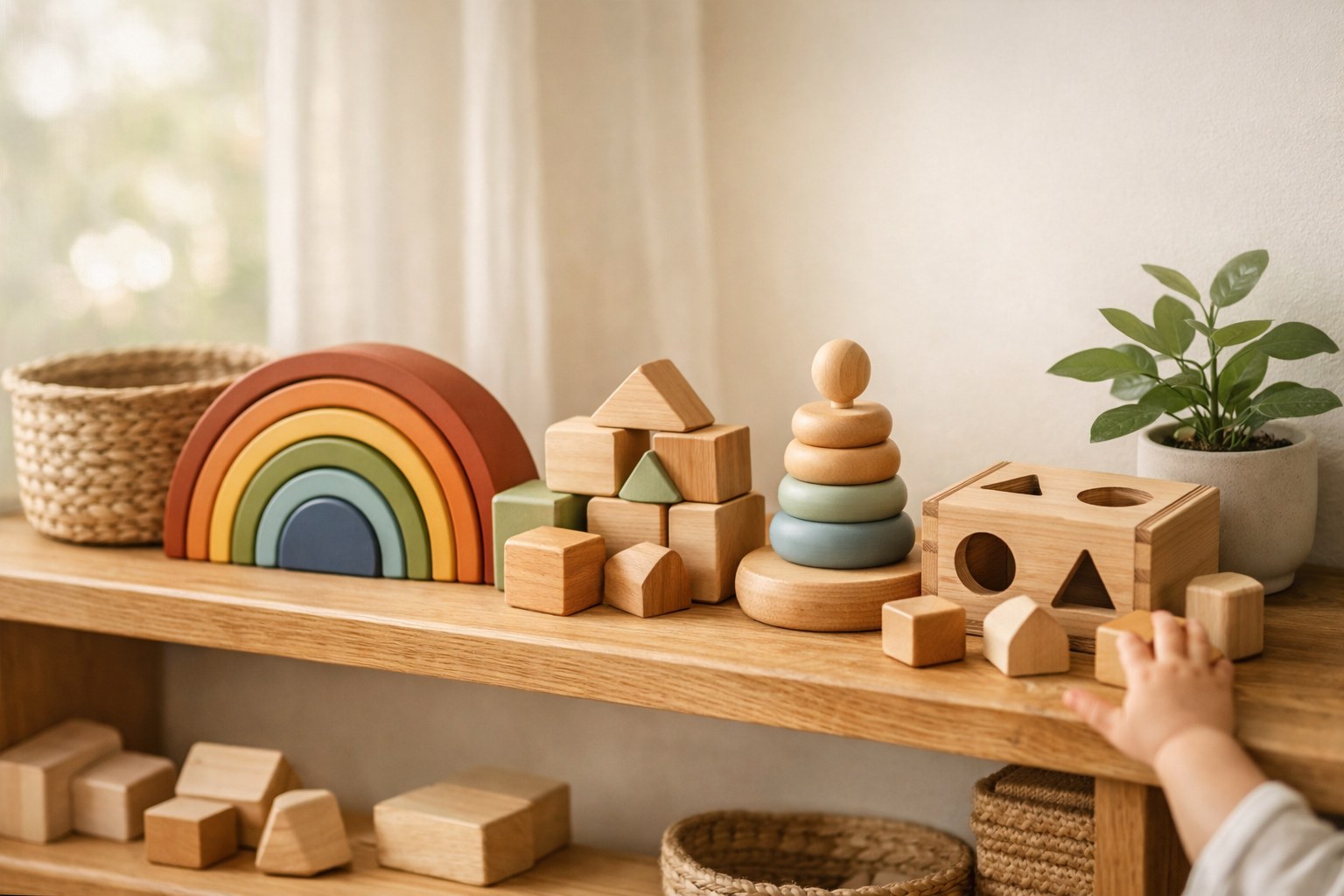
For floor activities, use a stable clear area. A decorative shelf display is not proof that every pictured item fits your child’s age. See the playmat materials guide for floor-surface choices, and keep toys out of infant sleep spaces.
When secondhand toys are worth considering
Confirm identity, instructions and recall status, then inspect the entire toy. Missing pieces can affect use, while damaged closures or magnets can affect safety. Reject unresolved cracks, splinters, loose parts and unknown repairs. Do not refinish a mouthed toy with household oil or paint unless the maker provides an appropriate repair procedure.
Passing on sound toys can extend their use. There is no guaranteed resale percentage, and a toy does not need high resale value to have been a useful purchase.
Sources
Products Compared in This Guide
Amazon search for Skwish Classic
Compare current manufacturer specifications, materials, and package options for Amazon search for Skwish Classic.
Amazon search for Grimm's Large Rainbow 10670
Compare current manufacturer specifications, materials, and package options for Amazon search for Grimm's Large Rainbow 10670.