Featured Options Compared in This Guide
Full specs & notes ↓This article contains affiliate search links. GreenChoice may earn a commission if you buy through them, at no extra cost to you.
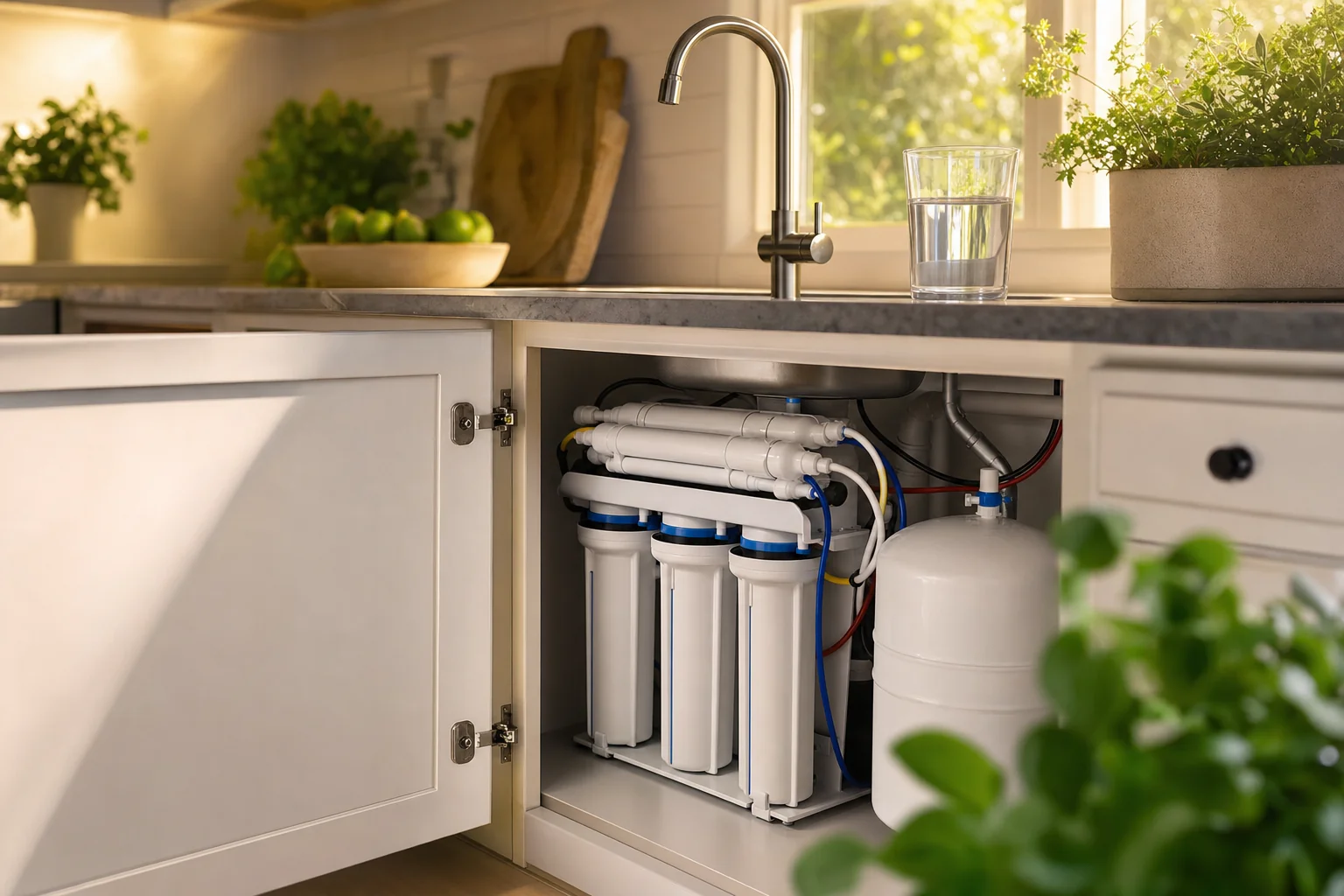
The most useful distinction among these under-sink reverse osmosis systems is how they fit your kitchen and maintenance routine. APEC ROES-50 uses separate filter housings and a storage tank. Waterdrop G3P800 offers a powered tankless design for municipal tap water. iSpring RCC7AK combines a tank with a mineral-adding final stage and operates without electricity.
First decide whether RO addresses your water needs. EPA explains that RO produces both treated water and a reject stream, and that less water-intensive filtration can be sufficient for some applications. Buying RO solely because it has more stages can add water use and maintenance without solving an additional problem. EPA’s RO guidance
Three systems, three practical choices
The specifications below are manufacturer-listed figures. Daily production capacity is not a measured faucet flow rate in your kitchen.
| Model | Reason to consider it | Installation and ownership trade-off |
|---|---|---|
| APEC ROES-50 | Conventional five-stage layout; APEC describes its parts and filters as industry standard | Needs space for both the filter assembly and a separate tank; listed feed pressure is 40–85 psi |
| Waterdrop G3P800 | Tankless enclosure; advertised 800 GPD maximum production and 3:1 treated-to-drain ratio | Requires power, its supplied faucet and model-compatible cartridges; specifications call for municipal tap water |
| iSpring RCC7AK | Six-stage system with remineralization; manufacturer states it needs no electricity | Retains a storage tank and adds an alkaline cartridge to the replacement schedule |
Sources: APEC ROES-50, Waterdrop G3P800, iSpring RCC7AK.
APEC ROES-50: consider it when standard components matter
APEC lists a filter assembly measuring 15.5 inches long, 5.25 inches wide and 17 inches high, plus a separate tank measuring 11 by 11 by 15 inches. Make room for both pieces before deciding that the narrow filter assembly fits your cabinet.
The manufacturer specifies 50 gallons per day at 60 psi and a lower output of 30 gallons per day at 50 psi and 77°F. That makes incoming pressure a meaningful purchasing consideration: the model name does not promise the same production in every home.
APEC identifies the system as WQA Gold Seal certified and specifically discusses testing for total dissolved solids, or TDS, reduction. Its much broader contaminant marketing list should not be read as a list of individually certified reductions. For a particular concern, such as lead or PFAS, request the model’s applicable certification details before relying on it.
The practical attraction is the manufacturer’s stated use of standard components. That is useful for planning service, but it does not establish a lower lifetime cost without pricing the compatible replacements. APEC specifications and certification description
Search Amazon for APEC ROES-50.
Waterdrop G3P800: consider it when a separate tank will not fit
Waterdrop lists an enclosure measuring 18.06 inches long, 5.65 inches wide and 17.75 inches high. Its tankless format removes the separate storage vessel, but the enclosure still needs substantial cabinet depth. Plan access to its cartridges as well as space for tubing and the power adapter.
The specifications identify municipal tap water as the feed-water requirement. The FAQ’s well-water advice is mixed, so well owners should obtain explicit suitability guidance for their tested water before choosing this model. Its UV feature is not a reason to assume untreated well water is an appropriate supply.
Waterdrop advertises NSF/ANSI 58 and 372 certification. The page’s broad removal claims do not establish which individual contaminants fall within the certification scope. Likewise, the faucet’s TDS display is not a contaminant-specific laboratory report.
Choose this design when removing the tank solves a real space problem and you can accommodate its power and faucet requirements. Price the CF, CB and G3P800 RO cartridges together before committing. Waterdrop specifications and FAQ
Search Amazon for Waterdrop G3P800.
iSpring RCC7AK: consider it when you want remineralization without power
iSpring describes the RCC7AK as an electricity-free system with a final cartridge that adds calcium and magnesium. That makes it a candidate for shoppers who specifically want mineral addition after RO. Treat this as a water-composition and taste preference; the page does not establish a health benefit from choosing alkaline water.
The listed product dimensions are 15.50 inches long, 5.10 inches wide and 19 inches high. The system also uses a pressure tank, so do not treat those dimensions as the complete installed footprint. iSpring explains that the tank supplies stored water for immediate use and that dispensing slows after the stored supply is drawn down.
The manufacturer states NSF/ANSI 58 certification and lists reductions including lead, fluoride and TDS in its certification section. PFAS appears in broader marketing copy but is absent from that particular list. A PFAS-focused purchase therefore needs documentation specifically covering that claim.
The FAQ also states that this system is not designed to disinfect water or treat microorganisms. That limitation matters more than the number of filtration stages when assessing a questionable source. iSpring specifications, certification description and FAQ
Search Amazon for iSpring RCC7AK.
These Amazon links open searches; match the model and included equipment before ordering.
Compare wastewater with the ratio facing the same direction
EPA says a typical point-of-use RO system discharges five or more gallons for each gallon of treated water. WaterSense-labeled models must discharge no more than 2.3 gallons per treated gallon and meet independently certified performance requirements. Those are program criteria, not a statement that any of these three models carries the label. EPA WaterSense requirements
Waterdrop advertises three parts treated water to one part drain water for G3P800. Expressed in EPA’s direction, that is about one-third of a gallon discharged per treated gallon. This is a conversion of the manufacturer’s advertised ratio, not a household measurement or proof of WaterSense certification. Waterdrop ratio explanation
The APEC and iSpring product descriptions do not provide comparable model-specific wastewater ratios. Do not assign EPA’s typical figure to either model or use Waterdrop’s generic competitor chart as their specification. If wastewater is decisive, obtain each model’s ratio and operating conditions before comparing.
Budget for the cartridges you will actually replace
A stage count is not a replacement shopping list. Waterdrop describes multiple filtration layers but lists three replacement cartridges; iSpring lists separate prefilters, post-carbon, membrane and alkaline components.
| Model | Replacement planning information |
|---|---|
| APEC ROES-50 | Obtain its exact replacement schedule and compatible filter list; the product description does not provide a complete interval schedule |
| Waterdrop G3P800 | Manufacturer lists CF every six months, CB every 12 months and RO every 24 months |
| iSpring RCC7AK | Manufacturer recommends sediment, both carbon prefilters, post-carbon and alkaline filters every six to 12 months; membrane every two to three years |
Sources: APEC, Waterdrop, iSpring.
For a three-year budget, add the purchase, installation, scheduled cartridges, membrane replacements due within that period, shipping and applicable water and electricity costs. Follow the model’s maintenance instructions and usage limits. A bundle labeled “one year” deserves a contents check: it may not include every component you will eventually need.
Before ordering, sketch the equipment around the disposal and drain pipes, leave access for servicing, and establish where the drinking-water faucet will go. Waterdrop specifies its included faucet; iSpring allows some alternative connections in its FAQ. Decide this before purchasing a matching kitchen faucet or arranging countertop work.
Match the purchase to your water—and check the result
Public-water customers can start with a utility Consumer Confidence Report through EPA’s CCR page. Use the report to identify questions for the utility and decide whether additional household testing is appropriate.
For private wells, EPA recommends annual testing for coliform bacteria, nitrate, TDS and pH, with additional tests guided by local risks. It advises using a laboratory certified for drinking-water testing. If a result exceeds a health standard, contact the public health department for next steps and retest to confirm the finding. Choosing an under-sink appliance should follow that assessment. EPA private-well guidance
For checking an installed RO system, choose tests that measure the contaminants of concern before and after treatment. Tap Score’s RO Treatment Water Test is one option: its page explicitly says a before-and-after comparison requires two packages. Its published analyte list includes lead, arsenic and nitrate, but does not list PFAS. A broad panel therefore should not be assumed to answer a PFAS question. Tap Score test scope and sampling requirements
Choose APEC when its conventional layout and standard-component approach suit your cabinet and service plans. Choose Waterdrop when eliminating a separate tank matters and your municipal supply and installation meet its requirements. Choose iSpring when electricity-free operation and mineral addition are priorities. In every case, the deciding evidence is the treatment claim that matches your water, followed by installation fit and a maintenance budget you can sustain.
Sources
Products Compared in This Guide
APEC ROES-50
Compare current manufacturer specifications, materials, and package options for APEC ROES-50.
Waterdrop G3P800
Compare current manufacturer specifications, materials, and package options for Waterdrop G3P800.
ISpring RCC7AK
Compare current manufacturer specifications, materials, and package options for ISpring RCC7AK.
Frequently Asked Questions
Which under-sink RO system should I consider?
Consider APEC ROES-50 for a conventional tank system with standard components, Waterdrop G3P800 for a powered tankless installation on municipal water, or iSpring RCC7AK for electricity-free operation with remineralization. Match treatment claims to your water concerns before choosing.
Do reverse osmosis systems produce wastewater?
Yes. RO separates incoming water into treated water and a reject stream. EPA says WaterSense-labeled systems must discharge no more than 2.3 gallons for each gallon treated. Waterdrop advertises a 3:1 treated-to-drain ratio for G3P800; that claim alone does not establish WaterSense certification.
Does a TDS reading prove that drinking water is safe?
No. A total-dissolved-solids reading does not provide results for individual contaminants. Choose laboratory testing that includes the substances you need to assess.
How often do these systems need replacement filters?
Waterdrop lists six months for its CF filter, 12 months for CB and 24 months for the RO membrane. iSpring recommends six to 12 months for RCC7AK non-membrane filters and two to three years for its membrane. Follow the exact model’s instructions and applicable usage limits.