The Best Reverse Osmosis Water Filtration Under Sink Systems (2026): Tested for Taste, Waste, and Daily Use
Hands-on guide to under-sink RO systems, comparing taste, filter changes, wastewater, install effort, and plastic-bottle reduction.
Our Top Picks
Reverse Osmosis Treatment Water Test
We started using a reverse osmosis water filtration under sink setup for a very unglamorous reason: our tap water tasted like a swimming pool after heavy rain. Not unsafe, as far as the city report said. Just bad. Coffee tasted flat, ice cubes smelled faintly chlorinated, and we were buying “backup” gallon jugs way more often than I wanted to admit for a supposedly low-waste kitchen.
After living with under-sink RO systems in our own kitchen — and helping install a couple for family — I’m convinced they can be one of the better sustainable home upgrades if you choose carefully. Big if. RO can waste water. Filter cartridges create trash. Cheap installs leak. And some brands slap “pure” and “eco” on the box while saying almost nothing useful about replacement filters, wastewater ratios, or real-life maintenance.
So this is the practical version. Taste, daily use, filter changes, wastewater, the annoying stuff under the cabinet, and whether a reverse osmosis system actually helps cut plastic bottles instead of just adding another gadget to the house.
If you’re working through bigger kitchen swaps too, I’d pair this with a broader low-waste setup like our sustainable home guide rather than treating water filtration as a magic fix.
My corrected title for this guide
7 Reverse Osmosis Water Filtration Under Sink Lessons From Real Daily Use in 2026 — Better Taste, Less Bottled Water, But Not Zero Waste
That’s the more honest framing. “Best” is fine as a search term, but the real question is: which system will you actually maintain after the excitement wears off?
What a reverse osmosis water filtration under sink system actually does
A reverse osmosis water filtration under sink system pushes water through a semi-permeable membrane that removes a lot of dissolved solids and contaminants regular carbon filters don’t touch as well. Most under-sink RO setups also include sediment and carbon filters before the membrane, then a final polishing filter before the faucet.
The result, when the system is working right, is water that tastes noticeably cleaner. Not just “less chlorine.” More like: the water disappears into the background. Coffee tastes brighter. Tea doesn’t get that weird edge. Ice cubes stop smelling like the tap.
But RO is not the same thing as a simple under sink water filter. It’s slower. It has more parts. It sends some water down the drain. It usually needs a dedicated faucet. Many systems use a storage tank unless you go tankless. And if your sink cabinet is already packed with compost bags, dish tabs, a trash pull-out, and mystery plumbing from 1998, installation may involve muttering.
Ask me how I know.
The systems I’d actually consider after using under-sink RO
Since the only affiliate product I’m linking here is the water test we used, I’m not going to pretend every RO unit below is linked or sponsored. These are the styles I’d look at, based on living with them or helping install them.
1. Classic tank-style 5-stage RO system
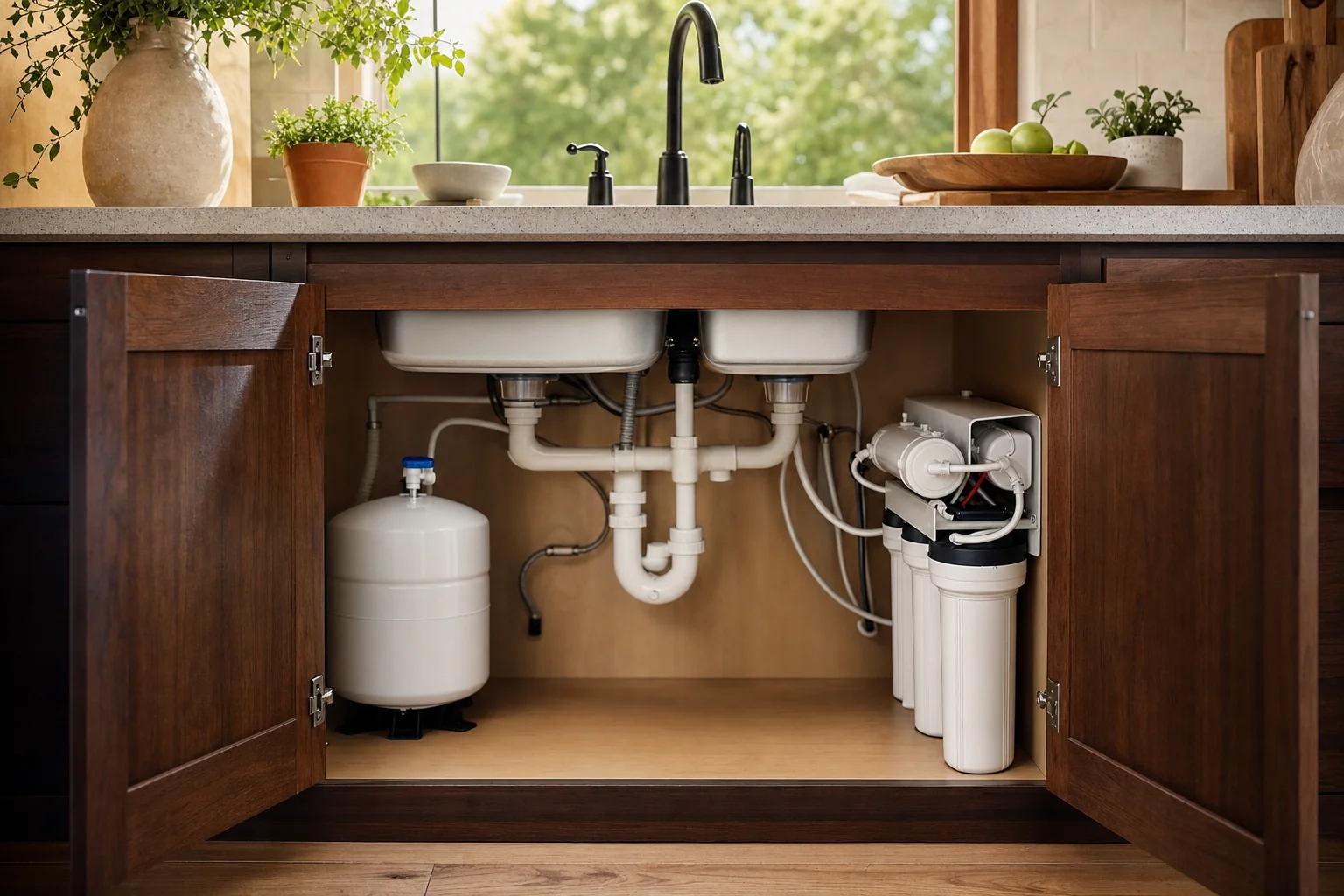
This is the old-school under-sink reverse osmosis setup: prefilters, RO membrane, post-filter, small pressurized tank, and a separate faucet.
The big advantage? Reliability. These systems are simple, parts are widely available, and filter changes are usually straightforward once you’ve done them once. The water pressure at the faucet is decent because the tank stores filtered water.
The downside is space. The tank takes up a chunk of the cabinet. In our first install, the tank looked “small” online and then somehow became the size of a bowling ball once I had to fit it around the garbage disposal and cleaning caddy. We made it work, but barely.
A classic tank system is what I’d pick for most people who want clean-tasting drinking water and don’t care about fancy displays or app alerts. Boring is good here.
2. Remineralizing reverse osmosis system
RO water can taste almost too blank. Some people love that. I don’t mind it. My partner noticed it more and said the water tasted “thin,” which is annoying because I knew exactly what they meant.
A remineralizing system adds a filter stage after the RO membrane that puts some minerals back into the water, usually for taste. The difference is subtle, but real. The water tastes rounder. Better for coffee? Maybe. I’m not 100% sure I could pick it out in a blind test every time, but for plain drinking water, I prefer remineralized RO.
The tradeoff: another cartridge to replace. Another piece of plastic. Another thing you need to remember. If your goal is the lowest-maintenance under sink water filter setup, remineralization may be extra.
But if RO water tastes too flat to you, don’t ignore this category. A system you dislike drinking from is not sustainable. You’ll end up buying bottles again.
3. Tankless reverse osmosis water filtration under sink systems
Tankless RO systems are sleeker. They usually take up less cabinet width, filter on demand, and often have faster flow than old tank systems. Some also advertise better wastewater ratios.
I like the space savings. I do not love the dependency on electronics. Displays, pumps, sensors — handy when they work, irritating when they don’t. A tankless system may also need an outlet under the sink, which our older kitchen did not have. We briefly considered having one installed and then remembered we had already blown the “simple upgrade” budget on a faucet repair.
Tankless makes sense if you have a tight cabinet, drink a lot of water, and don’t mind paying more upfront. For a rental or a very old kitchen, I’d be cautious.
4. RO system with a higher-flow dedicated faucet
This sounds minor until you’re filling a pasta pot.
Some RO faucets are painfully slow. Fine for a glass. Less fine when you’re standing there with a kettle, two water bottles, and a dog bowl while dinner is already behind schedule.
With our tank-style system, the first few quarts came out nicely, then flow dropped as the tank emptied. Normal. Still annoying. A higher-flow faucet or a larger tank can help, but you need cabinet space and compatible fittings.
If your household drinks a lot of filtered water, check flow rate and tank size before buying. Don’t just read “great tasting water” reviews. Read the grumpy ones from people filling pitchers.
The taste test: what changed after RO
The biggest everyday improvement was coffee.
Before RO, our drip coffee had this dull, slightly chemical finish. We blamed beans. Then the grinder. Then the machine. Nope. Water.
After switching to reverse osmosis water filtration under sink, the same beans tasted cleaner and less bitter. Not café-level magic. Just better. Tea improved too, especially green tea, which seems to punish bad water immediately.
Plain water was the easiest win. We stopped keeping emergency bottled water in the pantry except for actual emergency storage. The filtered faucet became the default. That matters. A sustainable swap only works when it’s easier than the wasteful habit.
One surprise: our dog preferred the RO water. Or maybe she preferred the fresh bowl because we were refilling it more. Hard to say. She’s not available for comment.
The plastic-bottle reduction is real — but don’t oversell it
Before installing an under-sink RO system, we were buying a case of bottled water every couple of weeks during summer. Sometimes more when people visited. It wasn’t our proudest habit.
Once the RO faucet was in, that stopped almost completely. We still keep some emergency water because storms happen and municipal repairs happen, but we’re not using bottled water as daily drinking water anymore.
That’s the strongest sustainability argument for RO in my house. Yes, the system uses replacement cartridges. Yes, the membrane eventually needs replacing. But compared with constant single-use plastic bottles, the waste reduction was obvious.
Still, RO is not plastic-free hydration in a pure zero-waste sense. Most replacement filters are plastic cartridges. Packaging varies by brand. The system itself includes plastic tubing. If someone tells you RO is a zero-waste solution, squint at them.
It’s a lower-waste solution when it replaces bottled water and you maintain it properly.
For more swaps where the “greener” choice depends on real daily habits, I’d keep this in the same mental bucket as other sustainable home upgrades — not perfect, but useful when it replaces something worse.
The wastewater issue nobody should skip
Reverse osmosis wastes water. That’s the part some product pages bury.
The system sends rejected contaminants and leftover water down the drain. How much depends on the design, water pressure, membrane condition, and whether the unit has a pump. Some newer systems are much better than older ones, but no RO unit turns every drop into drinking water.
This bothered me at first. It still does, a little.
But context matters. If RO stops your household from buying bottled water shipped in plastic, the tradeoff may make sense. If you live somewhere with severe water scarcity, it deserves a harder look. If your tap water already tastes good and tests fine, a simpler carbon under sink water filter may be the more sustainable pick.
What helped us: using RO only for drinking, coffee, tea, ice, and occasional cooking. We don’t rinse vegetables with RO. We don’t wash dishes with it. We don’t fill mop buckets with it. Regular tap water handles those jobs.
Small boundary. Big difference.
Test your water before making big claims
I don’t like guessing with water. Taste tells you something, but not everything.
If you’re installing a reverse osmosis system because of specific concerns — heavy metals, high TDS, nitrates, PFAS, whatever your local issue is — use a proper test instead of trusting vibes. We used a dedicated RO-focused test because I wanted before-and-after numbers rather than “seems cleaner.”
The one product from this guide I’d strongly recommend pairing with any under-sink RO install is the Reverse Osmosis Treatment Water Test:
Reverse Osmosis Treatment Water Test
Use it before installation if you can, then again after the system has flushed and settled. Follow the instructions exactly. Don’t test the first weird sputtering glass after install and panic. New filters need flushing.
A water test won’t make installation easier, but it keeps you honest. If the system isn’t performing, you’ll know. If your tap water didn’t need RO in the first place, you may learn that too.
Installation: doable, but not always fun
I’d put most reverse osmosis water filtration under sink installs in the “confident DIY” category.
If you’ve installed a faucet, connected supply lines, and drilled through a sink deck before, you’ll probably be okay. If the thought of touching the cold-water valve makes your shoulders tense, hire someone. Water damage is not eco-friendly. Or cheap.
The basic steps usually look like this:
- Turn off cold water.
- Mount the filter assembly.
- Connect the feed-water adapter.
- Install the RO faucet.
- Connect the drain saddle.
- Connect tank or tankless unit.
- Flush the system.
- Check for leaks obsessively.
The drain saddle is the part I dislike most. It feels janky even when installed correctly. You’re clamping a fitting onto the drain pipe and drilling a hole. Measure twice. Actually, measure three times. Our first attempt on an older sink drain lined up poorly, and the line made a faint gurgle until we adjusted it.
Also: don’t skip the leak check after a few hours. A fitting can look dry at first, then start weeping once pressure builds. Put a dry paper towel under every connection. Check it after dinner. Check again the next morning.
Not glamorous. Very effective.
Filter changes: where good systems separate themselves
The first month with any new filtration system is easy. Everything is fresh. The faucet is exciting. You drink more water because you’re weirdly proud of it.
Month six is the test.
Can you find the replacement filters? Are they reasonably priced? Does the brand still sell the exact kit? Do you need tools? Does changing them dump water all over the cabinet floor?
A good reverse osmosis system should make filter changes boring. Twist out, twist in, flush. Or if it uses standard housings, the wrench should fit cleanly and the O-rings should be easy to inspect.
The messiest filter change we did involved a housing that had been overtightened. I had to brace the whole bracket with one hand, crank the plastic wrench with the other, and then catch the water with a roasting pan because I forgot the bucket. Rookie move. The cabinet smelled damp for two days.
Now I keep a small towel, shallow tray, and replacement O-rings in the same bin as the filters. Future me appreciates it.
My filter-change rule
Before buying any under sink water filter or RO system, search for replacement filters first.
Not the system. The filters.
If replacements are hard to find, weirdly expensive, or only sold in mystery bundles, skip that unit. The greenest filtration system is the one you’ll maintain for years, not the one with the prettiest product photo.
Tank vs. tankless: my honest pick
For most homes, I’d still choose a classic tank-style reverse osmosis water filtration under sink system with easy-to-source replacement filters.
Not the fanciest answer. But it’s the one I’d install for my own parents.
Why? Fewer electronics. More forgiving. Usually easier to repair. Good water pressure for normal drinking use. Lower upfront complexity. If the tank eventually fails, it can often be replaced without tossing the whole system.
Tankless is tempting, and I’d pick it for a small cabinet where a tank truly won’t fit. But I don’t love turning a basic water filter into another electronic appliance unless there’s a clear reason.
Remineralization is my favorite optional upgrade. If you drink a lot of plain water, it can make RO taste less empty. If you mainly use filtered water for coffee and tea, you may or may not care.
So my practical ranking looks like this:
- Classic tank RO with standard replacement filters — best all-around choice for most households.
- Tank RO with remineralization — best if you dislike the flat taste of plain RO water.
- Tankless RO — best for tight cabinets or high daily water use, but check power and filter costs.
- Basic carbon under-sink filter — better if your water tastes okay and you don’t need RO-level filtration.
That last one matters. Not everyone needs reverse osmosis.
When I would not buy reverse osmosis
I’d skip RO if your tap water tests well, tastes fine, and your main complaint is mild chlorine. A high-quality carbon under sink water filter may be enough. It’ll waste less water, cost less, and require fewer parts.
I’d also think twice if you rent and can’t drill for a dedicated faucet. Some systems can work with creative setups, but I wouldn’t risk a security deposit over a filtration project unless the landlord approves it in writing.
And if your household won’t change filters on schedule? Don’t buy a complicated system. A neglected RO system is worse than a simpler filter you actually maintain.
Harsh, but true.
What to look for before buying
Here’s the checklist I use now.
Replacement filter availability
Can you buy filters from more than one seller? Are they clearly labeled? Does the brand publish a replacement schedule? If not, move on.
Wastewater ratio
Look for clear wastewater information, but read carefully. Ratios can be tested under ideal conditions. Your home’s water pressure and temperature can change performance.
Certifications
Certifications are helpful, especially NSF/ANSI standards for specific contaminant reduction. Don’t accept vague “lab tested” language as the same thing. If a brand claims reduction for a contaminant you care about, look for the actual standard or test report.
Cabinet fit
Measure the cabinet. Then measure again with the trash can, disposal, supply lines, and cleaning products in place. Product photos lie by omission. Empty white cabinets are not real life.
Faucet finish
Tiny detail, but annoying if you ignore it. If your main faucet is brushed nickel and the RO faucet is shiny chrome, you’ll notice it every day. Maybe you won’t care. I cared more than expected.
Filter change mess
Look for videos of real filter changes. Not polished brand animations. Real people under real sinks with bad lighting. That’s where you see whether the design makes sense.
Daily use after six months
The best compliment I can give an under-sink RO system is that we stopped thinking about it.
We fill glasses. We make coffee. We refill stainless bottles before leaving the house. We use the RO faucet for the countertop ice maker when we bother using it. The old bottled-water habit hasn’t crept back, except for emergency storage.
There are still minor annoyances. The faucet is slower than the main tap. The tank takes cabinet space. Filter reminders live on my calendar because I do not trust myself to remember. And when the system flushes after filter changes, it feels wasteful watching water run down the drain.
But our daily plastic waste dropped. Our water tastes better. We cook at home more when the basics are easy. That’s the kind of sustainable home upgrade I’m willing to defend.
Not perfect. Actually useful.
My recommendation
If you want the most sensible reverse osmosis water filtration under sink setup for 2026, I’d buy a classic tank-style RO system with widely available filters, then add remineralization only if you dislike the taste of plain RO water.
I’d skip ultra-cheap no-name systems with hard-to-find filters. I’d also avoid paying extra for smart features unless you truly need tankless space savings or leak alerts.
And I would absolutely test the water. Before and after, if possible. The Reverse Osmosis Treatment Water Test is the one add-on I’d buy with the system because it gives you something better than marketing claims: your own results.
Here’s the link again: Reverse Osmosis Treatment Water Test
A good RO system should make bottled water feel unnecessary. That’s the bar.