Best Countertop Herb Garden for a Small Kitchen
The best countertop herb garden for a small kitchen is one unit you can leave in place. Use pots and a grow light when each herb needs its own watering.
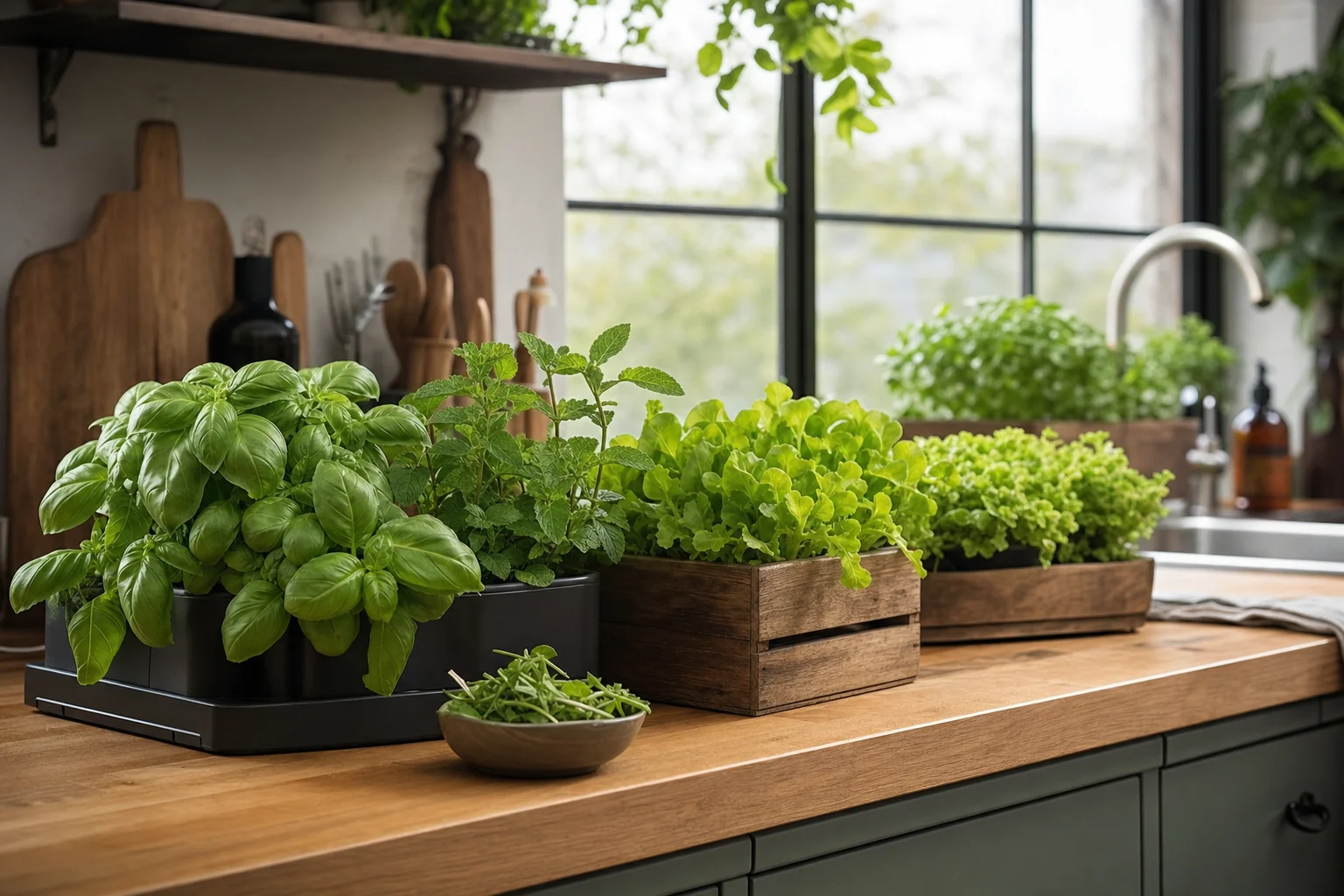
Featured Options Compared in This Guide
Full specs & notes ↓The best countertop herb garden for a small kitchen is an integrated unit you can leave in one spot, such as the LetPot LPH-SE, when the cabinet clears the raised light. Choose separate pots and a grow light when you need to move herbs or water them on different schedules. A sunny window may let you start with pots alone; a dim counter needs a lighting plan.
For a small kitchen, the deciding space is the room occupied by mature leaves, lighting, and maintenance access. The number of planting openings comes second.
Which setup fits your kitchen?
| Setup | What you manage | When it makes sense | Space tradeoff |
|---|---|---|---|
| Integrated hydroponic garden | A shared nutrient reservoir, pump, and built-in light | You can leave the garden in place and accommodate reservoir cleaning | Fixed planting positions limit how far apart you can move herbs |
| Individual pots under a separate light | Potting mix, drainage, watering for each pot, and a light schedule | Your herbs need different watering intervals or you already own suitable pots | The stand, pots, and drainage trays all need room |
| Pots at a sunny window | Individual watering and seasonal changes in sunlight | The window itself receives substantial direct sun | The available growing area follows the window, which may not be your preferred counter |
University of Maryland Extension recommends a south- or west-facing window receiving at least five hours of sun daily for indoor herbs, with supplemental lighting in winter. University of Minnesota Extension emphasizes mature plant spacing and notes that indoor hydroponics generally needs supplemental light. Maryland indoor-herb guidance; Minnesota hydroponics guide.
LetPot LPH-SE: a shared reservoir and light
LetPot lists 12 planting positions, a 5.5-litre reservoir, a 24W LED panel, and app plus touch controls for the LPH-SE. These features suit a permanent growing spot where you can tend several compatible herbs together.
Cabinet clearance needs particular attention. The product page describes the adjustable light as reaching 21 inches in one section and 30 inches elsewhere. Its listed overall size of 16 × 7 × 9.8 inches does not resolve the extended operating height. Obtain the assembled dimensions for the version being shipped before fitting it beneath a cabinet. Neither height statement alone establishes that your plants and raised light will fit. LetPot LPH-SE specifications.
LetPot GL-60: lighting for a separate planting setup
The GL-60 is a standalone grow light with app and remote controls. The page offers versions with and without a stand; its 60W specification table lists a light panel measuring 13.6 × 7.7 × 0.9 inches. Panel dimensions are not the footprint of the assembled stand. Allow separately for its base, pots, drainage trays, and leaf spread.
This option makes sense when you want to rearrange pots as herbs grow. It still requires a complete planting and watering setup. The higher listed wattage does not establish a larger harvest than the LPH-SE. LetPot GL-60 specifications and configurations.
Choose herbs around meals and care needs
Start with herbs you regularly buy. If your usual need is a few leaves for sandwiches or a sprig for dinner, a small planting is a sensible starting point. For recipes requiring large bunches, keep buying herbs until your garden’s actual harvest supports the recipe.
| Herb choice | Practical growing decision |
|---|---|
| Basil | A reasonable candidate for an indoor annual herb planting; Maryland Extension says it can grow indoors year-round. Leave room for its mature canopy. |
| Thyme, oregano, or sage | Separate pots let their growing mix dry between waterings without imposing that schedule on every herb nearby. |
| Parsley or cilantro | Provide a container with depth and good drainage; Minnesota describes these carrot-family herbs as preferring slightly moist soil. |
| Mint | Give it its own pot so you can manage its vigorous spread independently. |
These watering distinctions apply to herbs in potting mix. They are not instructions to dry out hydroponic roots. Maryland container-herb guidance; Minnesota herb-growing guide.
For pots, use a lightweight, well-draining potting mix and containers with drainage holes. Avoid leaving the growing mix persistently soggy. For a shared hydroponic reservoir, select crops with compatible nutrient requirements and use a fertilizer formulated for hydroponics. Minnesota Extension advises separating crops that require different nutrient concentrations. Maryland container guidance; Minnesota hydroponic nutrition guidance.
Do not fill every pod simply because it is available. Follow the seed variety’s mature spacing guidance; leave openings unused where necessary to avoid overlapping, crowded growth. Twelve openings describe the planting deck, not twelve guaranteed mature harvests. Minnesota spacing guidance.
Leave room to tend the garden
Before ordering, mark out the proposed setup on the counter and rehearse three jobs:
- Refilling: Can you reach the reservoir opening with your water container without moving the entire garden?
- Harvesting and adjusting light: Can you reach the herbs and raise the panel with the cabinet doors open?
- Cleaning: Is there room to lift the planting deck, manage hanging roots, and drain the reservoir?
If those jobs require dismantling your cooking area, consider fewer pots or a different location. For a standalone light, include its support structure in this exercise.
Also consider the long light schedule in a shared kitchen. Maryland recommends 14–16 hours of supplemental lighting in winter. That is useful planning guidance, not a universal setting for every lamp and crop; follow the light’s placement instructions and adjust as plants grow. Maryland indoor lighting guidance.
Reservoir care is part of the purchase
A hydroponic garden still needs water-level checks, nutrient management, plant inspection, and cleaning. Minnesota Extension recommends water changes for herbs harvested over an extended period, along with cleaning and sanitizing equipment between plantings. Harvest with clean tools and rinse the herbs before eating. Minnesota hydroponic maintenance and harvest guidance.
For LetPot equipment, the manufacturer instructs owners to disconnect power before cleaning and keep the light panel, telescopic rod, and power interface out of water. Its FAQ describes rinsing the pump’s filter sponge when debris or roots obstruct it. The FAQ covers multiple systems, so its external-reservoir and automatic nutrient-dosing descriptions should not be assumed to apply to the LPH-SE. LetPot maintenance FAQ.
There is a practical distinction between routine rinsing and sanitation between crops. LetPot advises against detergents in its tank-cleaning instructions, while Minnesota’s general hydroponics guidance includes detergent cleaning followed by sanitation. Obtain a compatible sanitation procedure from LetPot for the removable parts; do not apply a general immersion procedure to electrical components. LetPot cleaning instructions; Minnesota sanitation guidance.
LetPot lists a replacement cycling pump with an SE option. That provides a replacement route to consider, but does not establish how long a pump will last. Select the matching model if a replacement becomes necessary. LetPot replacement pump.
Electricity and realistic value
Electricity use is calculated as watts ÷ 1,000 × operating hours. For an illustrative 16-hour daily schedule at the published light ratings:
| Light rating | Calculated daily use | Calculated use over 30 days |
|---|---|---|
| LPH-SE: 24W | 0.384 kWh | 11.52 kWh |
| GL-60: 60W | 0.96 kWh | 28.8 kWh |
These calculations cover the stated light power only. They are not measurements of total appliance consumption, and they do not compare harvest efficiency. Pumps, controls, dimming, and actual operating schedules affect consumption. Multiply the relevant kWh total by your electricity rate to estimate cost. EIA explanation of watts and kilowatt-hours; LPH-SE light rating; GL-60 light rating.
Choose pots if independent watering and easy rearrangement matter most. Choose the integrated garden if its mature growing space and reservoir chores fit your kitchen. To assess value over time, track herbs actually used alongside electricity, nutrients, growing media, and replacement parts. Pod count alone cannot tell you whether the garden will replace your usual herb purchases.
Where to browse
Prices and availability change. These search listings are a place to check the current product.
Sources
- University of Maryland Extension: Growing Herbs in Containers and Indoors
- University of Minnesota Extension: Growing herbs
- University of Minnesota Extension: Small-scale hydroponics
- LetPot: LPH-SE Indoor Garden
- LetPot: GL-60 Grow Light
- LetPot: Indoor hydroponic garden FAQ
- LetPot: Replacement cycling pump
- U.S. Energy Information Administration: Measuring electricity
Products Compared in This Guide
LetPot LPH-SE
Compare current manufacturer specifications, materials, and package options for LetPot LPH-SE.
LetPot GL-60 grow light
Compare current manufacturer specifications, materials, and package options for LetPot GL-60 grow light.
Frequently Asked Questions
Does a 12-pod garden hold 12 mature herb plants?
Twelve pods are planting positions, not a guarantee of room for twelve mature plants. Follow mature spacing guidance and leave positions unused when needed.
Is the LetPot GL-60 a complete herb garden?
No. It is a standalone grow light, available with or without a stand. You still need containers, growing media, plants, and watering supplies.
Can herbs grow on a kitchen windowsill without a light?
A sufficiently sunny window can work, but winter light may be inadequate. Choose the location by direct sunlight reaching the plants, not how bright the room looks.